Generate summary with AI

In the modern world of IT, automation is king. Artificial intelligence (AI) has been exploding in popularity, and machine learning is a huge component of these technologies. As such, both AIOps and MLOps are crucial in modern enterprise environments for companies looking to stay ahead of the curve.
Today, we’re answering questions like what are AIOps and MLOps and looking at the difference between AIOps and MLOps to help you understand these two frameworks, compare them, and choose the right approach.
What is AIOps?
AIOps stands for artificial intelligence for IT operations. It refers to the application of both AI and machine learning (ML) to automate and improve IT operations, leading to more productivity and efficiency. The key aspects of AIOps typically include automating repetitive tasks, analyzing data in real time, optimizing IT resource allocation, enhancing security, offering predictive analytics, and improving resolution times.
Why has AIOps become so popular? Key goals of AIOps include reducing downtime, improving system reliability, and automating incident response. But don’t worry – AIOps is not meant to threaten the jobs of IT technicians.
On the contrary, it can operate as a supplement to existing team members, improving efficiency and lessening cognitive demands for professionals. Necessary staff to effectively implement AIOps include automation experts, programmers, and many other IT pros who will work in tandem with easy-to-learn tools like Atera’s AI Copilot and Robin by Atera.
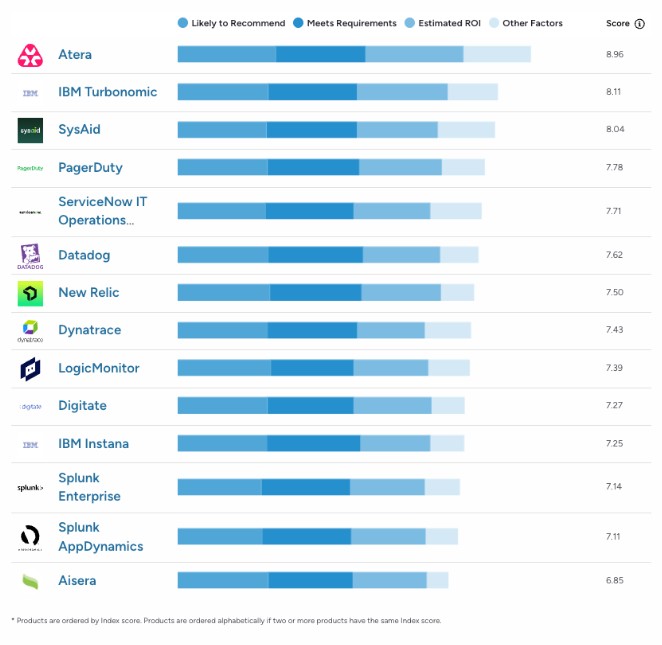
alk is easy – results are what matter. In G2’s Summer 2026 AIOps Platforms Results Index for Enterprise, Atera ranked #1 with a score of 8.96, ahead of IBM Turbonomic, SysAid, PagerDuty, ServiceNow IT Operations Management, and Datadog. The index is based on real customer data across likelihood to recommend, meets requirements, estimated ROI, and other factors, giving buyers a clear, evidence-based view of how AIOps platforms actually perform once deployed.
Key responsibilities of AIOps
- Real-time monitoring: AI tools for IT analyze data in real time, making it easier to proactively detect potential problems and even mitigate weaknesses before a breach occurs. You’ll also have total visibility into your IT environment like never before.
- Anomaly detection: With real-time monitoring, AI tools for IT can learn from patterns and behaviors to recognize signs of unusual or suspicious activity. Then, these AIOps solutions can isolate and triage a situation before it becomes harmful.
- Automated root cause analysis: Root cause analysis is a crucial part of security and reliability. AIOps can automate this process to strengthen your IT strategy and foster proactive solutions
- Proactive remediation: AIOps tools can learn from patterns over time to recognize anomalies and proactively take steps toward remediation. This improves organizations’ security postures and reduces the risk of a costly breach.
- Noise reduction in alerts: An overabundance of alerts can overwhelm IT technicians. With AIOps technology, many of these alerts can be resolved autonomously, without the need for human intervention. This allows professionals to focus on what really matters.
Example use case: Leeds United Football Club
Let’s dive deeper into that final AIOps responsibility: noise reduction in alerts. One of Atera’s AI Copilot users, Leeds United Football Club, was struggling with too many alerts and couldn’t keep up with IT tickets.
With Atera’s AI-powered solutions, the organization was able to reduce ticket volume by 35%, as the AIOps tools empowered end users to resolve common issues themselves and even helped generate knowledge base articles to improve results on an ongoing basis. Check out more about how we helped Leeds United transform their IT operations with our explainer video.
What is MLOps?
MLOps stands for machine learning operations. MLOps refers to the process of deploying, maintaining, and scaling machine learning models consistently, reliably, and efficiently. MLOps is focused on streamlining the entire machine learning lifecycle, lessening the manual load on IT technicians and other professionals.
That’s why it requires collaboration between various team members, including data scientists, engineers, and operations teams – in this sense, MLOps facilitates knowledge sharing and breaks down silos.
Source: Amazon Web Services
Key responsibilities of MLOps
- Model training and retraining: MLOps makes it easy to ensure that models remain up to date and are based on accurate training data. These tools can automatically detect problems like data drift and will retrain ML models accordingly.
- Version control and model deployment: MLOps offers tools that can easily track and compare different versions of machine learning models. This allows for easy rollback and better data for decision making.
- Monitoring and model drift detection: MLOps tools can monitor the performance of currently deployed models, detecting issues (such as data drift or bias) and triggering automated retraining when necessary to maintain accuracy.
- Ensuring reproducibility and governance: Ethical usage of machine learning and AI tools is a priority, as shown in the below graphic from UNESCO. MLOps provides frameworks for complying with regulatory requirements, which in turn helps ensure responsible use of machine learning models.
Source: UNESCO
Example use case: Merck vaccine research and development
There are plenty of examples of effective applications of ML and AI in healthcare, but pharmaceutical company Merck showcases an effective MLOps use case to support continuous improvement in their vaccine research models.
They embraced an MLOps system to help them automate workflows, streamline asset allocation and purchasing decisions, and monitor inventory and usage rates to make their labs more profitable and efficient. The result? Streamlined operations and more robust research in a shorter period of time.
What is the difference between AIOps and MLOps?
AIOps and MLOps are both related to machine learning and AI, but they ultimately differ in their applications and focus areas. Still, these tools can be used in tandem to support your organization holistically as you strive toward more robust automation – in other words, they serve different but complementary roles.
AI technology is focused on allowing computing devices to mimic the cognitive functions we typically associate with human minds – learning, thinking, perceiving, decision-making, reasoning, taking actions, and problem solving.
Machine learning technology helps computing devices achieve these goals, and MLOps makes these technologies a reality. Let’s dive deeper into some specifics comparing AIOps vs MLOps…
AIOps vs MLOps comparison table
| AIOps | MLOps | |
|---|---|---|
| Responsibilities | Real-time monitoring, anomaly detection, automated RCA, predictive analytics, proactive remediation, alert reduction | Model training and retraining, version control and model deployment, monitoring and model drift detection, ensuring governance and reproducibility |
| Goals | Streamlining and optimizing IT workflows through using AI to process and analyze huge amounts of data from IT systems | Bridge the gap between teams to bring ML models from production to development, all while keeping performance and accuracy |
| Scope | Enhancing and automating IT operations | Lifecycle management for machine learning models |
| Data | Uses operational data from IT systems | Uses training data to deploy machine learning models |
| Primary users | ITOps teams, network admins, DevOps and DataOps teams, ITSM teams | ITOps teams, machine learning engineers, DevOps teams, data scientists |
Can AIOps and MLOps work together?
While they are distinct technologies, MLOps and AIOps often work together in IT environments. MLOps technologies are used to develop and deploy the machine learning models that AIOps require to automate IT tasks. Essentially, AIOp supports the infrastructure behind ML models, and how MLOps ensures those models perform.
With both MLOps and AIOps in use, you can achieve a unified AI strategy that allows you to work smarter, not harder. AIOps is all about making IT operations more efficient and productive. MLOps is focused on making the models that power those innovations more reliable and operational.
When to use AIOps, MLOps, or both
When you should use AIOps, MLOps, or both technologies depends on the unique needs of your business. If you’re focused on operational resilience and automation through AI models for one-off situations, you’ll want to focus on using AIOps.
On the other hand, if you’re working on product development and using AI/ML models on a larger scale, you’ll want to look further into using MLOps for your business. Using both AIOps and MLOps in tandem allows for full AI lifecycle management that’s efficient and streamlined.
When you compare AIOps vs MLOps, it’s important to consider how both of these tools empower a better overall IT strategy. If you’re looking to reduce your manual workload and streamline your operations, both MLOps and AIOps can play an important role.
Stay on the cutting edge of AI innovation
For any company hoping to stay ahead of the curve when it comes to 21st century IT and automation, AIOps vs MLOps are essential components of a holistic IT strategy. With Atera’s AI Copilot, we support AIOps through automation and intelligent IT management. Want to give our products a try and see how AI can boost your productivity and empower your team? Try out our industry-leading IT service management tools (including our AI tools) with a 30-day free trial, no credit card required!
Related Articles

Are AI agents actually autonomous?
Every vendor calls their product an "AI agent" now, but a chatbot, a copilot, and an agent behave very differently once they're running in production. Before you sign a contract based on that label, it's worth knowing what real autonomy requires, and where the gap between demo and deployment tends to show up. Here's what the data says about which claims hold up, and the questions worth asking before you buy.
Read now
ISO 42001 for IT leaders: what the certification actually means for your stack
ISO 42001 is a still-new AI standards certification that’s becoming more popular in vendor security questionnaires. See what ISO 42001 for IT leaders means.
Read now
AI governance standards for IT teams, explained: ISO 42001, SOC 2, and the EU AI Act
Check out this plain-English guide to governance standards ISO 42001, SOC 2, and the EU AI Act for IT teams, and what each one actually requires from AI vendors.
Read now
Atera is ISO/IEC 42001 certified. Here’s what that actually means.
AI governance is no longer a nice-to-have. Here's how Atera is staying ahead of it—and what that means for you.
Read nowEndless IT possibilities
Boost your productivity with Atera’s intuitive, centralized all-in-one platform