

Atera for
IT Departments
Save hours every day by automating 99% of your work.

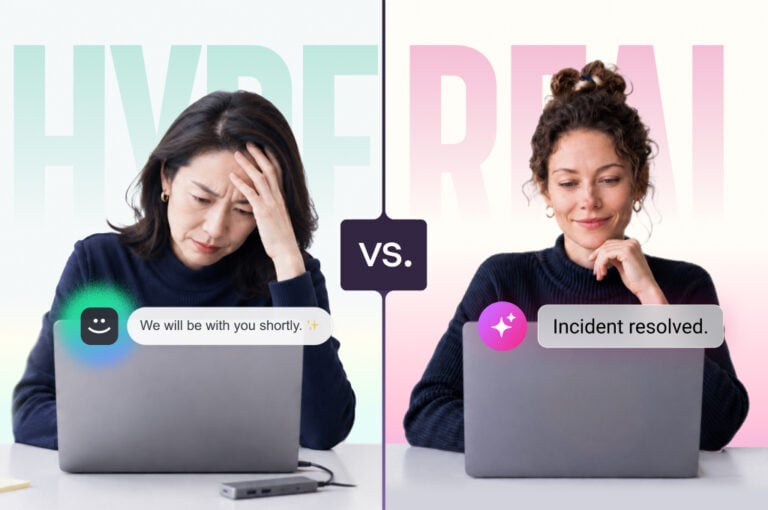
IT runs on a constant stream of technical failures: the access request that stalls a new hire, the outage that stops important work in its tracks, the printer that never works, all contributing to an incident queue that never empties. And every one of these is now a target for AI, with a promised solution […]
Read now
ISO 42001 is a still-new AI standards certification that’s becoming more popular in vendor security questionnaires. See what ISO 42001 for IT leaders means.
Read now
Check out this plain-English guide to governance standards ISO 42001, SOC 2, and the EU AI Act for IT teams, and what each one actually requires from AI vendors.
Read now
At a glance, it can be tough to tell the difference between trustworthy and convincing AI agents. Both project plenty of confidence, but only one can show where its information comes from and what it did with your data. Learn how AI data governance makes an important difference in your organization's AI implementations.
Read now
Robin and Otto are both AI agents for enterprise AI, but they operate in different ways. This Robin vs. Otto comparison breaks down the key differences.
Read now
Beyond adopting AI, enterprises have to reach the absorption stage to find actual value in the technology. Instead of simply adding AI, teams have to develop a new operating model to allow AI to solve IT problems autonomously.
Read now
AI governance is no longer a nice-to-have. Here's how Atera is staying ahead of it—and what that means for you.
Read now
IT departments need to modernize away from the typical help desk support model, where tickets pile up to be triaged and solved, and technicians get stuck in a break/fix cycle. Agentic AI can reshape IT teams for the better without taking jobs.
Read now
The path to absorption of enterprise AI technology often stalls in the adoption phase, where users might speed up some tasks incrementally. But organizations that move to the absorption stage can get real value from AI, rethinking their operating model to incorporate true autonomy that saves time and helps IT become proactive.
Read now
Autonomous AI technology doesn’t have to involve a long, drawn-out deployment. Agentic AI tool Robin offers guarantees to solve half of your tier 1 tickets within 90 days — showing that AI can be fast, easy, and prove ROI and scale within days, not years.
Read now
Most enterprises are deploying AI faster than they can measure it. As AI agents become operational contributors rather than software tools, leaders need a new framework to understand whether AI is actually creating business value.
Read now
A side-by-side look at the 7 best autonomous IT support tools for 2026. See the pros and cons, features, pricing, and what users really think.
Read now
A ticket that reaches the wrong team eats hours of productivity before resolution even begins. Manual routing is inconsistent by design because it depends on whoever reads the ticket first with enough context. Automated routing removes that bottleneck entirely.
Read now
Faster routing isn't the same as fewer tickets. We ranked the best AI ticket triage tools of 2026 — and explain why the smartest teams are skipping triage altogether.
Read now
IT teams have been stuck in a reactive firefighting mode for years. Help desk tickets pile up, burning out technicians and creating an endless break/fix loop. Autonomous, agentic AI has now matured enough to bring performance guarantees for enterprises looking to ease their IT teams’ workloads.
Read now
Agentic AI that powers a self-healing enterprise can free up IT teams from common, mundane tasks, solving issues before a user even notices. IT workloads drop, and resolution times can drop from hours to seconds with autonomous AI technology.
Read now