Table of contents
Table of contents
- First: what is ISO/IEC 42001?
- Why so few companies have it
- What the audit actually covered
- Why this matters specifically for Robin
- How it fits alongside certifications you already know
- The regulatory context: getting ahead, not catching up
- What it means for you, practically
- Questions worth asking any AI vendor
There’s a question showing up in enterprise vendor evaluations that wasn’t there two years ago:
“Do you have ISO 42001?”
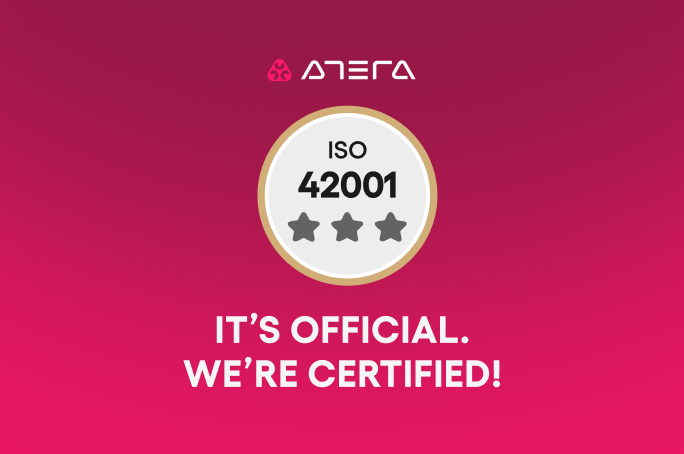
Most AI vendors can’t answer it. Around 400 organizations globally hold this certification, and among IT management platforms, Atera is one of the first.
We know certification announcements can feel like noise. So instead of telling you it matters, we’re going to show you why: what the standard actually covers, what the audit required us to prove, and what it means for you when AI is running inside your environment.
First: what is ISO/IEC 42001?
Published in December 2023, ISO/IEC 42001 is the world’s first international standard specifically for AI management systems. Think of it as the AI equivalent of ISO 27001, the information security standard most enterprise procurement teams already know well, but built from the ground up for the unique risks that AI introduces.
Where ISO 27001 governs how you secure information, ISO 42001 outlines how you govern AI: how risks are identified and managed across the full AI lifecycle, how data is handled, how decisions get made, and where humans stay accountable when AI acts autonomously.
The standard requires organizations to demonstrate controls across governance, risk management, transparency, bias mitigation, human oversight, and lifecycle monitoring.
Critically: this is not self-reported. An accredited third party audits everything against the standard independently. They verify it themselves. That distinction between self-attestation and independent certification is exactly why the standard matters to enterprise buyers.
Why so few companies have it
ISO/IEC 42001 was only published in late 2023, and certification requires more than paperwork. It demands enterprise-wide commitment, cross-functional governance, documented controls, and a rigorous independent audit. As of mid-2026, around 400 organizations globally hold the certification, and Atera is one of the first in its industry.
The companies that have earned it tend to be names you’d recognize: Microsoft, AWS, Anthropic, and a handful of security-focused SaaS vendors who moved early. The rest of the market is still working toward it. That gap exists for a reason. Most AI vendors operate on claims, but ISO 42001 is proof.
What the audit actually covered
For Atera, the audit wasn’t abstract. Our CISO Noam Vander put it plainly: “An accredited third party comes in and audits everything against the standard—not a self-assessment, not paperwork. They verify it all themselves.”
Here’s what that verification covers in practice:
How AI is built and trained. Training data governance, bias testing, and provenance tracking. The audit requires documentation of how models are developed, not just what they produce.
Risk management across the full AI lifecycle. From development to deployment and through ongoing operation. Every stage where something could go wrong has a documented control and a responsible owner.
Human oversight. Where AI acts autonomously, the standard requires documented evidence that humans remain accountable, that escalation paths exist, and that edge cases are handled deliberately, not silently.
Data governance. How data is collected, used in AI training, and protected during AI operations. Especially relevant when AI is operating across client environments, as it does for MSPs using Atera.
Incident response. What happens when AI behaves unexpectedly. The standard doesn’t assume perfection; it requires a documented system for catching, escalating, and learning from failures.
Why this matters specifically for Robin
Robin by Atera is not a chatbot. It doesn’t suggest actions and wait for a human to click approve. It resolves tickets autonomously, executes remediations, works on devices, and makes decisions on behalf of your IT team—end-to-end, without requiring a technician in the loop.
That level of autonomous action carries a different class of responsibility than an AI assistant. When AI is operating inside your environment, on your clients’ machines, making changes on their behalf, “trust us” isn’t a good enough answer for enterprise security and procurement teams. And it shouldn’t be.
ISO 42001 is the independent answer to that question. It verifies that the AI taking autonomous action in your environment was built, secured, and governed to an internationally recognized standard. And with Robin, AI security was built in from the start.
As Noam put it: “The governance was always there. Now it’s certified.”
How it fits alongside certifications you already know
If your security team is familiar with ISO 27001 and SOC 2, here’s how ISO 42001 sits alongside them:
ISO 27001 governs information security—access control, encryption, network security. It’s the foundation most enterprise vendors start with.
SOC 2 is a US-focused attestation (not certification) that verifies how service operations meet security and privacy expectations. It doesn’t have specific AI governance requirements.
ISO 42001 is the only standard that explicitly addresses AI risk, transparency, accountability, and bias mitigation across the full AI lifecycle. It’s global, industry-agnostic, and independently audited.
Think of it this way: ISO 27001 proves your information is secured. SOC 2 proves your service operations meet expectations. ISO 42001 proves your AI is governed responsibly. These aren’t overlapping; they answer different questions.
The regulatory context: getting ahead, not catching up
Gartner projects AI regulation will extend to 75% of the world’s economies by 2030. Organizations evaluating AI vendors today are buying ahead of that curve—and they need vendors who already have proof, not promises. ISO 42001 is the proactive answer to that pressure, for vendors and for the enterprises evaluating them.
For procurement and legal teams: when an AI vendor holds ISO 42001 certification, the certification itself serves as objective evidence of governance, streamlining the vendor risk management process significantly.
What it means for you, practically
The honest answer, as Noam said: nothing changes day-to-day. Robin still resolves your tickets. AI Copilot still assists your technicians. Your workflows stay the same.
That’s the point. The work happened on our side, in the audit, in the controls we built and proved, so you don’t have to worry about it on yours.
What does change is what you can say to your clients, your leadership, and your procurement reviewers when they ask whether the AI running in your environment is governed responsibly. Now there’s an independent answer.
Questions worth asking any AI vendor
Whether you’re evaluating Atera or any other vendor deploying AI in your environment, these are the questions ISO 42001 gives you the right to ask:
- Is your AI governance independently audited, or self-reported?
- Who owns AI risk in your organization, and how often does leadership review it?
- What guardrails are in place to provide responsible and secure usage of AI?
- How do you assess the impact of your AI systems on customers and end users before deployment?
These aren’t trick questions. They’re what enterprise security and procurement teams should expect clear answers to and now, we at Atera can provide them.
Want to go deeper on Atera’s security and compliance posture? Visit our Trust Center for more information.
Related Articles

How to run an AI readiness assessment for your IT organization
Most AI rollouts in IT don’t fail on the technology. They fail on stale asset data, overprivileged accounts, missing rollback plans, and technicians who’ve never been taught to question AI output. A readiness assessment exposes those gaps before production does.
Read now
How to spot AI washing in IT tools
AI washing has brought SEC fines and federal fraud charges, and now the pattern shows up in IT procurement. Here’s how to spot it before you sign a contract.
Read now
Are AI agents actually autonomous?
Every vendor calls their product an "AI agent" now, but a chatbot, a copilot, and an agent behave very differently once they're running in production. Before you sign a contract based on that label, it's worth knowing what real autonomy requires, and where the gap between demo and deployment tends to show up. Here's what the data says about which claims hold up, and the questions worth asking before you buy.
Read now
ISO 42001 for IT leaders: what the certification actually means for your stack
ISO 42001 is a still-new AI standards certification that’s becoming more popular in vendor security questionnaires. See what ISO 42001 for IT leaders means.
Read nowEndless IT possibilities
Boost your productivity with Atera’s intuitive, centralized all-in-one platform