Robin by Atera and Atlassian’s Request Resolver both have their Autonomous IT offerings.
Request Resolver is Atlassian’s AI layer, and within Jira Service Management, it helps to resolve requests autonomously based on generated plans. Robin is built specifically to remediate Tier-1 and Tier-2 IT incidents, acting directly on the device, server, or network.
If you’re a VP of IT or service delivery manager choosing an AI agent, this comparison can help.
The AI layer, not the old ITSM debate
There are dozens of ITSM software comparisons, including this Atera vs. Jira comparison.
However, this article focuses entirely on the AI layer: Robin vs. Rovo/Request Resolver.
Let’s start by looking at each AI solution individually.
What is Request Resolver
Request Resolver is Atlassian’s AI system, built into Jira, Confluence, Bitbucket, and the rest of its products. It covers search, chat, and AI agents that can take action on your behalf. Inside Jira Service Management specifically, Request Resolver helps to create plans and resolve requests end to end.
From Rovo Service to Request Resolver
Jira rebranded its Rovo Service to Request Resolver in September 2026. Since Request Resolver is the part of Rovo that generates and executes resolution plans for service requests, it’s the closest thing Jira Service Management has to Robin, and a key focus area of this comparison.
However, Rovo also covers other AI features in Jira Service Management (the virtual service agent, Rovo Ops, and custom Rovo Studio agents), so this comparison focuses on those where relevant.
What Rovo/Request Resolver actually does
- Request Resolver: The most direct alternative to Robin, Request Resolver helps to resolve issues autonomously (or with supervision) by generating a plan and then executing it. For example, one task is creating an employee onboarding journey.
- Virtual service agent: Rovo virtual service agents help answer commonly asked questions, resolve issues, and triage requests, just like a technician would.
- Ops Expert: Ops Expert (previously Rovo Ops) helps teams manage alerts and incidents by providing historical context and recommended actions. It does this by gathering context from Atlassian apps and third-party tools.
- Custom Rovo agents (via Rovo Studio): Rovo’s custom agents let you create agents with specialized knowledge that are designed to work with your organization.
Governance and AI security
Request Resolver’s governance is configurable by IT admins. Admins can choose between two execution modes:
- Supervised, where a team member reviews and assigns the plan before anything runs
- Autonomous, where Request Resolver assigns itself and starts immediately
It’s good to note that Jira explicitly says Request Resolver isn’t HIPAA-compliant, meaning it shouldn’t be used by companies handling protected health information.
What is Robin by Atera
Robin is an AI technician that remediates Tier-1 and complex Tier-2 technical incidents end to end by autonomously taking real actions on devices, servers, mainframes, and networks, without needing a technician in the loop.
How Robin works
Robin follows a four-step process:
- Robin diagnoses the issue: Robin captures the request through Teams, Slack, email, the Atera Customer Portal, or third-party ITSM tools. To gather the full context and figure out the right resolution path, Robin asks follow-up questions.
- It remediates the issue: Robin acts directly on the device, server, network, or in the cloud. It autonomously resets credentials, updates software, repairs network faults, and routes for approval only when a step requires it.
- It verifies it’s resolved: Before closing anything, Robin confirms the fix is actually applied. If it hasn’t, the ticket escalates to a technician with full context of the issue.
- It closes the loop: Robin updates the ticket in whatever ITSM the team already runs, with the outcome and any follow-up noted. Every request, action, approval, and outcome gets logged for governance and compliance.
Robin in action: the tasks it actually resolves
See all Robin use cases here; below are six highlighted.
Provisioning software for employees
The issue: An employee needs application access
Robin resolution: Robin checks their rights against what’s approved for their role, then installs the software directly on the device.
Suspicious email triage
The issue: An employee forwards a suspicious phishing email
Robin resolution: Instead of just telling a user to be careful, Robin uses MXToolbox to analyze the actual email. If there’s a threat, Robin escalates it to a technician.
Password reset and credential recovery
The issue: A user has forgotten their password
Robin resolution: Robin detects whether the user is in-office or on VPN, picks the right resolution path, and resets the credential directly against the identity provider.
Clearing disk space and reclaiming storage
The issue: A user needs to reclaim storage space
Robin resolution: Robin finds out what’s taking up the space, flags what it can remove, and reclaims the storage once the user confirms.
Wi-Fi and network self-service
The issue: A user can’t access Wi-Fi and get online
Robin resolution: Robin isolates whether the fault sits with the device, the adapter, DNS, or a proxy, then repairs that exact point itself.
- Onboarding a new employee
The issue: A new hire needs accounts and software access
Robin resolution: Robin validates the employee’s AD groups, approved software, VPN access, and security posture against their role, then provisions each one directly.
Guardrails and enterprise trust
Atera’s AI security sets high standards for how Robin operates:
- ITSM agnostic: Robin integrates with platforms your team already runs: Jira, ServiceNow, Salesforce, Zendesk, and SysAid. It works wherever your IT already lives in.
- Guardrails are admin-defined: Playbooks, custom instructions, and KB articles set the scope for what Robin executes. Anything outside of that gets escalated to a technician.
- Every action is traceable: Robin logs each action under its own Robin ID, showing the original request, Robin’s reasoning, and the action taken. This is the same record-keeping a human technician’s work would generate.
Robin vs. Rovo/Request Resolver: a core difference
You can see the core differences between Rovo and Robin in the table below.
Dimension | Rovo/Request Resolver | Robin by Atera |
Primary function | General work-management AI platform; in JSM, Request Resolver generates and executes resolution plans | AI technician, pre-built, diagnoses and remediates directly |
Scope | Enterprise-wide (Jira, Confluence, dev tools); within JSM, Request Resolver limited to service request types | IT-specific (Tier-1 and complex Tier-2 incidents) |
Where it executes | Inside Jira Service Management, acting through whichever third-party tools an org has connected | On the device, server, mainframe, or network, out of the box |
Starting point | Rovo ships with search, chat, and other JSM AI features out of the box; Request Resolver requires configuring | Already deployed, able to diagnose and remediate; admins configure guardrails and scope |
Governance | Executes autonomously or with supervision (admin-configurable), org-level permissions, audit trail; not HIPAA compliant | Configurable guardrails, approval workflows, full audit trails |
Time / performance impact | No named resolution-rate or average-resolution-time figure published for Request Resolver at time of writing | Up to 92% autonomous resolution rate; 120-second average resolution time; 0.1-second first response (Atera published proof points) |
In market since | Rovo platform: May 2024 (announced) Request Resolver’s execution capability: September 2026 | May 2025 (as IT Autopilot), rebranded Robin by Atera in March 2026 |
Why Robin has the edge
Production tenure
Atlassian first brought Rovo into general availability in October 2024, about 8 months before Robin’s underlying technology launched as IT Autopilot in May 2025.
However, Request Resolver (the true Robin competitor from Jira) reached availability only on September 1, 2026. Before that, it only existed in early access under its previous name, Rovo Service.
Robin was launched in May 2025 and has been resolving IT incidents since. This is roughly sixteen months before Request Resolver reached full availability.
Infrastructure reach
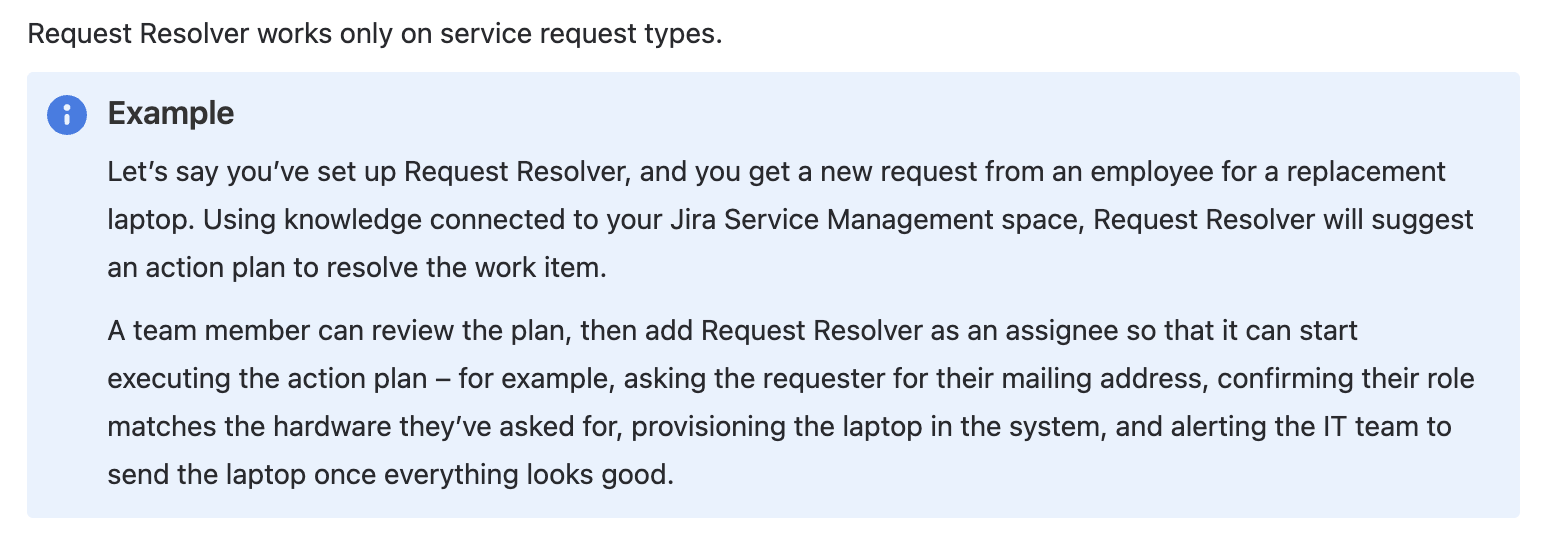
On Request Resolver’s resource page, Atlassian gives an example of the type of issues it resolves:
The page explicitly says “Request Resolver works only on service request types.”
This means Request Resolver can’t reach past the ticket itself, into the device, server, or network infrastructure the ticket is actually about.
In contrast, Robin’s remediation surface reaches well past the ticket; it reaches directly into devices, servers, mainframes, and networks.
It doesn’t just document a fix; it goes and performs it: resetting a network adapter, restarting a hung service, provisioning approved software directly on the machine.

- Built-in use cases
Robin ships with a named, public catalog of actions it can take. These include actions like printer management, OS updates, performance diagnostics, and other device and network actions.
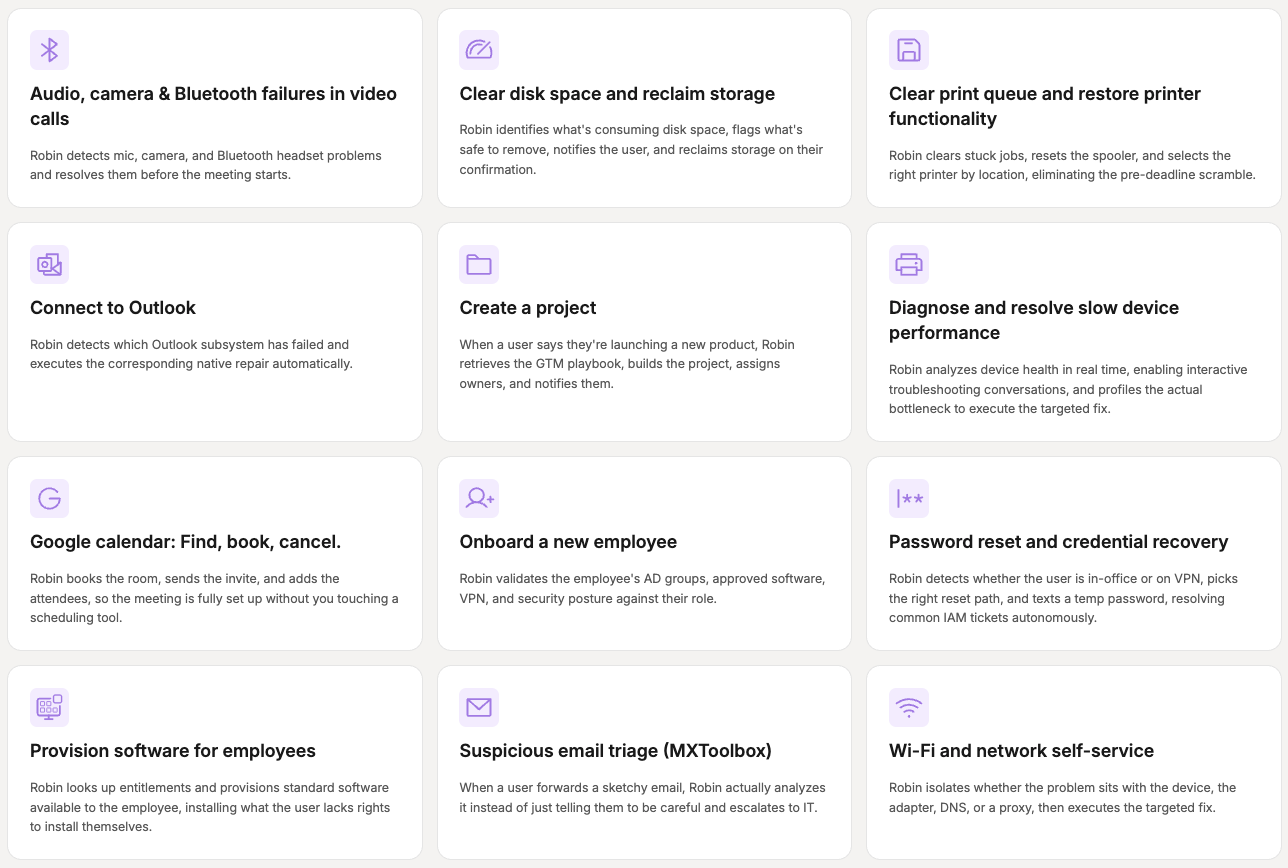
These are actions Atera engineered into Robin directly; potential customers can read exactly what it does before deploying.
Request Resolver doesn’t have an equivalent public catalog. Per Atlassian’s own example, when a request comes in, Request Resolver generates a plan grounded in whatever knowledge is connected to the space, and a team member needs to review that plan before assigning Request Resolver to execute it. There’s no pre-built library of technical actions underneath it.
Why this distinction matters
Where autonomy reaches is what separates Robin and Request Resolver.
Request Resolver works only on service requests, meaning the ticket layer, not the infrastructure underneath it.
Robin’s remediation surface sits one layer down. It acts directly on the device, server, or network the ticket is actually about.
Here’s what that looks like in practice:
- A resolved ticket and resolved problem aren’t always the same thing. Request Resolver can close out a replacement laptop request end to end: confirm the role, provision in the system, notify the team to ship it. But a failed network adapter is a fault sitting in the infrastructure itself, and Request Resolver’s scope doesn’t reach that far.
- After-hours coverage still needs someone at the infrastructure layer. Even in autonomous mode, Request Resolver’s scope stops at the service request. It can plan and execute steps like provisioning or notifying a team, but it has no path to the device, server, or network itself. Robin’s scope reaches that layer without waiting for a technician to log in.
- Pre-built actions save the setup work, not just the execution time. Request Resolver’s plans are only as capable as what’s already been written into the connected knowledge base, so technicians have to spend extra time documenting a fix before Request Resolver can ever act on it. Robin’s actions arrive ready to run, but can also be further customized with admin-defined instructions and playbooks.
Bottom line
Rovo is genuinely good for what it’s built to do. Request Resolver can generate resolution plans from your KB articles and enable them to fix issues autonomously. And if your team already lives inside Jira, Confluence, or the rest of the Atlassian ecosystem, this is a real advantage.
Robin’s strength is breadth. Its remediation surface reaches past the ticket, into the device, server, mainframe, or network that the request is actually about. Atera promises up to a 92% resolution rate for Robin.
If you’re evaluating Robin as a Rovo alternative, book a demo with Atera’s sales team to learn more.
Frequently Asked Questions
Related Articles
Robin vs Kaseya Intelligence
Robin by Atera and Kaseya Intelligence both talk about autonomous IT, but structure their AI technologies differently. See where each one's autonomy actually reaches and which works for your org.
Read now
Robin by Atera vs. Ivanti Neurons: comparing two very different approaches to autonomous IT
In this article, we'll compare Robin vs. Ivanti Neurons: one AI agent that resolves IT incidents end to end, and one platform that splits autonomy across two separate AI capabilities.
Read now
Robin vs Freddy AI Agent Studio
Not all agentic ITSM starts from the same place. See how Robin's deploy-ready model compares to Freddy AI Agent Studio's no-code, build-it-yourself approach.
Read now
Robin vs ConnectWise Sidekick & AI Agents: Execution versus orchestration
Robin and ConnectWise's AI products, Sidekick and the newer AI Agents, both support IT service work, but they act at different layers. This comparison breaks down where each one's autonomy actually reaches.
Read nowEndless IT possibilities
Boost your productivity with Atera’s intuitive, centralized all-in-one platform