Table of contents
Table of contents
- What are AI agents for Managed Service Providers?
- How does Atera improve MSP service delivery?
- What are the benefits of AI agents for MSPs?
- How do MSPs apply AI agents in practice?
- 8 key considerations for implementing AI agents in your MSP
- What are common use cases for AI agents in MSPs?
- Are AI agents right for your MSP?
Technicians spend 63 minutes of active work on the average support ticket (Endsight, 2024), versus Robin by Atera resolving in under 2 minutes. Across the full lifecycle, the average ticket takes 21.96 hours to get from opened to resolved (Freshworks, 2025), versus Robin’s average resolution of under 2 minutes. For a Managed Service Provider (MSP), that gap is margin: every hour a technician spends on a routine ticket is an hour not spent on projects or client growth.
AI agents for MSPs are autonomous IT systems that detect, diagnose, remediate, and close IT incidents without human intervention. Atera is an Autonomous IT platform, and Robin is its AI technician: it resolves up to 92% of Tier-1 and complex Tier-2 technical incidents end to end, with an average resolution time under 120 seconds. For MSPs, that means shorter queues and technician time redirected to security, planning, and client advisory work.
Key takeaways
- AI agents move IT service delivery from reactive troubleshooting to autonomous resolution.
- Robin by Atera resolves up to 92% of Tier-1 and complex Tier-2 technical incidents end to end, with an average resolution time under 120 seconds.
- Robin follows four steps on every incident: diagnose, remediate, verify, and close.
- MSPs stay in control through configurable guardrails, approval workflows, and full audit trails.
What are AI agents for Managed Service Providers?
AI agents in managed services use artificial intelligence to independently manage and resolve IT support tasks, shifting the burden of repetitive ticketing away from human technicians. Unlike systems that only advise a technician, AI agents act on incidents directly. Traditional IT support relies heavily on manual intervention, where technicians review, categorize, troubleshoot, and close every individual alert or request. AI agents change this workflow optimization model by acting on technical problems the moment they arise.
The challenge for MSPs is capacity. Technicians spend much of their day on routine Tier-1 and Tier-2 incidents, which slows response times, raises the cost of service delivery, and leaves little room for strategic work. AI agents directly address these challenges by transforming the IT helpdesk from a system of record into a system of action.
Rather than merely suggesting answers or routing tickets to the appropriate human queue, modern AI agents perform the work itself. For the bigger picture, see autonomous IT for MSPs.
How does Atera improve MSP service delivery?
Atera improves MSP service delivery with an all-in-one Autonomous IT platform that combines remote monitoring and management (RMM), ticketing, and Robin, an AI technician. More than 13,000 customers in 120+ countries use Atera, and the platform handles about 1 million tickets per month.
Robin is an AI technician that remediates Tier-1 and complex Tier-2 technical incidents end to end by autonomously taking real actions on devices, servers, mainframes, and networks, without needing a technician in the loop. Unlike systems that layer artificial intelligence over broken workflows to merely assist a human technician, Robin serves as a true system of action. It does not deflect tickets; it closes them completely.
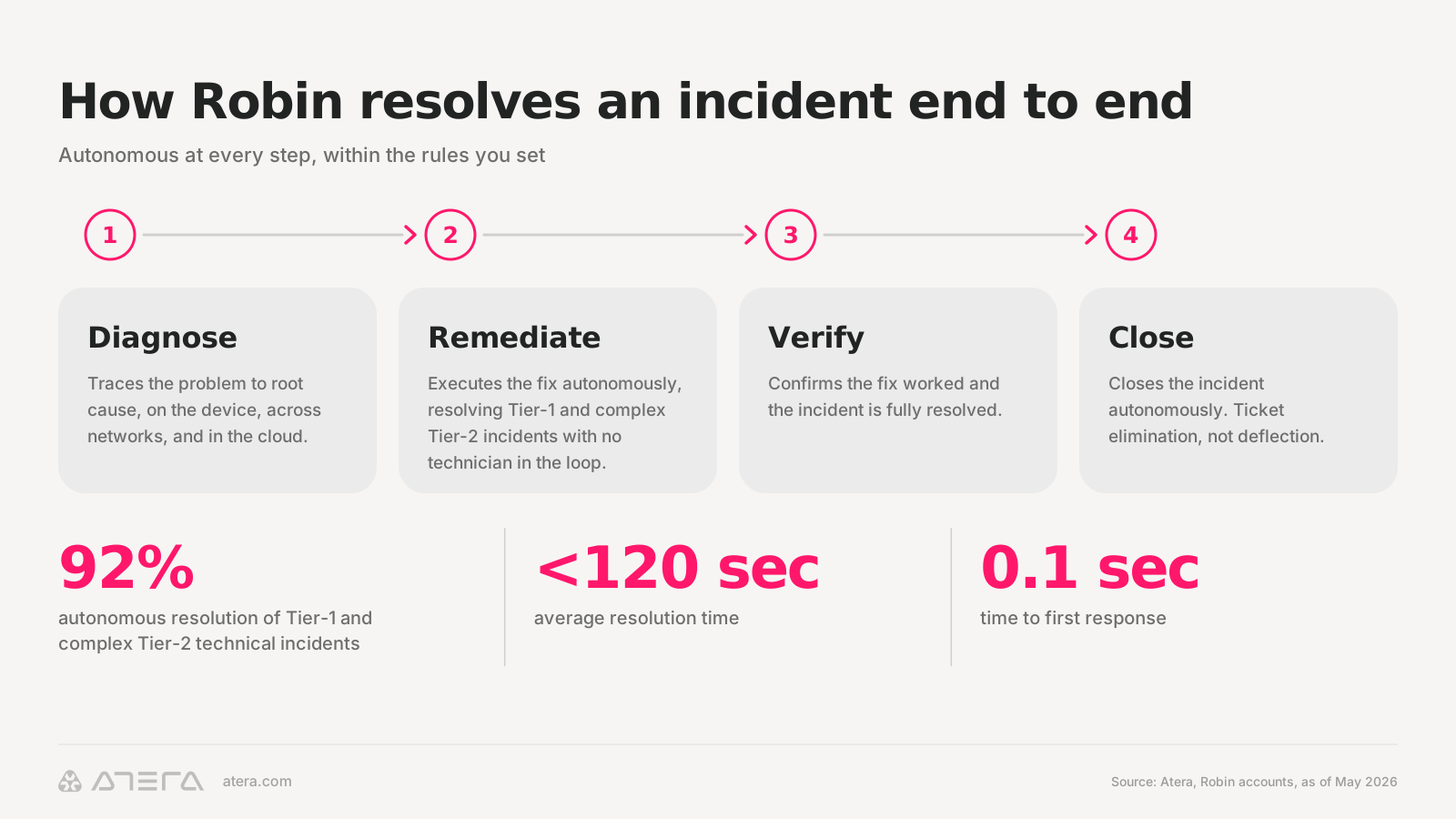
Robin resolves every incident through a four-step sequence:
- Diagnose. Traces the problem to root cause, on the device, across networks, and in the cloud.
- Remediate. Executes the fix autonomously, with no technician in the loop.
- Verify. Confirms the fix worked and the incident is fully resolved.
- Close. Closes the incident autonomously. Ticket elimination, not deflection.
By operating within configurable guardrails and approval workflows, Robin provides enterprise-grade trust. Robin acts only within the rules an MSP defines, and every action leaves a full audit trail. Teams that run Atera as their all-in-one platform get RMM, ticketing, and Robin together, and Robin also layers into an existing stack because Atera is ITSM agnostic.
What are the benefits of AI agents for MSPs?
The main benefits of AI agents for MSPs are faster resolution, less technician time on routine tickets, and consistent control. Robin resolves incidents with an average resolution time under 120 seconds and a first response in 0.1 seconds, so clients wait less. Tier-1 and complex Tier-2 technical incidents stop consuming technician hours, which frees the team for security, planning, and client advisory work. Because Robin acts only within the guardrails and approval workflows an MSP defines, every action stays within agreed rules and leaves a full audit trail.
How do MSPs apply AI agents in practice?
MSPs apply AI agents by deploying an AI technician to handle high-volume, repetitive incidents directly on the client’s network, effectively clearing the queue before human intervention is ever required.
Consider a client employee whose application crashes or whose connection drops. Historically, the request waits in a queue until a technician is free. With Robin, the first response takes 0.1 seconds. Robin diagnoses the failing service or misconfiguration, executes the fix, verifies the system is back online, and closes the ticket, with an average resolution time under 120 seconds.
Robin works within scope. When an incident falls outside what Robin can or should resolve on its own, or when governance requires a human, Robin hands off to a technician with full context and a summary of the actions it has taken.
By setting configurable guardrails, service providers dictate exactly which systems the AI is permitted to modify and which sensitive actions require human oversight.
One customer describes the effect on a small team:
“It takes care of the small stuff that used to slow us down. Things that don’t need a human, but still needed to get done.”
Hunter Patterson, CIO at Repacorp
8 key considerations for implementing AI agents in your MSP
- Audit your existing workflows. Identify the Tier-1 and Tier-2 tickets that consume the most technician time. Note which autonomous IT support tool handles each one today.
- Choose a system of action, not a system of record. A system of record logs data and routes tickets. A system of action executes the fix on the endpoint or network. Map your AI agent stack to see where each piece acts.
- Define configurable guardrails. Set exactly which tasks the AI technician may perform on its own, so it operates only within your rules.
- Set approval workflows. For sensitive systems or infrastructure changes, require human authorization before the final fix runs.
- Plan the integration. Choose a platform that works with your existing RMM and ticketing stack, so the AI has the visibility to trace root causes accurately.
- Monitor all four steps. Track whether each incident is diagnosed, remediated, verified, and closed. Verification protects against false positives.
- Communicate the impact to clients. Frame adoption as less waiting and more working for their employees, not as a technical upgrade.
- Redirect technician time. Move freed hours to security auditing, infrastructure planning, and client advisory work.
Success metrics to track: average resolution time, the share of Tier-1 and complex Tier-2 technical incidents resolved without a technician, time to first response, and technician hours returned to billable or strategic work.
Common pitfalls: granting broad permissions on day one, skipping approval workflows for sensitive systems, and counting closed tickets without confirming the fix held.
What are common use cases for AI agents in MSPs?
- Password resets. Employees lock themselves out and reset requests pile up. Robin verifies identity under the rules you define, resets the credentials, and restores access.
- Print and peripheral errors. Failed services interrupt remote workers. Robin restarts the failed component on the local machine, verifies the device responds, and closes the ticket.
- Disk space alerts. Cache and temp files trigger critical alerts across client endpoints. Robin identifies the cause, clears temp and cache files without touching user data, and closes the alert.
Are AI agents right for your MSP?
AI agents are moving from suggesting fixes to completing them. Robin resolves up to 92% of Tier-1 and complex Tier-2 technical incidents end to end, with an average resolution time under 120 seconds, inside the guardrails you set.
See Robin resolve incidents end to end and book a demo
Which Tier-1 incident takes the most technician time in your MSP, and what would you do with those hours back? Share your answer in the comments.
Frequently Asked Questions
Endless IT possibilities
Boost your productivity with Atera’s intuitive, centralized all-in-one platform