Generate summary with AI

Robin by Atera and ConnectWise’s AI products (Sidekick and the newer AI Agents) all support IT service work, but they act at different layers. ConnectWise’s AI Agents is positioned to organize and route tickets autonomously; Robin resolves issues directly on the device, server, or the network.
If you’re an MSP owner, service delivery manager, or technician lead comparing AI agents for your service desk, this Robin vs. ConnectWise AI comparison can help.
Note: This article is part of Robin’s ongoing comparison series: see also Robin vs. ServiceNow Otto and Robin vs. Nexthink Spark.
The AI layer, not the old RMM and PSA debate
This article is entirely AI-focused: Robin vs. ConnectWise Sidekick & AI Agents. We cover what each platform’s AI offerings are, what they do on their own, and how they compare.
For a platform-focused comparison, see Atera vs. ConnectWise.
What is ConnectWise Sidekick & AI Agents?
ConnectWise offers two AI-focused products: Sidekick and AI Agents.
Sidekick is ConnectWise’s original AI product, which helps technicians triage tickets, draft responses, generate scripts faster, and more.
AI Agents is a newer product, which is positioned as a step toward more autonomous execution inside AI service desk workflows.
Where they came from
ConnectWise first introduced Sidekick on November 8, 2023, at IT Nation Connect, describing it as the “world’s first purpose-built AI companion” for technology solution providers. Sidekick for Security later launched in June 2024.
More recently, ConnectWise acquired zofiQ in January 2026 and used it to build a separate product called AI Agents. It reached availability in mid-2026.
What it actually does
Sidekick, across its three modules, handles:
- Ticket triage, categorization, and summarization
- Customer sentiment tracking
- AI-assisted PowerShell, batch, and bash script generation
- Email response drafting
- Sidekick for Security: natural-language security posture queries, ticket assistance, and threat intelligence surfacing
AI Agents, ConnectWise’s newer product, consist of four AI agents:
- Service desk agent: Uses context from PSA to recommend and execute next steps within the ticket workflow, such as updating records or routing to the right technician.
- Triage agent: Automates the work of classifying, labeling, prioritizing, and routing incoming tickets.
- Data analyst agent: Turns operational data into insights. Users can query business and service metrics across PSA, RMM, and financial data.
- Oversight agent: Monitors agent-driven workflows to support compliance, accountability, and service quality.
Human review by design
ConnectWise is clear in its own documentation that Sidekick requires a technician to review and approve every AI-generated script before it runs. That’s a stated design choice, not a limitation ConnectWise is trying to hide.
AI Agents is scoped differently. ConnectWise describes it as closed-loop and autonomous, taking action directly inside workflows rather than only suggesting it. But its own materials say that autonomy is limited only to the ticket lifecycle: triage, routing, documentation, and technician guidance, not the device, server, or network the ticket is actually about.
What is Robin by Atera?
Robin is an AI technician that remediates Tier-1 and complex Tier-2 technical incidents end to end by autonomously taking real actions on devices, servers, mainframes, and networks, without needing a technician in the loop.
The four-step resolution loop
MSPs and enterprise IT departments can put autonomous IT to work with Robin through its four-step resolution loop:
- Diagnose: Robin interacts with end-users via Slack, Teams, email, the Customer Portal, or third-party ITSM tools. It picks up the intent and asks follow-up questions to understand the issue entirely.
- Remediate: Once Robin has gathered enough context, it carries out the fix on the device itself, in the network, or in the cloud. This includes actions like a credential reset, a software install, a service restart, and more.
- Verify: Robin confirms the fix actually worked before closing out anything. If the issue didn’t get solved, Robin escalates it to a human technician with full context of the issue.
- Close: Robin closes the incident autonomously, updating whatever ITSM your team already runs with the outcome and any follow-up noted. Every request gets logged for audit and compliance.
Robin in action: the tasks it actually resolves
The full list of Robin’s use cases is listed here; below are six highlighted.
Diagnosing and resolving slow device performanceThe issue: An employee reports their device has become slow.Robin resolution: Robin analyzes device health in real time, isolates the actual bottleneck, and applies the fix directly on that machine, rather than logging an incident for someone to investigate later.
Password reset and credential recoveryThe issue: A user is locked out of their account.Robin resolution: Robin checks whether the user is in-office or on VPN, selects the right resolution path, and resets the credential directly with the identity provider.
Provisioning software for employees
The issue: An employee needs an application they don’t have rights to install.
Robin resolution: Robin checks their entitlements against the approved software and installs it directly on the device.
Clearing print queue and restoring printer function
The issue: A stuck print job is blocking output.
Robin resolution: Robin clears the queue, resets the spooler, and reconnects the correct printer for that user’s location.
Wi-Fi and network self-serviceThe issue: A user can’t connect to the network.Robin resolution: Robin isolates whether the fault sits with the device, the adapter, DNS, or a proxy, then repairs that exact point itself rather than opening a general network IT ticket incident.
- Onboarding a new employee
The issue: A new hire needs accounts and access ready.
Robin resolution: Robin validates the employee’s Azure AD groups, approved software, and VPN access, then provisions each one directly.
Guardrails and enterprise trust
Agentic AI for MSPs and enterprises only makes sense when it’s governed.
That’s as true for an MSP running IT operations for 100+ clients as it is for single enterprise IT department.
Atera takes its AI security for Robin seriously:
- Admin-defined guardrails. IT admins decide what Robin is allowed to do, not Robin itself. Custom instructions, playbooks, and knowledge base articles set that scope in plain language. Anything outside it gets escalated to a technician rather than attempted.
- Human-approved execution. Robin resolves on its own within its approved scope, but high-risk scripts and code still need a technician to review and turn on before they can run for the first time.
- Full audit trails. Every action Robin takes is logged under its own Robin ID, capturing the original request, Robin’s reasoning, and the action itself, the same record-keeping a human technician’s work would generate.
- ITSM agnostic. Robin operates inside the ITSM your team already runs: ServiceNow, Atlassian, Salesforce, Zendesk, SysAid, and others, rather than requiring you to switch systems first.
Robin vs ConnectWise Sidekick & AI Agents: the core difference
In the comparison table below, Robin is compared against both of ConnectWise’s AI products: Sidekick and the newer AI Agents.
Dimension | ConnectWise Sidekick & AI Agents | Robin by Atera |
Primary function | Sidekick: generative AI assistant; drafts and suggests. AI Agents: (newer, from ConnectWise’s 2026 zofiQ acquisition): described by ConnectWise as executing tasks like triage and routing directly | Robin: AI technician, diagnoses and remediates directly |
Scope | Sidekick: spans TSP/MSP roles (technicians, dispatchers, sales, finance, security) AI Agents: focuses on service desk triage, dispatch, and documentation | Robin: IT-specific (Tier-1 and complex Tier-2 incidents) |
Where it executes | Sidekick: assists within PSA, RMM, and security workflows; a human reviews and approves every generated script or action. AI Agents: runs inside PSA today, with RMM and security planned | Robin: On the device, server, mainframe, or network, autonomously within admin-defined scope |
Human checkpoint | Sidekick: Required for every Sidekick-generated script or action, by design. AI Agents: checkpoint isn’t clearly stated by ConnectWise; no independent verification is available either way | Robin: Reserved for what falls outside defined scope, or for enabling higher-risk scripts |
Governance | Sidekick: self-contained proprietary model, positioned around data privacy. AI Agents: governance not yet detailed in ConnectWise’s public materials | Robin: Configurable guardrails, approval workflows, full audit trails |
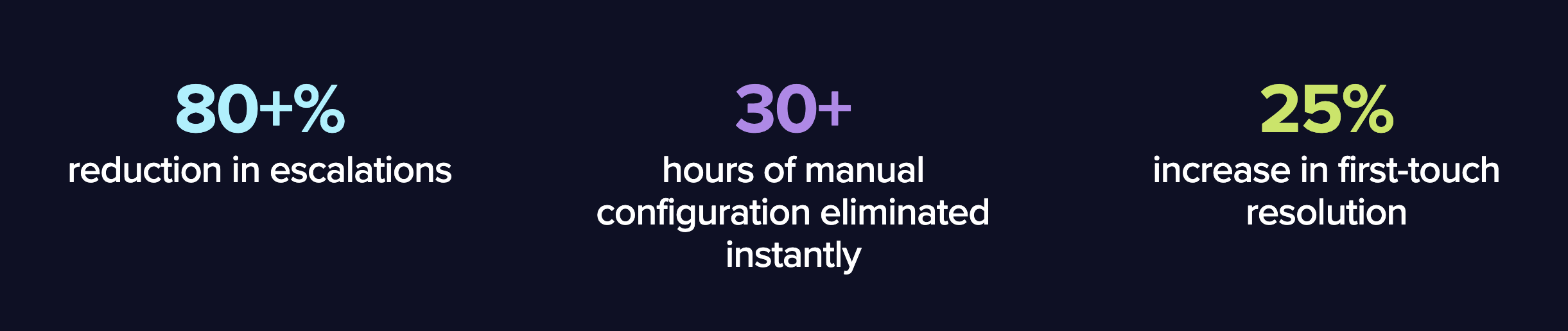
Time / performance impact | AI Agents: Publishes its own escalation and capacity figures (80% fewer escalations, 25% increase in first-touch resolution, 30+ hours of manual configuration eliminated), not an autonomous resolution rate | Robin: Up to 92% autonomous resolution rate; 120-second average resolution time; 0.1-second first response (Atera published proof points) |
In market since | Sidekick: November 2023 (PSA), June 2024 (Security) AI Agents: general availability mid-2026, following ConnectWise’s January 2026 acquisition of zofiQ | Robin: May 2025 (as IT Autopilot), rebranded Robin by Atera in March 2026 |
Why Robin has the edge
A later start still produced autonomous execution first
ConnectWise Sidekick launched in November 2023, about a year and a half before Robin’s underlying technology (IT Autopilot, May 2025). Robin arrived later than Sidekick and still reached autonomous, end-to-end execution first.
ConnectWise AI Agents only reached general availability in mid-2026, more than a year after Robin.
ConnectWise AI Agents autonomous resolution rate isn’t confirmed
Robin’s up to 92% autonomous resolution rate and 120-second average resolution time describe completed, unsupervised technical work.
ConnectWise’s AI Agents page publishes its own figures: 80+% reduction in escalations, a 25% increase in first-touch resolution, and 30+ hours of manual configuration eliminated.
None of these describe an actual autonomous resolution rate and, based on ConnectWise’s own case studies, are not consistent across customers.
Peak Global Solutions is the main testimonial on ConnectWise’s AI Agents. That case study reports a 20% drop in escalations, not 80%.

- Robin acts on the infrastructure. ConnectWise’s AI Agents acts on the ticket.
ConnectWise is clear in its documentation that Sidekick requires a technician to approve every generated script or action.
AI Agents, ConnectWise’s newer product, describes itself as closed-loop and autonomous, but its own materials scope that autonomy to the ticket lifecycle: triage, routing, documentation, technician guidance. Nowhere does ConnectWise describe AI Agents installing software, resetting a credential, or fixing a device the way Robin’s use cases do.
Robin’s autonomy operates one layer deeper. It acts within its admin-defined scope on the device, server, or network itself, without a technician approving each individual action. Human review is reserved for what falls outside that scope, or for enabling higher-risk scripts before they’re ever available to run.
Why this distinction matters, for MSPs and enterprise IT alike
A ticket that’s been triaged, routed, and documented is still a ticket. Someone still has to reset the password, install software, or fix the device before it’s actually resolved.
That gap, between orchestrating the work and actually doing it, is where the difference between Robin and ConnectWise’s AI products actually shows up.
Here’s what that looks like in practice:
- Ticket-layer automation speeds up the queue, not the fix. AI Agents can classify and route a locked-out user’s ticket to the right technician in seconds. Robin skips that step entirely by resetting the credential itself.
- Technician hours only get reclaimed at the layer where the fix happens. A technician opening ten well-triaged tickets a day is still opening ten tickets. Robin returns those hours by actually resolving the routine tasks, such as password resets, software installs, and network fixes.
- After-hours coverage still needs someone at the infrastructure layer. A ticket triaged and routed at 2 a.m. stays unresolved until an agent capable of acting on the device itself picks it up. Robin’s scope reaches that layer without waiting for a technician to log in.
- The math scales the same either way. Whether the backlog belongs to one enterprise IT department or a portfolio of MSP clients, the distance between a well-organized incident and a resolved one doesn’t change based on who the end customer is.
The bottom line
ConnectWise’s AI has come a long way since 2023, and its newer AI Agents product brings real autonomy to how tickets get triaged and routed. But a triaged ticket is still a ticket until someone solves the printer issue, installs the software, or fixes the device underneath it, and that’s the layer Robin works on.
Robin arrived later than Sidekick and still reached autonomous, end-to-end technical execution first at the device, server, and network level.
If you’re choosing a ConnectWise Sidekick alternative, see how Robin can autonomously resolve your first tickets incidents; book a demo with our sales team.
Frequently Asked Questions
Related Articles
Robin vs Request Resolver (Former Rovo)
Robin and Atlassian's Request Resolver (Former Rovo) both bring Autonomous IT into ITSM, but they operate at different levels. This full comparison breaks down where each one's autonomy actually reaches.
Read now
Robin vs Kaseya Intelligence
Robin by Atera and Kaseya Intelligence both talk about autonomous IT, but structure their AI technologies differently. See where each one's autonomy actually reaches and which works for your org.
Read now
Robin by Atera vs. Ivanti Neurons: comparing two very different approaches to autonomous IT
In this article, we'll compare Robin vs. Ivanti Neurons: one AI agent that resolves IT incidents end to end, and one platform that splits autonomy across two separate AI capabilities.
Read now
Robin vs Freddy AI Agent Studio
Not all agentic ITSM starts from the same place. See how Robin's deploy-ready model compares to Freddy AI Agent Studio's no-code, build-it-yourself approach.
Read nowEndless IT possibilities
Boost your productivity with Atera’s intuitive, centralized all-in-one platform