Generate summary with AI

Robin by Atera and Nexthink Spark are both AI agents for IT support, but they act on different infrastructure. Spark’s strength is depth at the employee endpoint, while Robin’s strength is breadth. Robin not only reaches endpoints but also servers, mainframes, and networks.
If you’re a CIO or VP of IT choosing an AI agent for IT operations, this Robin vs. Spark comparison can be truly helpful.
The AI layer, not the old DEX debate
This comparison focuses entirely on the AI layer: Robin vs. Spark, not Atera against Nexthink. Both Robin and Spark are built specifically for IT support, so this is a closer matchup than Robin’s earlier comparison against ServiceNow Otto.
What is Nexthink Spark?
Nexthink Spark (announced in January 2026) is the ‘world’s first personal IT agent’ built on real-time digital employee experience (DEX) data, operating on top of the company’s Nexthink Infinity platform.
Built on two decades of DEX telemetry
Nexthink has spent over 20 years building a DEX business: continuous, passive monitoring of device health, applications, network conditions, and how employees actually use their tools. Per Nexthink’s own figures, their software monitor 20+ million employees across 1,300+ customers.
Spark sits on top of that telemetry rather than starting from scratch. When an employee reports an issue, Spark already has live evidence about the state of that device and network. Spark uses this data to diagnose what’s actually happening rather than a scripted decision tree.
What Spark actually does
Spark performs five functions:
- Conversational diagnosis from live device data: Employees describe an issue in plain language through Teams, Microsoft 365 Copilot, or the Spark app, and Spark reasons over real-time telemetry.
- Proactive IT support: Spark can catch some issues before an employee notices or reports them (using the same passive telemetry). This is a genuine differentiator from tools that only respond when a ticket comes in.
- IT-approved remediation: Spark executes fixes that IT has pre-approved directly on the device: restoring connectivity, applications, and performance.
- Escalation with context: If Spark can’t fix an issue, it hands it to the AI service desk with the full conversation history, rather than an empty ticket.
- Agent-to-agent handoff: Spark can pick up a request mid-conversation from an organization’s existing chatbot, so an IT conversation doesn’t need to restart in a new tool.
Governance and guardrails
As written in Nexthink’s AI Model card, user approval is required before Spark can go ahead with issue resolution (unless autonomous resolution is enabled).
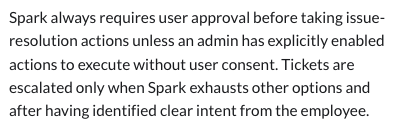
Every conversation, decision, and remediation is logged for audit. Every request Spark processes also runs through AWS Bedrock Guardrails for safety and privacy filtering, and Spark is certified to SOC 2 Type II and ISO 27001.
What is Robin by Atera?
Robin is an AI technician that remediates Tier-1 and complex Tier-2 technical incidents end to end by autonomously taking real actions on devices, servers, mainframes, and networks, without needing a technician in the loop.
How Robin works
Robin makes autonomous IT possible by resolving device and cloud issues end to end.
It follows a four-step process:
- Robin diagnoses the issue: Robin receives the request through Teams, Slack, email, the Atera Customer Portal, or third-party ITSM tools. It verifies the user against identity providers like Okta, Azure AD, or Google. Then it asks follow-up questions to gather the context it needs.
- It remediates the issue: Robin takes the approved action directly on the device, network, or in the cloud. That might mean resetting a password, provisioning approved software, or resetting a network adapter. It routes for approval only when a step requires it.
- It verifies it’s resolved: Robin confirms the issue is actually resolved before closing anything. If it isn’t, Robin escalates to a technician with full context.
- It closes the loop: Robin closes the incident autonomously, updating your existing ITSM with the outcome and next steps. Every request, action, approval, and outcome gets logged for governance and compliance.
Robin in action
Not only does Robin resolve endpoint issues, but it also reaches into the identity, network, and security layers.
Here are seven Robin use cases listed.
Password reset and credential recovery
The issue: A user is locked out of their account.
Robin resolution: Robin detects whether the user is in-office or on VPN, selects the correct reset path, and resets the credential directly against the identity provider.
Onboarding a new employee
The issue: A new hire needs account and network access before their first day.
Robin resolution: Robin validates the employee’s Azure AD group membership, approved software, and VPN access against their role, then provisions each one directly. It does this by reaching into identity infrastructure that sits past the employee’s device.
Suspicious email triage
The issue: An employee forwards a phishing email they’re unsure about.
Robin resolution: Robin uses MXToolbox to analyze the email, instead of just warning the user to be careful. If the threat is confirmed, it escalates it to a human technician with full context. This is a security and network-layer action, not an endpoint fix.
Clearing disk space and reclaiming storage
The issue: A user’s device is running low on storage space.
Robin resolution: Robin identifies what’s consuming the space, flags what’s safe to remove, and reclaims the storage on the device once the user confirms.
Fixing Outlook connectivity issues
The issue: An employee can’t connect to Outlook and email sync has broken.
Robin resolution: Robin detects which specific Outlook subsystem has failed (e.g., the profile, the connection, a corrupted cache), and executes the matching native repair.
Wi-Fi and network self-service
The issue: A user can’t connect to the network.
Robin resolution: Robin isolates whether the fault sits with the device, the adapter, DNS, or a proxy, then repairs that exact point itself, reaching into network configuration beyond the device.
- Diagnosing and resolving slow device performance
The issue: A user reports their device has become slow.
Robin resolution: Robin analyzes device health in real time, finds the actual bottleneck, and executes the fix directly on the machine.
Guardrails and enterprise trust
Adopting Agentic AI for IT only makes sense when strong internal security practices are in place.
That’s the premise behind Atera’s AI security:
- Admins set the guardrails: IT admins write the custom instructions, KB articles, and playbooks that define what Robin is allowed to execute.
- Human-approved execution: Robin acts autonomously within its approved scope, but high-risk scripts or code require a technician to review and turn on first.
- Full audit trails: Every action is attributed to a distinct Robin ID, capturing the original request, Robin’s reasoning, and the action taken. This is the same record-keeping a human technician’s actions would get.
- ITSM agnostic: Robin works inside your existing ITSM systems: ServiceNow, Atlassian, Salesforce, Zendesk, SysAid, and more. This means you don’t need to switch tools you’re already using.
Robin vs Spark: the core difference
See the table below to understand Robin vs. Spark differences even better:
Dimension | Nexthink Spark | Robin by Atera |
Primary function | Personal IT agent built on DEX telemetry, diagnoses and remediates at the endpoint | AI technician, diagnoses and remediates directly across the IT estate |
Scope | Employee endpoint, applications, network, and collaboration experience | IT-specific, devices, servers, mainframes, and networks (Tier-1 and complex Tier-2 incidents) |
Where it executes | On the employee’s device and connected apps, informed by real-time DEX data | On the device, server, mainframe, or network |
Distinctive strength | Proactive detection: can resolve issues before the employee notices, using passive telemetry | Full infrastructure reach: acts beyond the endpoint, into servers, mainframes, and networks |
Autonomy model | Employee confirmation required by default for actions that change the device, admin-configurable per action; diagnostic actions run automatically | Fully autonomous within approved scope, no technician or end-user confirmation required |
Governance | IT-approved actions and workflows, configurable governance policies, audit logs, AWS Bedrock Guardrails | Configurable guardrails, approval workflows, full audit trails |
Time / resolution impact* | 77% first-contact resolution of L1 endpoint-related issues, resolved in under 2 minutes on average (Nexthink and AWS published figures) | Up to 92% autonomous resolution of Tier-1 and complex Tier-2 technical incidents; 120-second average resolution (Atera published figures) |
In market since | January 2026 | May 2025 (as IT Autopilot), rebranded Robin by Atera in March 2026 |
The time / resolution figures measure different populations. Spark’s rate reflects first-contact resolution across employee endpoint issues. Robin’s rate reflects autonomous resolution of Tier-1 and complex Tier-2 technical incidents across a broader infrastructure surface.
Why Robin has the edge
Production tenure
Robin has been resolving IT incidents in production for eight months longer than Spark has existed.
Robin’s underlying technology launched as IT Autopilot in May 2025, autonomously resolving technical issues end to end without a technician in the loop. Nexthink Spark launched in January 2026, roughly eight months later.
Breadth of infrastructure reached
Spark’s remediation surface (per their own materials) is employee endpoints, plus the applications, network, and collaboration tools within them. Beyond endpoints, Robin’s remediation surface extends also to servers, mainframes, and networks.
For an IT leader whose Tier-1 and Tier-2 backlog includes server- and infrastructure-level incidents (not just endpoint issues), that’s a real scope difference.
- Full autonomy by default
By default, Spark asks the employee to confirm before running any remediation that changes their device (this can be turned off).
Robin’s default runs the other way: it acts within its approved scope without a technician or the employee needing to confirm each action. Robin’s human checkpoint sits earlier: a technician reviews and enables high-risk scripts before they’re ever available to run, not after the fact.
Why this distinction matters for IT leaders
Depth versus reach is the main distinction between Robin and Spark.
Spark’s proactive detection can resolve issues before an employee ever notices, which can lead to genuine reduction in ticket volume, at the endpoint level.
Robin’s reach into servers, mainframes, and networks address a different part of the same backlog, the incidents that never touched the employee’s device in the first place.
Here’s what that split looks like in practice:
- Proactive detection lowers volume, not the whole backlog. An expired service account, a failed overnight job on a mainframe, or an Azure AD group that’s out of sync doesn’t originate at the endpoint Spark is watching. Reducing friction at the endpoint level doesn’t reduce the workload sitting at the server, network, or identity layer.
- The math compounds at scale. Industry benchmarks put the cost of solving a ticket manually at 63 minutes of active technician work, and 21.96 hours of average full lifecycle time from ticket opened to resolved. Robin promises up to 92% autonomous resolution rate at a 120-second average, which adds up in time savings at enterprise ticket volumes.
- An interrupted employee doesn’t care which layer caused it. A locked account, a stalled provisioning step, or a failed network connection feels the same to the person waiting on it, regardless of whether it happened at the device or one layer up. That digital friction costs organizations the same way, no matter where in the IT environment it starts.
The bottom line
Robin has been resolving IT incidents in production since May 2025, eight months before Spark existed. Its remediation surface reaches beyond endpoints into networks, mainframes, and servers.
Spark’s strength sits at the endpoint level: two decades of DEX telemetry that lets it catch and resolve some issues before an employee ever notices.
If you’re looking at Robin as a Nexthink Spark alternative, what matters most is where your organization’s incident backlog lives. At the device level, or further at the infrastructure level?
See how Robin can autonomously resolve your first incidents – book a demo with our sales team or sign up for Atera’s free 30-day trial!
Frequently Asked Questions
Related Articles
Robin vs Request Resolver (Former Rovo)
Robin and Atlassian's Request Resolver (Former Rovo) both bring Autonomous IT into ITSM, but they operate at different levels. This full comparison breaks down where each one's autonomy actually reaches.
Read now
Robin vs Kaseya Intelligence
Robin by Atera and Kaseya Intelligence both talk about autonomous IT, but structure their AI technologies differently. See where each one's autonomy actually reaches and which works for your org.
Read now
Robin by Atera vs. Ivanti Neurons: comparing two very different approaches to autonomous IT
In this article, we'll compare Robin vs. Ivanti Neurons: one AI agent that resolves IT incidents end to end, and one platform that splits autonomy across two separate AI capabilities.
Read now
Robin vs Freddy AI Agent Studio
Not all agentic ITSM starts from the same place. See how Robin's deploy-ready model compares to Freddy AI Agent Studio's no-code, build-it-yourself approach.
Read nowEndless IT possibilities
Boost your productivity with Atera’s intuitive, centralized all-in-one platform