Table of contents
Generate summary with AI

Looking for an Atera vs. Level.io comparison? The two are some of the best RMM software, frequently compared by IT teams.
On paper, they seem highly similar: RMM, remote control, patching, scripting, and automations. But this is far from the full picture. Atera and Level.io differ significantly in their feature level, pricing, Agentic AI development, support, and interfaces.
And in this article, we’ll aim to take a look at these differences (and similarities), so you can choose the best one for your organization.
Key takeaways:
- Platform Scope: Atera’s autonomous IT platform bundles RMM, PSA, ticketing and AI, while Level focuses on a streamlined, purpose-built RMM solution that often requires third-party PSA integrations.
- Pricing Structure: The two use different pricing structures: Atera charges per-technician for unlimited endpoints, which can be more cost-effective for scaling, while Level uses a per-endpoint pricing model.
- Patching and Reliability: Level emphasizes reliable patch management with detailed logs and real-time error reporting, noting that its agents self-update automatically, which can contrast with some competitors’ reported inconsistencies.
- User Experience: Both Atera and Level are praised for their intuitive, cloud-native interfaces, but Atera is marketed for its fast setup and uncluttered experience focused solely on core RMM functionality.
Atera vs. Level.io: An overview
Before we compare the two in-depth, here’s an overview of Atera vs. Level.io:
Atera Features | Level.io Features |
– Autonomous IT tool with built-in RMM, remote access, network discovery, and documentation – Atera’s RMM for managing Windows, macOS, and Linux workstations, servers, and other network devices – Robin for managing up to 92% of Tier-1 and complex Tier-2 requests autonomously – AI Copilot for AI-powered troubleshooting, scripting, ticketing, and more – Atera’s ticketing system for summarizing and resolving issues instantly – Scripting engine powered by AI Copilot – Asset management to track the lifecycle of IT assets – Patch management to keep Windows, macOS, Linux, and third-party apps up-to-date – PSA for MSPs to track contracts, billing, SLAs, and more | – Monitoring and alerting for network devices – Asset management for hardware and software assets – Patch management for Windows, macOS, Linux, and third-party apps – Remote control for troubleshooting – Scripting and automation library – Scripting engine – 2FA and IP allowlist security features – CLI for running Level directly or through an outside AI coding agent |
Customer support | Customer support |
– 24/7 email and live chat support for all customers – An extensive knowledge base, IT community, webinars, and tutorials available | – Live chat (weekdays, 8 AM–5 PM ET), email, phone, and bookable support – Onboarding sessions, documentation, and a Discord community |
Integrations | Integrations |
– Integrations with 25+ cybersecurity, automation, backup, remote access, and network monitoring software – Integrations with 50+ more third-party tools for Robin – Access to 5,000+ apps through Zapier | – Integrations with HaloPSA, Zest, ConnectWise, Hudu, ConnectWise PSA, ilert, and Deskday – API available for custom integrations |
Pricing | Pricing |
– Transparent pay-per-technician pricing, starting from $129/month – 30-day free trial available | – Per-endpoint pricing, starting from $2/endpoint/month – First 10 devices free with no time limit |
#1: Features and capabilities
Atera and Level.io share similarities in their RMM software offerings. Both platforms have their unique RMM agents, which you can install on your devices and track key performance metrics to stay on top of potential issues.
Both platforms combine RMM with patch management, remote troubleshooting, and inventory management. Atera adds to this with its fully-fledged ticketing system and AI agents, which not only detect issues early on but also initiate remediation actions fully autonomously.
Level.io’s patching on Windows works through automations built on Winget (the Windows Package Manager); there’s no built-in patch management. Atera’s patch management tool covers OS and third-party app updates across Windows, macOS, and Linux devices.
Also, while both platforms offer third-party integrations, there’s a clear gap in breadth. Level.io lists eight integrations, all of which are with PSA and ticketing tools. Atera’s 25+ integrations cover key categories, such as endpoint security, MDM, network monitoring, CRM, ITSM, payroll, and much more.
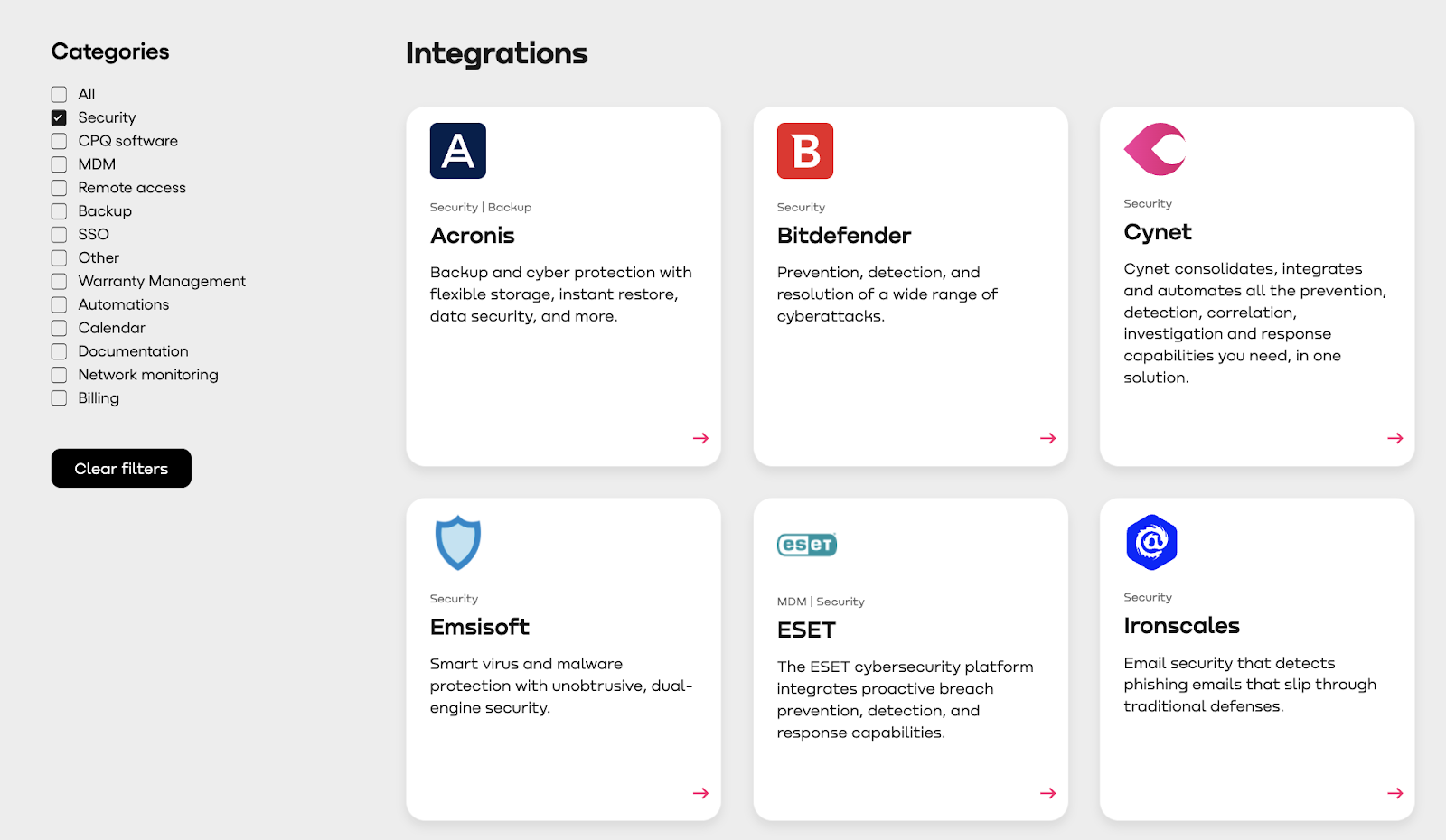
Atera also has the added benefit of its 50+ third-party integrations for Robin, meaning your technicians can act directly inside your identity providers, ITSM, and other SaaS apps.
#2: Agentic AI development
Atera and Level.io take very different approaches to AI. Atera offers autonomous IT agents that are built directly inside its platform, while Level.io lets technicians connect their own AI coding agent to its CLI.
For example, once you connect a coding agent to Level’s CLI, you can:
- Find root causes
- Fix issues across device groups
- Draft and run automations
- Prepare bulk OS updates
- Manage automation runs
- Manage files, tags, and groups
Level.io’s CLI connection is truly helpful, but technicians still need to manually prompt it and approve its actions. Like Atera’s AI Copilot, Level.io’s CLI is purely assistive, rather than an agent that resolves issues on its own.
In contrast, Robin by Atera works differently. Robin is an autonomous IT agent built into Atera’s platform that reaches directly onto the server, network, or cloud, resolving issues without a technician in the loop.
Robin does this by following a four-step resolution loop:
- Diagnose: Robin interacts with end-users through Teams, Slack, email, or the portal, gathering the full context for issue resolution.
- Remediate: Robin takes the approved action directly on the device, server, network, or in the cloud, routing approvals only when required.
- Verify: Robin confirms the issue is actually resolved, and escalates to a technician with full context if it isn’t.
- Close: Robin updates the ticket with the outcome and logs every action, approval, and result for governance and compliance.
Atera promises up to a 92% autonomous resolution rate for Tier-1 and complex Tier-2 technical incidents, with a 120-second average resolution time and a 0.1-second first response.
At Atera, we plan to continue developing our Agentic AI offerings, and our efforts have already been recognized. In G2’s Summer 2026 rankings, Atera took the top spot for Results, Usability, and Relationship in the Enterprise AIOps Platforms index.
A Forrester study commissioned by Atera also found that Robin delivers a 321% ROI, with payback in under six months.
#3: Pricing and value for money
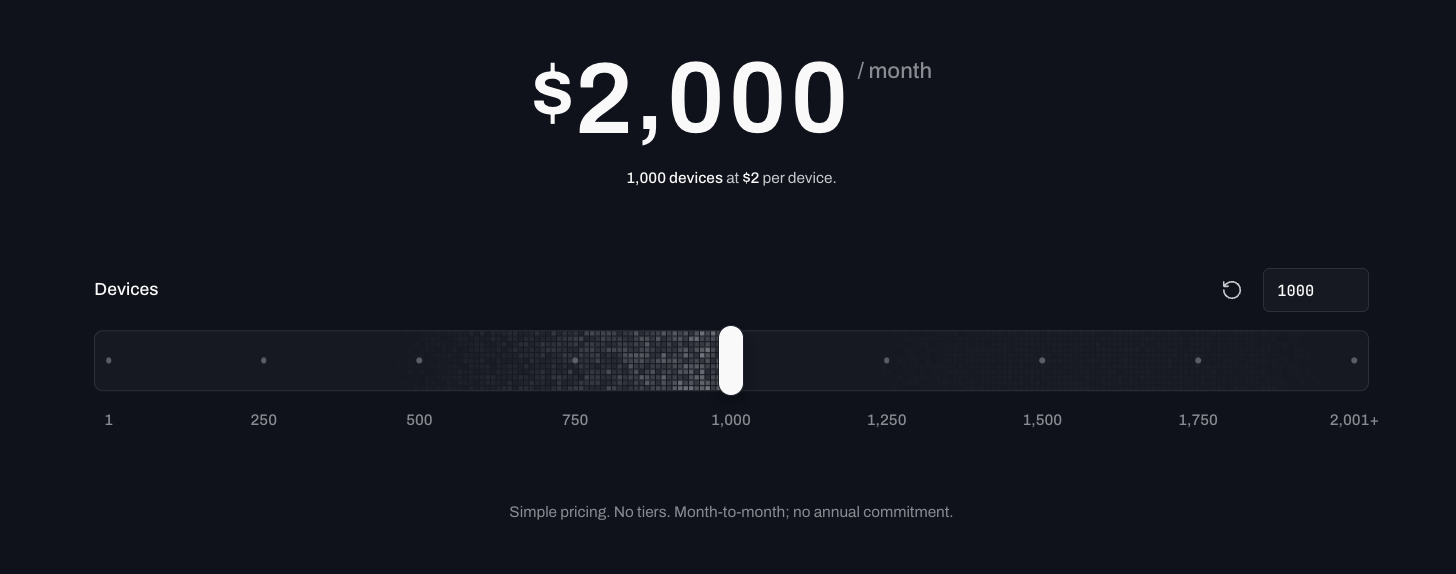
Atera and Level.io use completely different pricing structures. Level.io’s pricing is similar to most RMM pricing plans, with a pay-per-device model starting at $2 per device per month. This means you pay extra for each new endpoint you add.
For example, managing 1,000 endpoints costs $2,000/month:
At Atera, we take a different approach. Our pricing is based on a pay-per-technician model, meaning you can manage unlimited endpoints for a fixed cost.
While enterprises can request a custom quotation, our pricing plans for IT departments start from just $149/month per technician.
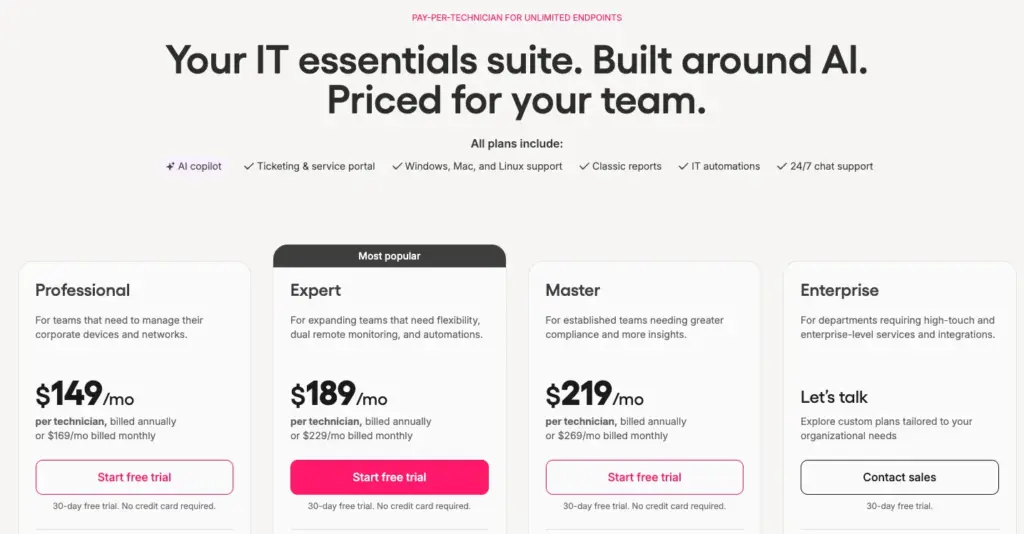
Per-technician pricing arguably makes scaling more predictable, and you’ll not be hit with surprise fees as you grow your IT environment. This is something Atera users, such as Emil C., love about the platform:

In addition, the cost savings you can get from Atera’s AI agents are unmatched. With up to 92% of Tier-1 and complex Tier-2 technical incidents solved by Robin, your technicians have the time to focus on higher-value work.
#4: User interface and usability
Let’s also look at the user interfaces of both Atera and Level.io.
At Atera, we have some of the highest ease-of-use ratings across key review platforms, like G2, Capterra, and Gartner. And ease of use is arguably linked to how intuitive a platform’s interface is.
Level.io hasn’t received enough ratings yet to get an ease of use score, but here are Atera and Level.io side by side on G2’s comparison:
G2 Category | 2. Level.io | 1. Atera |
1. Ease of Use | n/a | 9.2 (980+ reviews) |
2. Ease of Setup | n/a | 9.1 (1,100+ reviews) |
3. Ease of Admin | n/a | 9.0 (990+ reviews) |
Level.io has very limited pictures of how their admin dashboard looks in reality, but we got this screenshot from their YouTube channel:
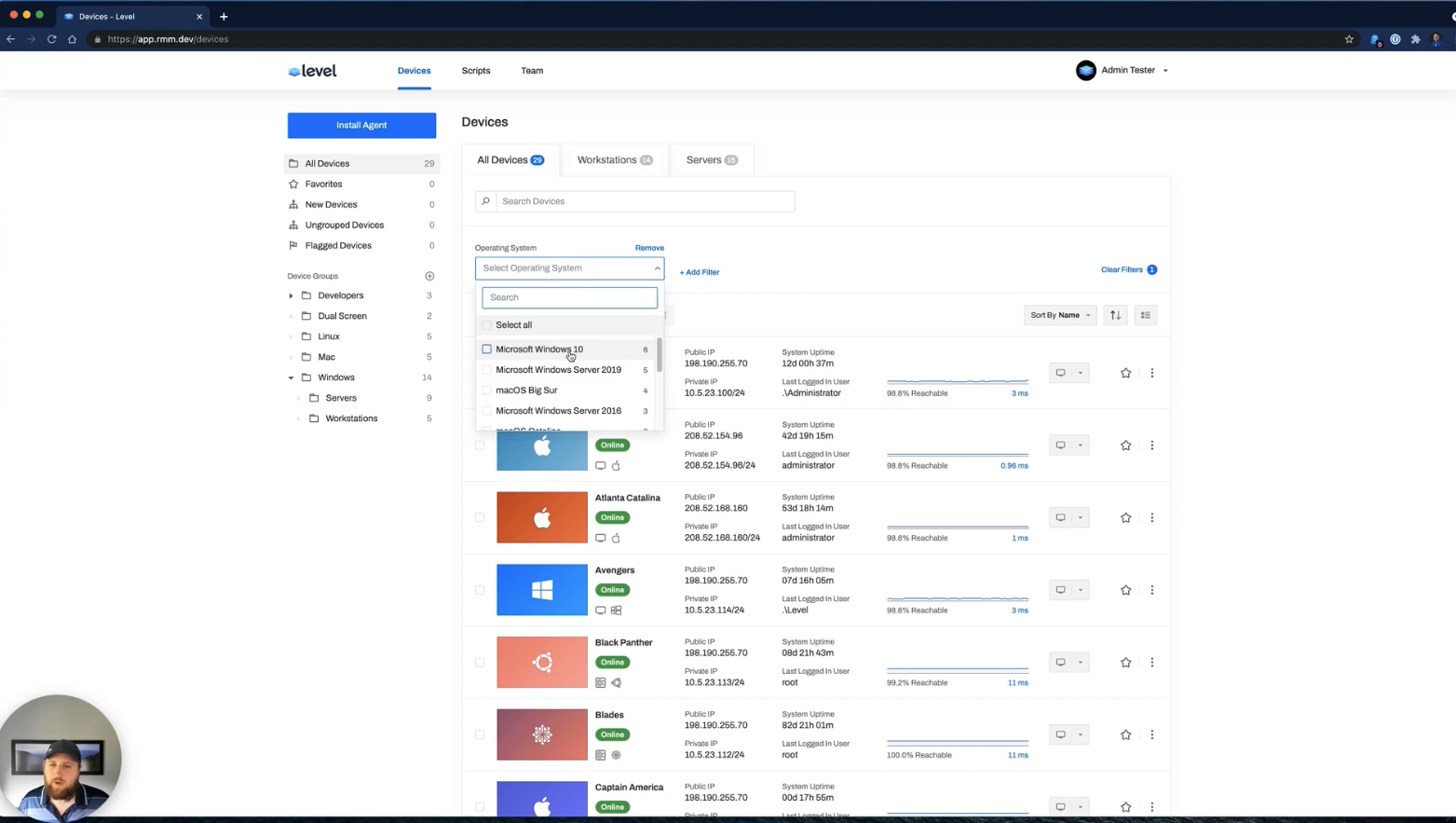
Level.io dashboard (Source)
And this is how Atera’s admin dashboard looks:
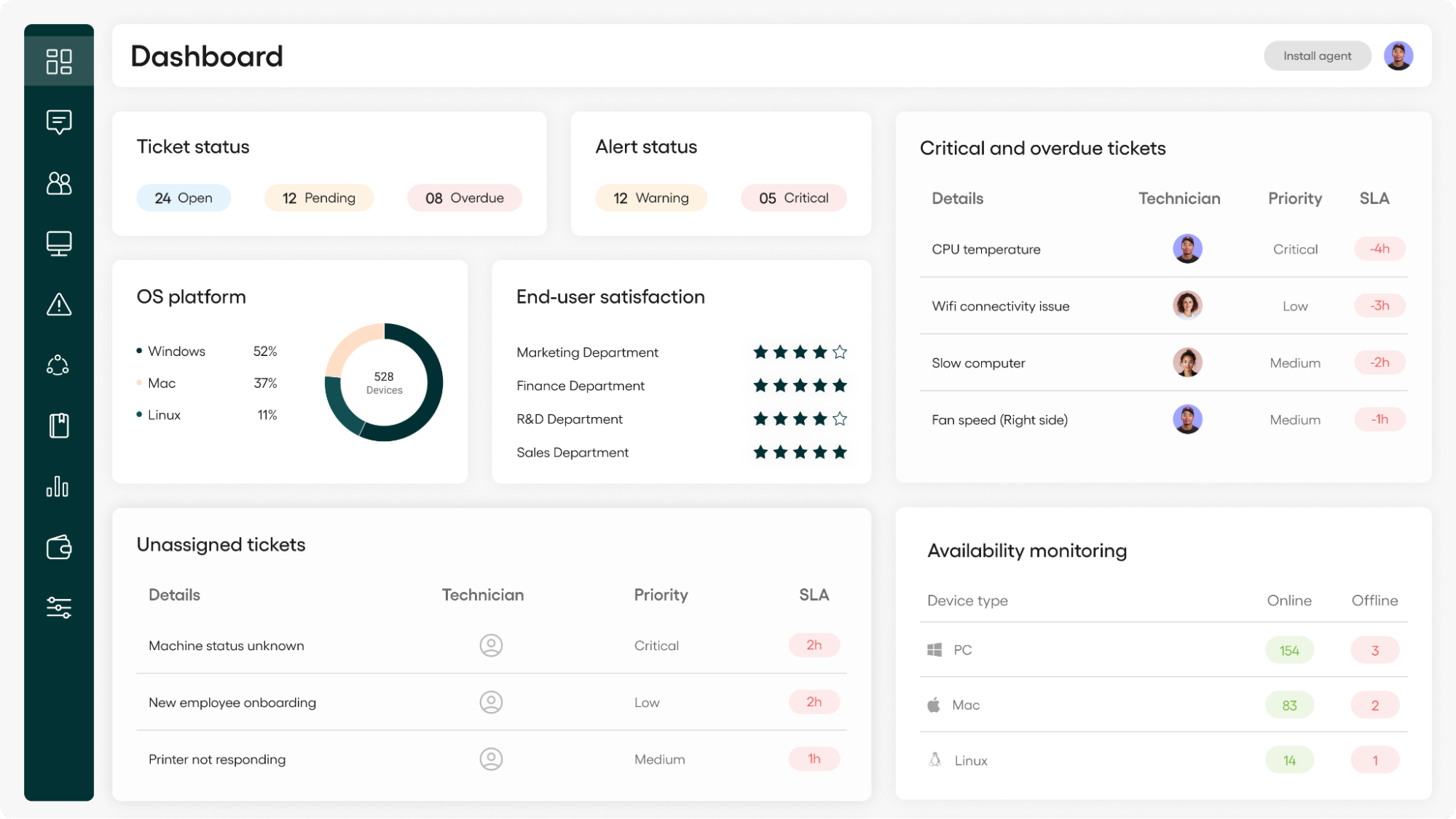
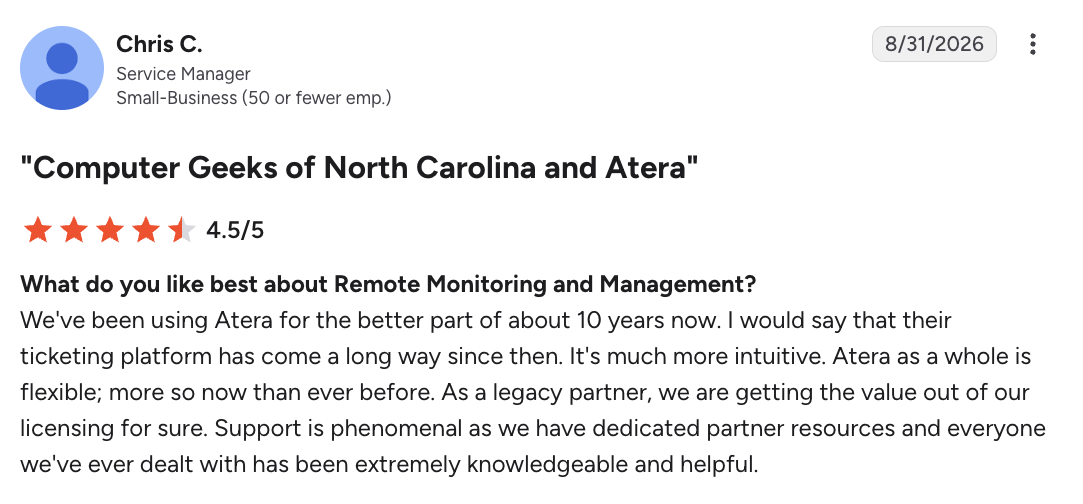
This is how one Atera user, Chris C., commented on how the platform has evolved:
- “We’ve been using Atera for the better part of about 10 years now. I would say that their ticketing platform has come a long way since then. It’s much more intuitive. Atera as a whole is flexible; more so now than ever before.”
#5: Customer support and community
Since we first wrote this comparison, Level.io has updated its support offerings, now also offering live chat, onboarding help, email, and phone support.
Its live chat, however, is only available on weekdays during US business hours, so teams in other time zones have to rely mostly on email.
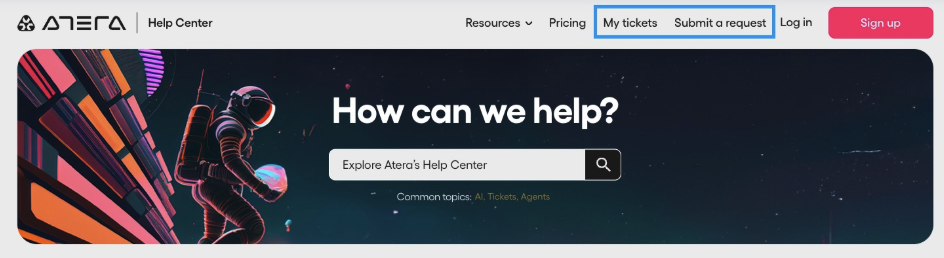
In comparison, Atera’s support is available 24/7 through live chat or email, meaning you get help no matter your time zone. Atera also has an extensive knowledge base, tutorials, webinars, and an active IT community, all of which are helpful for troubleshooting.
#6: User feedback and reviews
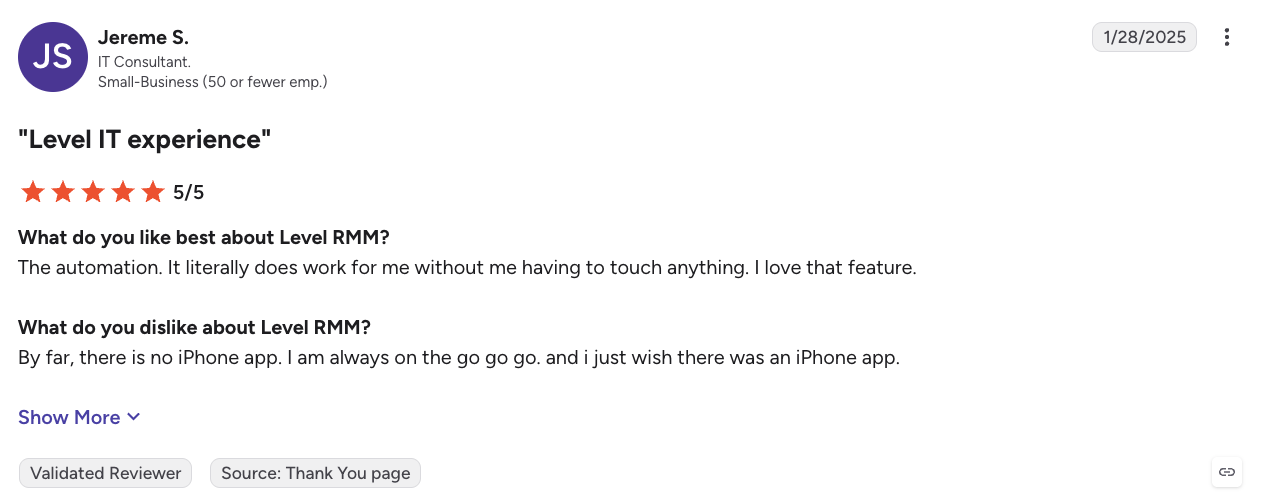
On G2 alone, Atera has gathered nearly 1,200 reviews, with an average rating of 4.6 out of 5.0 stars. Level.io has a 5-star rating with 1 review on G2.
Of Atera’s reviews, one G2 user, Emil C., praised Robin’s advantages for both technicians and end-users:

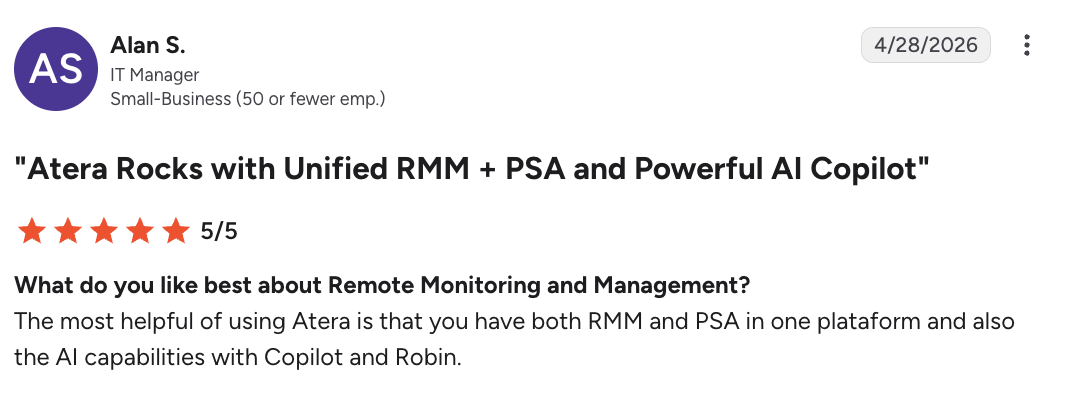
Another Atera user, Alan S., simply said, “The most helpful of using Atera is that you have both RMM and PSA in one platform and also the AI capabilities with Copilot and Robin.”
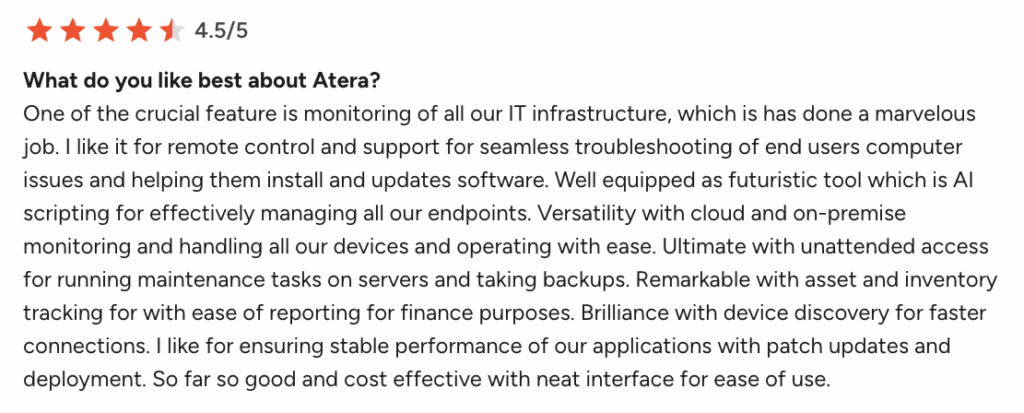
Another user mentioned Atera’s RMM, which comes with an AI script generator:
Level.io has one review on G2 from Jereme S. The reviewer likes Level.io’s automation, but criticizes the lack of a mobile app for iPhone:
Atera is a cloud-based RMM platform, but it also has a mobile app for both Android and iOS devices.
Final comparison: Atera vs. Level.io for your organization?
Still not sure whether Atera or Level.io is better for your IT team?
In our opinion, Level.io’s RMM offering can work for basic-level IT management, but for organizations looking to scale efficiently while keeping their costs down, Atera is hard to beat.
If you’re still not convinced, here are four things that make Atera stand out from Level.io:
- Agentic AI: Of Atera and Level.io, only Atera has developed Agentic AI technology. Robin takes care of up to 92% of your Tier-1 and complex Tier-2 technical incidents, without a technician in the loop.
- Per-technician pricing: Atera charges based on pay-per-technician, which allows you to manage unlimited devices. With Level.io’s per-device pricing, the total cost can quickly skyrocket if your IT environment grows.
- All-in-one product: In addition to RMM, Atera’s broad offering includes patch management, remote control, asset management, ticketing system, reporting, and network discovery, all powered by our autonomous IT agents. This means you don’t need to invest in redundant software for IT management.
- Third-party integrations: Level.io’s integrations are limited to PSA products. Atera’s platform and Robin integrations expand much beyond that and are ideal for enterprises looking to take endpoint management and security seriously.
Ready to see Atera in action? An easy step you can take is to sign up for Atera’s 30-day free trial; no credit card required!
Frequently Asked Questions
Related Articles
Atera vs. Automox: A full comparison for IT decision-makers in 2026
Compare Atera vs. Automox across all key categories: Agentic AI, features, pricing, user interface, customer support, and user feedback. Choose the best one for your organization.
Read now
Robin vs Request Resolver (Former Rovo)
Robin and Atlassian's Request Resolver (Former Rovo) both bring Autonomous IT into ITSM, but they operate at different levels. This full comparison breaks down where each one's autonomy actually reaches.
Read now
Robin vs Kaseya Intelligence
Robin by Atera and Kaseya Intelligence both talk about autonomous IT, but structure their AI technologies differently. See where each one's autonomy actually reaches and which works for your org.
Read now
Robin by Atera vs. Ivanti Neurons: comparing two very different approaches to autonomous IT
In this article, we'll compare Robin vs. Ivanti Neurons: one AI agent that resolves IT incidents end to end, and one platform that splits autonomy across two separate AI capabilities.
Read nowEndless IT possibilities
Boost your productivity with Atera’s intuitive, centralized all-in-one platform