Table of contents
IT runs on a constant stream of technical failures: the access request that stalls a new hire, the outage that stops important work in its tracks, the printer that never works, all contributing to an incident queue that never empties. And every one of these is now a target for AI, with a promised solution arriving from every direction.
“Autonomous IT” is the new AI promise on the market, appearing on half the booths in any recent conference, and it seems to cover a wide variety: tools that answer a question in seconds, surface the right knowledge article, recommend a likely fix, gather information from an employee, or trigger a workflow. Some are capable of taking real actions.
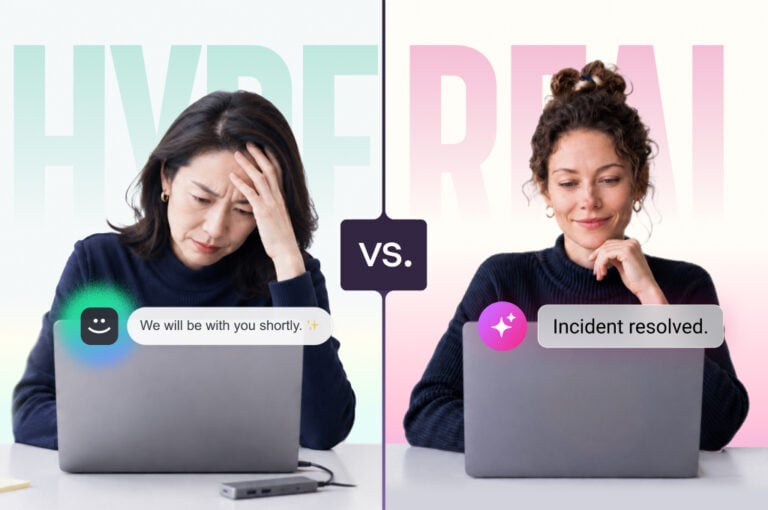
Watching one of these product demos, it can feel as though they make the work disappear. But then the demo ends, and someone still has to finish the job.
“Autonomous” has to mean something specific, or it stays an empty label.
At its core, Autonomous IT is AI that determines how to resolve a technical incident at run time, takes the actions needed across the environment and changes direction if it determines a need, verifies the outcome, and closes the incident without a human technician being brought in to finish the work. Anything short of that is assisting the work, not owning it.
That distance between what an AI tool can say or start and the outcome the organization actually needs is the action gap. It can be identified by a simple test on anything that claims autonomy: after it acts, look at what is left behind, because useful steps are not the same thing as completed work. Did the total amount of work in the system actually go down? And as enterprises move from experimenting with AI to expecting measurable returns from it, that gap matters more than the growing list of things a model can technically do.
The work hiding behind the AI promise
Consider an employee who cannot access a business application. An AI assistant might retrieve the instructions, or go further and recommend a likely fix. Useful, but the employee still has to judge whether the recommendation fits, carry it out, and check the result.
It might instead trigger a predefined workflow, or execute an action itself. More work is removed, as long as the incident follows the path someone anticipated. But an action is not an outcome: if the command succeeds and the employee still cannot get in, the original problem remains, and someone has to handle the exception.
Each of these systems did something valuable, and each left a different amount of work behind. That is what makes the action gap easy to overlook: on the same conversational interface, each of these looks like asking the AI to fix something. But underneath, the economics are very different.
When AI completes only part of a task, the rest does not disappear; it returns to the organization, where a person interprets the result, makes the call, handles the exceptions, and confirms the problem is gone. This is where the cost hides: the organization pays for the AI while its people keep owning and doing the work it was supposed to remove.
Not every handoff is unfinished work, of course. When a system recognizes that a case falls outside its defined scope, or when organizational policy requires human approval, and the AI hands it over with its diagnosis and the steps it has already taken, it is not a gap. It’s a call made and passed on a case the receiver can pick up without starting over: the technician inherits a resolved investigation rather than a blank ticket. The action gap is a different situation, a partly-finished incident that comes back by default, because the system ran out of capability rather than because it made a reasoned decision to escalate.
None of this makes partial assistance worthless. Cutting ten minutes of research to two has value, and automating a predictable sequence removes repetitive work and can save dozens or even hundred of hours. But work accelerated and work removed are not the same economic outcome nor the same objective, and the business case cannot stop at the AI. It has to count what everyone still had to do afterward, alongside licensing, integrations, knowledge maintenance, governance, and exception handling.
IT makes the action gap obvious
The action gap shows up across many AI domains, but IT makes it plain, because technical outcomes are observable: a laptop connects or it does not, access is restored or it is not. Explaining how to fix the problem is a different thing from fixing it.
Closing the action gap takes more than permission to run a command. The system has to work out what this particular incident needs while it is unfolding, act where the condition exists, and verify that it restored the intended state without creating new problems.
That last step is easy to underestimate. A process can restart while the application stays down. A policy can be applied without restoring access. An API can return success while the employee is still stuck. The action can succeed even when the desired outcome was not achieved. That is why verification is part of resolution, not an optional step after it: the finish line is not that the AI did something, but that the problem is resolved and the system can prove it.
The action gap is also a platform problem
This is why a more capable reasoning model will not, on its own, close the action gap. A model can understand exactly what needs to happen and still lack the context, access, and reach to make it happen. Owning the outcome takes all of those together, not just better reasoning. That is the difference between AI that sits beside the work and AI that owns it.
Measure what is taken off the table
That standard also changes how you evaluate a system. A feature list tells you less and less as these tools come to look alike on paper, and the more revealing test starts where the demo ends: when a person does step in, are they finishing work the system left undone, or picking up a case it judged and handed over with its findings, or just going over the post-case documentation?
It changes the economics, too. A verified resolution removes the technician task and shortens the employee’s interruption at once, and even a case escalated with its full history spares the receiver the diagnosis. The value moves beyond efficiency inside the service desk to productive capacity returned across the business.
Come back to where this started: the stranded new hire, the team pulled off its work, the queue that never empties. The promise was never just that AI would do impressive things. It was that this work would finally be finished, by the AI. The important question for enterprise AI is no longer simply how much a system can do. It is how much is left for people to finish, and why.
Related Articles
Robin’s fast implementation and faster ROI
Autonomous AI technology doesn’t have to involve a long, drawn-out deployment. Agentic AI tool Robin offers guarantees to solve half of your tier 1 tickets within 90 days — showing that AI can be fast, easy, and prove ROI and scale within days, not years.
Read now
Measuring AI for Enterprises
Most enterprises are deploying AI faster than they can measure it. As AI agents become operational contributors rather than software tools, leaders need a new framework to understand whether AI is actually creating business value.
Read now
Robin leading the way
IT teams have been stuck in a reactive firefighting mode for years. Help desk tickets pile up, burning out technicians and creating an endless break/fix loop. Autonomous, agentic AI has now matured enough to bring performance guarantees for enterprises looking to ease their IT teams’ workloads.
Read now
The AI assistant trap
Adding an AI assistant onto IT workflows without strategy or specifics can actually add a lot more work for technicians. Common failures of AI usage can also lead to data breaches, undertrained or unprepared technicians, or wasted time validating AI outputs.
Read nowEndless IT possibilities
Boost your productivity with Atera’s intuitive, centralized all-in-one platform