Table of contents
Generate summary with AI

These Israeli AI innovators are shaping cybersecurity, healthcare, autonomous operations, and enterprise IT. Learn what their momentum signals for modern IT teams.
For IT leaders tracking where artificial intelligence (AI) is headed next, Israel remains one of the most important markets to watch. From cybersecurity and healthcare to developer tools and enterprise operations, the country’s AI ecosystem is driving practical, production-ready innovation. Below are seven Israeli companies that are influencing how modern infrastructure, security, and IT operations are built.
Key Takeaways
- Israeli AI companies lead in proactive security, autonomous operations, and predictive infrastructure management.
- The strongest platforms focus on prevention rather than response, reducing the need for manual intervention.
- AI is rapidly becoming foundational across cybersecurity, healthcare, networking, and IT automation.
- These trends are shaping how AI-powered IT operations are designed, deployed, and scaled.
Why Israel Is a Global AI Powerhouse
Israel’s AI dominance is driven by a rare mix of technical talent, enterprise adoption, and real-world problem-solving at scale. The country curates and trains elite military cyber units that serve as a pipeline for advanced engineering talent, while heavy collaboration between startups and global enterprises boosts commercialization.
As of 2025, Israel hosts more than 2,300 active AI startups, including 342 that specialize in generative AI. Even more striking, AI-focused companies make up only 25 to 30 percent of the country’s startup base but draw roughly 47 percent of all startup funding and about 40 percent of all funding rounds.
Together, these dynamics have positioned Israel as a launchpad for some of the most influential AI companies operating today. Below is a closer look at seven Israeli AI startups currently shaping cybersecurity, enterprise software, healthcare, and automation.
7 Israeli AI Companies to Watch
| Company | Sector | Core AI Focus | Enterprise Impact |
| Wiz | Cloud Security | Risk analysis | Proactive cloud defense |
| Orca Security | Cloud-Native Application Protection Platform | Agentless security | Cross-cloud visibility |
| Atera | IT Management and Automation | IT operations and autonomous support | Scalable IT service delivery |
| Cato Networks | Network Security | Traffic inspection and optimization | Secure and optimized networking |
| Videa Health | Healthcare AI | Diagnostics | Medical imaging accuracy |
| Bluewhite | AgriTech AI | Autonomous operations | Smart machinery control |
| Deep Instinct | Cybersecurity | Deep learning malware defense | Real-time threat protection |
Wiz: Proactive Cloud Risk Detection at Scale
Wiz applies AI to continuously scan cloud environments for vulnerabilities, misconfigurations, and exposure paths without impacting performance. It builds a continuously updated security graph that maps risk across complex cloud environments.
Key AI capabilities:
- Agentless cloud security scanning
- AI-driven vulnerability prioritization
- Real-time misconfiguration detection
- Identity and exposure path analysis
- Multi-cloud security visibility
Why IT teams care: As hybrid and multi-cloud environments become standard, Wiz replaces manual audits with continuous, automated risk detection. This same move toward always-on, preventive automation now defines modern IT platforms that aim to minimize downtime and response delays.
Atera: AI-Driven IT Operations and Autonomous Support
Atera delivers an AI-powered IT management platform that integrates Remote Monitoring and Management (RMM), ticketing, technician assistance, and end-user automation to automate device management and service delivery across distributed environments.
Key AI capabilities:
- Autonomous Tier 1 support via Robin
- Automated ticket resolution and escalation
- AI script and command generation
- Smart knowledge-base search and responses
- Proactive device and cloud monitoring
- Unified RMM, ticketing, and PSA operations
Why IT teams care: Atera shows how AI can automate both technician workflows and end-user support from a single platform. This two-tier automation model reflects the broader shift toward autonomous IT operations that scale without adding headcount.
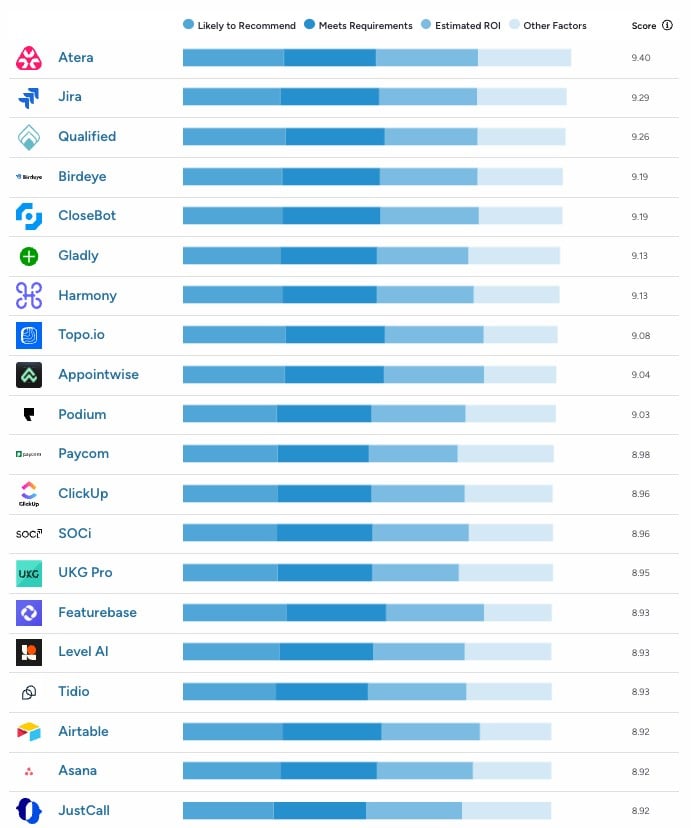
The results speak for themselves: Atera topped G2’s Agentic AI ranking with a 9.40 score, landing the #1 spot ahead of Jira, Qualified, and Birdeye.
Orca Security: Agentless AI for Cloud-Native Security
Orca’s AI builds a real-time risk graph across cloud workloads using read-only APIs. It identifies toxic combinations of vulnerabilities, identities, and exposed data without requiring endpoint agents.
Key AI capabilities:
- Zero-agent cloud security deployment
- Full attack surface visibility
- AI-driven breach path analysis
- Continuous asset risk scoring
- Unified cloud vulnerability management
Why IT teams care: By removing the need for agents, Orca reduces operational overhead while strengthening security coverage. This agentless approach is shaping the future of remote IT management, where teams need broad visibility and automation without expanding their infrastructure.
Cato Networks: AI-Optimized Secure Networking
Cato merges SD-WAN (Software-Defined Wide Area Network) and SASE (Secure Access Service Edge) into a single global networking platform, powered by AI-based traffic routing, security inspection, and threat detection.
Key AI capabilities:
- AI-driven traffic prioritization
- Automated threat detection and inspection
- Unified networking and security stack
- Global policy enforcement
- Performance optimization across distributed users
Why IT teams care: As perimeter-based security models give way to cloud-first architectures, AI-optimized networking helps ensure secure, reliable access for distributed workforces. This reflects the broader shift toward centralized RMM and IT automation platforms that replace fragmented tools.
VideaHealth: AI Diagnostics in Regulated Healthcare Environments
VideaHealth uses deep learning to analyze X-rays and detect conditions such as cavities, bone loss, and infections with high diagnostic accuracy.
Key AI capabilities:
- Deep learning image recognition
- Automated anomaly detection
- Clinical decision-support integration
- Continuous diagnostic model improvement
- High-accuracy visual data analysis
Why IT teams care: VideaHealth shows that AI can be trusted even in tightly regulated industries like healthcare. That level of reliability is helping IT teams rely more on AI to sort alerts, route issues automatically, and fix device problems without manual intervention.
Bluewhite: Bringing Autonomous Intelligence to Industrial Operations
Bluewhite enables heavy farm equipment to operate autonomously, using AI to improve safety and performance as conditions change in real time.
Key AI capabilities:
- Autonomous machine navigation
- Real-time environmental sensing
- AI-based route and task optimization
- Predictive system adjustments
- Remote fleet monitoring
Why IT teams care: As farm machines take on more responsibility in the field, demand for automation is rising. A similar shift is now happening in enterprise IT, where autonomous agents handle diagnostics, remediation, and escalation without manual intervention.
Deep Instinct: Predictive Cyber Defense with Deep Learning
Deep Instinct was among the first to apply deep learning to malware prevention. Its solutions detect and block threats before execution, rather than after a system is compromised.
Key AI capabilities:
- Pre-execution threat prevention
- Deep learning malware classification
- Zero-day attack detection
- Autonomous threat blocking
- Real-time endpoint protection
Why IT teams care: Deep Instinct’s prevention-first model reflects how predictive IT operations platforms now stop outages before they occur through proactive monitoring, alert correlation, and automated remediation.
What IT Leaders Can Learn From These AI Companies
Across cybersecurity, healthcare, networking, industrial automation, and IT operations, top-performing companies apply AI in remarkably similar ways despite serving different markets. These strategies can create a blueprint for how AI should be applied at scale.
- Predict before failure: These platforms use continuous monitoring and predictive models to surface risks and potential failures. This shift from post-incident response to preventive operations is now becoming the default expectation for modern IT environments.
- Reduce dependence on centralized response teams: Many of these companies push decision-making closer to where activity occurs, whether it’s a device, workload, or machine. This reduces bottlenecks, shortens response times, and lowers the operational strain on centralized teams.
- Operate at scale: Each platform is designed to perform consistently across large, distributed environments, not just small pilot deployments. Reliability at scale is what separates experimental AI from operational AI in enterprise settings.
- Minimize friction: Agentless models, lightweight integrations, and automated workflows allow these platforms to deliver value without slowing down processes. Frictionless deployment is now a core requirement for AI adoption in production environments.
Together, these platforms define what enterprise-ready AI looks like in practice. The same mindset now drives IT environments, where automation, monitoring, and service management are unified into a single, streamlined system.
Where Atera Fits Into the AI Operations Landscape
Across security, healthcare, networking, and industrial systems, these companies apply AI to automate decisions, reduce manual effort, and operate at scale. Atera brings those AI principles into IT operations by applying automation across device management, service delivery, and end-user support.
With AI Copilot, technicians use natural language to generate scripts, commands, ticket replies, knowledge-base articles, and device queries, streamlining daily workflows and speeding up resolution. With Robin, end users receive real-time, autonomous Tier 1 support across email, Slack, Teams, and service portals, with unresolved issues escalated to technicians with full context.
By unifying RMM, ticketing, network discovery, and asset management, Atera establishes an AI-first operating model. This approach delivers the kind of predictive, autonomous, and scalable architecture that defines Israel’s most advanced AI ecosystems.
Use Cases Where AI Drives Immediate Value
Across enterprise IT environments, AI automation is already delivering measurable operational gains—not just in theory, but in day-to-day execution. Here are some use cases where AI can bring immediate value by removing manual effort, reducing response times, and improving system reliability:
- Proactive device and patch monitoring
- Autonomous software deployment
- AI-driven alert triage and response
- Intelligent ticket resolution and knowledge creation
- Predictive maintenance across distributed environments
For organizations hoping to manage growth without increasing headcount, this AI-driven IT automation model is becoming a core operational necessity.
The Bigger Picture
Israeli AI companies continue to accelerate the move toward:
- Autonomous operations
- Predictive infrastructure management
- AI-driven service delivery
- Zero-downtime architectures
For IT departments and enterprises, this signals a permanent change in how support models scale. Intelligent automation is no longer just about working faster. It’s becoming the baseline for reliable IT operations.
Learn How AI Can Transform Your IT Operations
AI is already reshaping cybersecurity, healthcare, and global networking. The same transformation is now powering smarter, faster IT operations.
Ready to level up your IT environment? Try Atera for free today to see AI Copilot and Robin in action.
Related Articles

Are AI agents actually autonomous?
Every vendor calls their product an "AI agent" now, but a chatbot, a copilot, and an agent behave very differently once they're running in production. Before you sign a contract based on that label, it's worth knowing what real autonomy requires, and where the gap between demo and deployment tends to show up. Here's what the data says about which claims hold up, and the questions worth asking before you buy.
Read now
ISO 42001 for IT leaders: what the certification actually means for your stack
ISO 42001 is a still-new AI standards certification that’s becoming more popular in vendor security questionnaires. See what ISO 42001 for IT leaders means.
Read now
AI governance standards for IT teams, explained: ISO 42001, SOC 2, and the EU AI Act
Check out this plain-English guide to governance standards ISO 42001, SOC 2, and the EU AI Act for IT teams, and what each one actually requires from AI vendors.
Read now
Atera is ISO/IEC 42001 certified. Here’s what that actually means.
AI governance is no longer a nice-to-have. Here's how Atera is staying ahead of it—and what that means for you.
Read nowEndless IT possibilities
Boost your productivity with Atera’s intuitive, centralized all-in-one platform