Table of contents
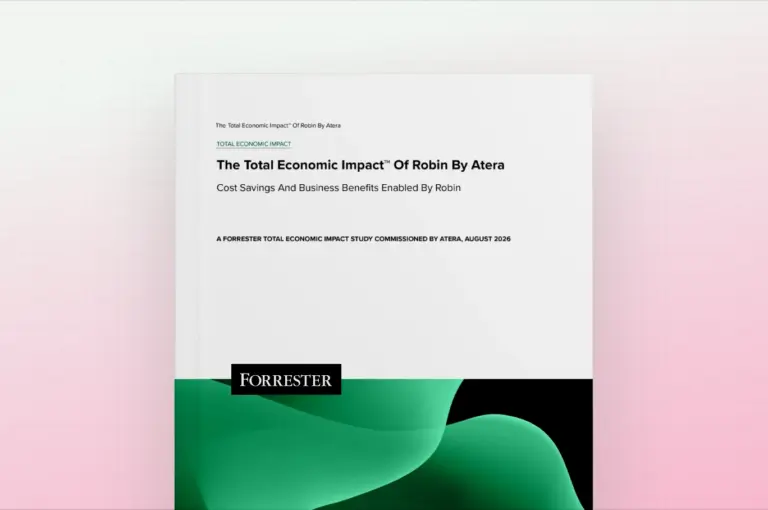
This 321% figure, however, comes from a Total Economic Impact (TEI) study that Atera commissioned Forrester Consulting to run independently on Robin by Atera, Atera’s Autonomous IT agent. Forrester interviewed four existing customers who have already deployed Robin, took their reported outcomes, applied its own risk adjustments, and built the final numbers around a composite enterprise of 2,500 employees over three years.
Why the number holds up
TEI is built for exactly the claim decision makers are trained to distrust. Rather than projecting what Robin might do, Forrester started from what it has already achieved inside real organizations, then discounted the results to stay conservative. Every benefit in the model is risk-adjusted downward by 10%-20%, and all future value is discounted at 10% a year.
The composite that came out of that process, a 2,500-employee enterprise with $800 million in revenue and a 30-person Level 1 and Level 2 service desk, saw $7.3 million in benefits against $1.8 million in costs over three years. That nets to $5.5 million in present value, a 321% return, and payback in under six months.
Those numbers are modeled, yes, but they come from real-world deployments.
Where the return comes from
Forrester split the benefit into five lines. Read together, they explain why the total lands where it does.
Two lines come straight off the service desk. Robin resolves a growing share of manual tickets on its own, 60% in year one, rising to 90% by year three as integrations mature and its knowledge base grows, saving specialists about 1.5 hours on every ticket it closes. That is worth $3.3 million.
On tickets it does not fully resolve, Robin still runs first-line triage, capturing context and structuring the request before a human sees it, saving another 30 minutes per ticket, worth $533,000.
The larger surprise is what happens away from the queue. The single biggest line, $2.9 million, is end-user productivity, most of it the time employees get back when Robin resolves their tickets faster, and a smaller share from everyday friction it fixes before a ticket is ever raised. Robin monitors for problems like a device quietly running low on disk space and clears them before the employee notices.
The head of IT at the interviewed healthcare organization described setting up exactly that: “We got Robin to go and scrape through [and alert us] if it reaches our threshold to … clean out the temporary files. I’m sure we had a few dozen employees who had that issue, but now they don’t.”
Two smaller lines round out the total: $241,000 in hiring the organization avoided as ticket volume grew, and $305,000 less spent remediating shadow IT, because always-on support gives people less reason to route around IT in the first place.
More than half the modeled return comes from value beyond IT’s own labor savings, in recovered employee time, avoided hiring, and lower shadow IT cost, which is the value a service-desk-only view of AI misses.
What it looked like in the interviewed teams
The four organizations behind the model, anonymized by Forrester, span multiservice, retail, real estate, and healthcare operations.
Their starting point was familiar. As the infrastructure and security architect at the retail organization put it: “Our ticketing system was completely inefficient. Everyone was all over the place and doing two jobs. We needed to be more efficient.”
The after looked different on the numbers IT leaders actually study against. The service desk lead at the multiservice organization described clearing backlog as well as current load: “Thanks to Robin, we went from closing 75% of our tickets to closing 105% of them.” The healthcare organization pushed SLA compliance to close to 100%.
The math behind the headline
A 321% return is easier to believe once you see the baseline it is measured against, and Forrester built that baseline from the composite’s own operations rather than an industry average. Before Robin, the composite handled 36,000 tickets a year, 70% of them requiring full manual work at an average of 1.5 hours each, at a fully burdened cost of $51 an hour for L1/L2 staff.
Move 60% of those manual tickets off human hands in year one, rising to 90% by year three, and you can see why the desk-cost line alone reaches $3.3 million.
Get the full study
The figures above are the summary. The full 27-page study breaks down Forrester’s methodology line by line: the risk adjustment on each benefit, the composite’s full assumptions, the three-year cost model and its various formulas, and the interview findings behind every number.
If you are building a business case for an AI agent on your service desk, this is the independent data to bring into that conversation.
Forrester Total Economic Impact™ of Robin by Atera study
Disclaimer: A commissioned study conducted by Forrester Consulting on behalf of Atera
Related Articles
Atera ranked #1 Agentic AI software by G2 for both Results and Usability
In a field of more than 90 products, Atera earned the top score in G2's Agentic AI category for both Results and Usability, ahead of every other vendor evaluated.
Read now
Atera sweeps G2’s Summer 2026 enterprise AIOps rankings
In G2's Summer 2026 Enterprise indices for AIOps Platforms, Atera took the top spot for Results, Usability, and Relationship, ahead of every other vendor in the category.
Read now
Atera makes the CRN AI 100 list for 2026
This prestigious recognition reflects Atera’s commitment to AI innovation.
Read now
IT Autopilot is now Robin by Atera and is on a mission to let people work
We’re introducing a new chapter for Atera. IT Autopilot is becoming Robin by Atera, and we’re putting a stake in the ground with a simple belief: technology should remove friction, not create it. With our new campaign, Let People Work, we’re doubling down on a future where AI doesn’t just assist IT teams, but actively resolves issues, clears operational noise, and gives people the freedom to focus on the work that actually matters.
Read nowEndless IT possibilities
Boost your productivity with Atera’s intuitive, centralized all-in-one platform