Table of contents
Generate summary with AI

The hidden costs of the wrong IT management platform extend far beyond the price tag—lost productivity, security vulnerabilities, and scaling limitations can impact your entire organization. For IT leaders tasked with selecting a platform that will serve as the backbone of their technical operations, understanding the nuanced differences between solutions isn’t just helpful—it’s essential.
Atera and Freshservice are both leading IT management platforms that share similar features but ultimately serve different use cases. Freshservice is primarily used for service desk management, while Atera offers an autonomous IT platform for organizations.
Even though Atera and Freshservice differ, IT decision-makers often compare them for IT management tasks such as asset management, ticket management, and workflow automation. If you’re looking for information on which platform is right for your IT team, this article is for you.
Below, we have compared Atera’s and Freshservice’s key features, pricing, user interfaces, and customer reviews to help you make the right choice for your IT team. Let’s begin!
Why should you trust our reviews?
We don’t just examine the features of Atera and Freshservice; we also consider feedback from our community and insights from reviews on platforms like G2 and TrustRadius. This comprehensive approach helps highlight the strengths and weaknesses of each solution.
Our goal is to keep our content transparent and objective, empowering you to make informed decisions for your business. Your trust in our reviews matters to us because we understand the crucial role that choosing the right IT management platform plays in the success of your IT department.
Atera vs. Freshservice: A brief overview
Let’s start with a brief overview of Atera and Freshservice:
| Atera Features | Freshservice Features | ||
| – Autonomous IT tool with built-in RMM, remote access, network discovery, and documentation – Robin by Atera for autonomously resolving up to 92% of IT incidents – Patch management for Windows, macOS, and Linux devices – Asset management to track the lifecycle of IT assets – Agentic AI (Includes Robin, AI Copilot, AI-powered troubleshooting, scripting, ticketing, and more) – PSA for MSPs to track contracts, billing, SLAs, and more | – Incident management (route and manage tickets) – Service health monitoring & alerting – SLA management – Project management – Workflow automation – Workload management – Freddy AI Agent Studio (no-code AI agents for IT and HR service requests) | ||
| Customer support | Customer support | ||
| – 24/7 email and live chat support for all customers – An extensive knowledge base, IT community, and tutorials | – 24/5 live chat and email support for all Freshservice customers – Knowledge base and blog articles – Freshworks community | ||
| Integrations | Integrations | ||
| – Integrations with 25+ cybersecurity, automation, backup, remote access, and network monitoring software – Integrations with 50+ ITSM, identity provider, CRM, office suite, and more for Robin – Access to 5,000+ apps through Zapier | – Integrates with access, knowledge, and document management, remote support, and collaboration software | ||
| Pricing | Pricing | ||
| – Transparent pay-per-technician pricing, starting from $129/month – 30-day free trial available | – Pay-per-user pricing, starting from $25/month – 14-day free trial available |
We also looked at G2’s user review comparison of Freshservice vs Atera, which considers factors like ease of use, quality of support, and how well the software meets user requirements.
As you can see below, customers have rated Atera and Freshservice mostly equally, although Atera has an edge in ease of setup and how good a partner the product has been in doing business:

You can access the full G2 comparison here.
#1: Features and capabilities
Let’s start with an important comparison: The features and capabilities of Atera and Freshservice. While the two platforms’ features may seem similar at first glance, they differ significantly when you look closer.
Freshservice is mainly focused on the ITSM aspect of IT management, and its main use case is resolving and managing users’ IT issues. Its key features are ticket and knowledge base management, a self-service portal, change management, and asset management.
In comparison, Atera is an all-in-one IT management platform that allows users to monitor and manage their entire IT environment from one platform.
Atera offers many of the same features as Freshservice, including ticketing, asset management, a self-service portal, and knowledge base management. The key difference is that Atera expands its capabilities to other areas, including RMM, Network Discovery, remote access, Agentic AI, and patch management. Atera’s RMM allows users to monitor and manage their endpoints, such as workstations, servers, and switches, a feature Freshservice lacks.

Atera’s device monitoring page
#2: Agentic AI development
We’ve reviewed the Agentic AI of Atera’s Robin and Freddy AI Agent Studio in detail here, but below is a summary of where the two stand.
Freddy AI Agent Studio (part of Freshservice’s Freddy AI umbrella brand) is a no-code platform inside Freshservice for building and deploying autonomous agents. Instead of just assisting, it helps to resolve service requests end to end.
It was launched at the Refresh conference on May 14, 2026, roughly a year after Robin’s predecessor, IT Autopilot, launched in May 2025.
Here’s what Freddy AI Agent Studio is capable of:
- No-code agent builder for designing agent logic and workflows
- Pre-built IT and HR agents, including a library of 30+ workflows for common service requests
- MCP Gateway to pull context from and act across third-party tools (e.g., Notion, ClickUp, and Linear)
- AI Insights and Experience Level Agreements (xLAs), which is an analytics layer connecting service performance to employee sentiment
Freddy AI Agent Studio’s flexibility has its own genuine strength, but building your own agents also means time and internal investment.
Robin’s resolution loop is already built for resolving Tier-1 and complex Tier-2 IT incidents. An organization configures Robin’s guardrails and scope, but the resolution logic doesn’t have to be built from scratch.
Here’s the four-step resolution process Robin follows:
- Robin diagnoses the issue: It interacts with end-users via Teams, Slack, email, the Atera Customer Portal, and third-party ITSM tools. It detects intent and asks follow-up questions to get the full context needed for resolution.
- It takes approved action: Robin takes approved action directly on the device, network, or in the cloud, routing approvals only when required.
- It verifies the resolution: Before closing anything, Robin verifies the issue is actually resolved. If needed, it escalates the issue to a human technician with a summary of all actions performed.
- It closes the ticket: Robin closes the loop in your ITSM and logs requests, actions, and outcomes for governance and compliance.
Atera promises up to a 92% autonomous resolution rate and a 120-second average resolution time for Robin, which are its own named, published metrics.
Due to the impact Atera’s AI agents are having on organizations, G2 has continuously selected it as one of the best AIOps tools.
Freshservice’s headline figure, a 168% three-year ROI (from a vendor-cited Futurum Group report), tracks platform consolidation, not resolution speed, so the two can’t be compared in a head-to-head score.
AI Copilot (similar to Freddy AI Copilot) is Atera’s AI assistant for technicians, helping them with insights and troubleshooting. It’s available on each Atera plan at no extra cost.
Copilot learns about your IT environment in real time and provides actionable insights to questions like “How many devices are running outdated software?” or “Which endpoints are experiencing performance issues?”

#3: User interface and usability
Atera and Freshservice are mainly designed for different purposes within IT management; therefore, their user interfaces and usability also differ.
Based on G2’s ease of use scores, this is how actual users have rated the usability of Atera vs. Freshservice:
| G2’s Ease of Use Categories | 1. Atera | 2. Freshservice |
| 1. Ease of Use | 9.2 stars (1,100+ reviews) | 9.2 stars (1,200+ reviews) |
| 2. Ease of Setup | 9.2 stars (970+ reviews) | 8.8 stars (980+ reviews) |
| 3. Ease of Admin | 9.0 stars (620+ reviews) | 9.0 stars (970+ reviews) |
Both Atera and Freshservice have received strong feedback for their UIs. Managing tasks, such as ticketing, device monitoring, and asset management, is straightforward.
From Atera’s dashboard, you can set up an IT automation profile for automating tasks, like patch management, software updates, and system reboots.

In addition, you can access AI Copilot from the bottom-right corner of our admin dashboard or directly from the device, tickets, or alerts page.

From the main dashboard view, you can gain insights into the overall health and performance of your IT environment. You can see the ticket and alert status, customer satisfaction, ticket activity, critical and overdue tickets, and more.

For comparison, here is a look at Freshservice’s admin dashboard:

Freshservice dashboard (via Capterra)
Freshservice’s admin dashboard mainly revolves around its key features, such as ticketing.
While we might be a bit biased, we truly believe that Atera offers more intuitive user interfaces that benefit both IT departments and MSPs. Onboarding new customers to Atera is quick, and you can get up and running within minutes of signing up.
#4: Pricing and value for money
Both Atera and Freshservice charge users based on a pay-per-user/technician model, where you pay for the number of technicians using the platform.
Atera is known for its transparent pricing plans. While enterprises can request a custom quote, the pricing plans range from $149 to $219 per month for IT departments and from $129 to $209 per month for MSPs.
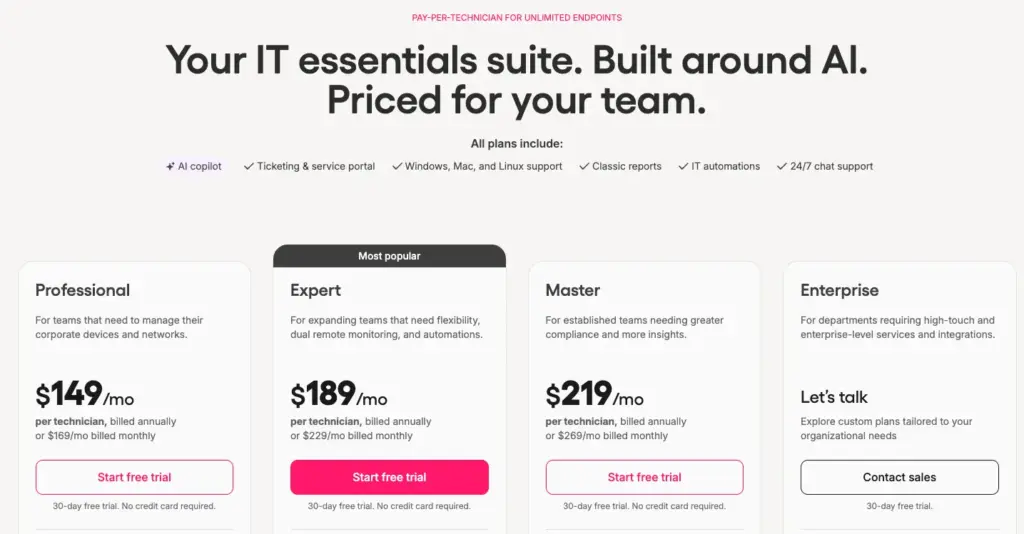
In comparison, Freshservice pricing plans for ITSM range from $25 to $102 per month, and there is an enterprise plan with a custom quotation.
Freshservice appears more affordable than Atera on the surface, but there are some key differences.
Both Atera and Freshservice offer integrations with remote support software, but only Atera offers remote access as part of its standard plans. In addition, Atera’s standard plans include RMM, PSA, Network Discovery, asset management, and patch management, most of which Freshservice lacks.
Freshservice offers many of its features, such as asset management, as add-ons, which also increase the overall cost.
#5: Customer support and community
Both Atera and Freshservice offer live chat and email support to their customers. A small difference is that Atera offers 24/7 support, while Freshservice offers 24/5 support.
Both Atera and Freshservice also have extensive knowledge bases and active IT communities, which allow users to get help on their own and troubleshoot problems with other IT professionals.
The question is, though, how do customers see the support levels of both platforms?
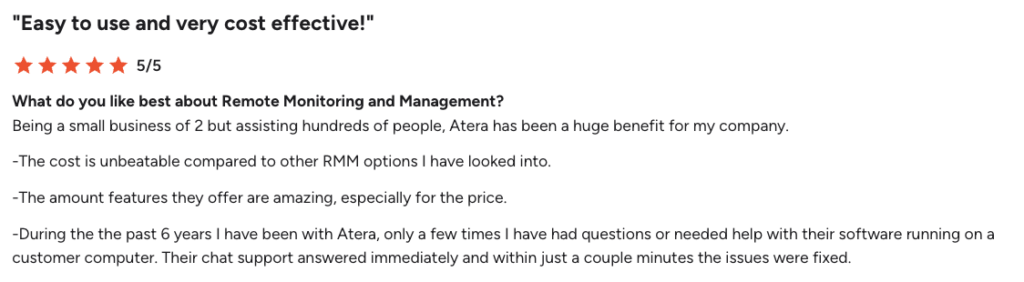
Many Atera customers say that the 24/7 live chat support is one of the best parts of the platform. One G2 user stated:
“During the past 6 years I have been with Atera, only a few times I have had questions or needed help with their software running on a customer computer. Their chat support answered immediately, and within just a couple of minutes the issues were fixed.”
Atera users are actively part of the product development process and can leave and vote on new features on the Features board.
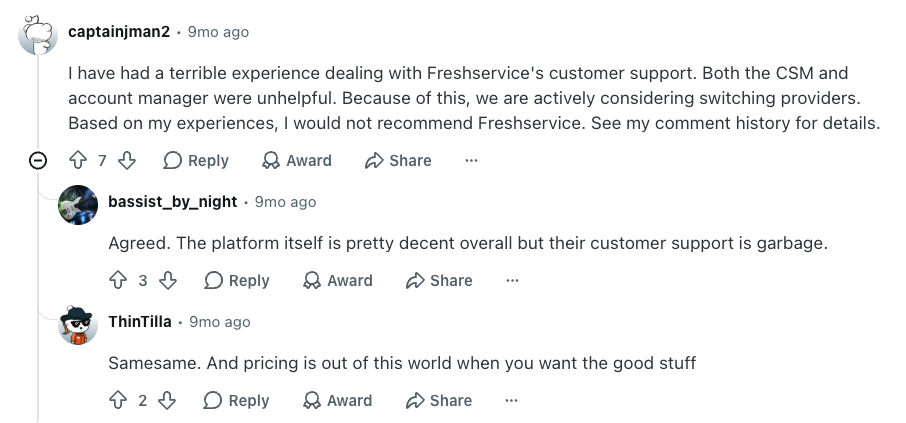
Freshservice’s 24/5 technical support is mostly well received, although some users have shared criticism of it. For instance, in this Reddit thread, multiple users mention receiving poor support from their support team:
#6: Security and compliance
As an IT decision-maker, you probably want to compare the security and compliance offerings since this is one of your core responsibilities.
As part of its ITSM offerings, Freshservice provides role-based access control, encryption, multi-factor authentication, and audit logs to help users secure their information.
At Atera, security is our top priority, so security is at the center of everything we do, which is why it is integral to our products and features. We are HIPAA compliant, SOC 2 certified, and more!
With smart logging and reporting and strict adherence to industry standards, we ensure our customers’ organizations are protected from malicious third parties. In addition, Atera’s AI agents add a layer of security (read more about Atera’s AI security here). Instead of waiting for things to break, Robin flags issues and offers advice and autonomous actions based on real-time data.
Robin helps end-users install and update pre-approved software, which removes one of the most commonly exploited attack vectors: outdated and unauthorized applications.
In addition, Atera offers plenty of cybersecurity integrations with tools such as ThreatDown, Ironscales, ESET, Emsisoft, Bitdefender, Cynet, and Acronis, to further strengthen your security.
Atera’s Robin can also be integrated with different Freshworks products: Freshsales, Freshdesk, and Freshservice.
#7: Performance and reliability
Performance and reliability are keys to effective IT operations. That’s why we at Atera continually work to ensure that our performance and reliability scores remain high and that downtime is minimized.
If you ever do run into problems using Atera, you can rest assured that you will always get the right help, thanks to our 24/7 live chat support. You’ll also see our commitment to expanding our support offerings through our digital resources including our blog, knowledge base, and an active community. You can always count on us.
Plus, with Robin handling first-tier support, your users also feel like they’re getting the required support to keep working without unnecessary delays or escalations.
#8: User feedback and reviews
Both Atera and Freshservice have received strong reviews from customers on platforms like G2, Capterra, and Reddit. On G2, Atera currently has 830+ reviews rated 4.6 out of 5.0, while Freshservice has 1,000+ reviews rated 4.6 out of 5.0.
Both platforms are strongly rated by customers, but for different reasons.
Atera customers appreciate the platform’s all-in-one capabilities, Agentic AI technology, and the fair pay-per-technician pricing.
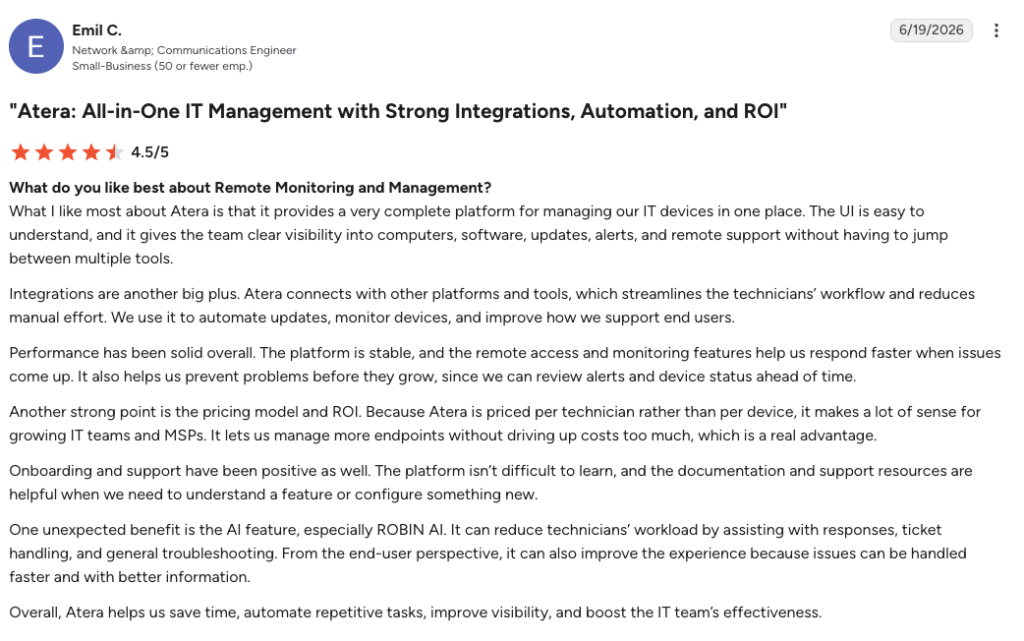
Emil C. on G2 commented on Atera’s AI and said:
- “One unexpected benefit is the AI feature, especially Robin. It can reduce technicians’ workload by assisting with responses, ticket handling, and general troubleshooting. From the end-user perspective, it can also improve the experience because issues can be handled faster and with better information.”
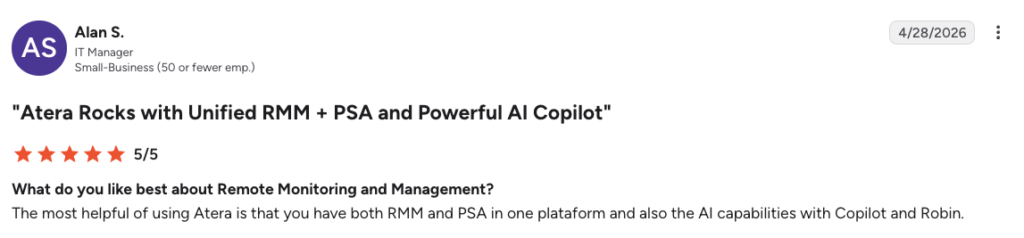
Another G2 user, Alan S., said, “The most helpful of using Atera is that you have both RMM and PSA in one platform and also the AI capabilities with Copilot and Robin.”
One G2 user appreciated Atera’s continued development in the IT management space:

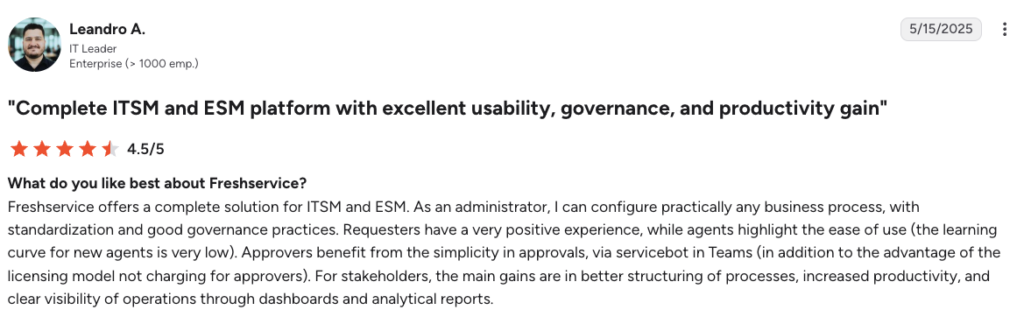
Freshservice’s positive reviews mainly relate to the product’s ITSM capabilities. One G2 user said:
In addition to the positive feedback, MSPs and IT teams have criticized Freshservice for lacking a proper RMM and PSA.
One Reddit user said, “Freshservice is a pleasant ticketing system to use, but it isn’t really a PSA tool. We currently use it, but are a far smaller MSP than you, and it is showing its cracks easily.”

Freshservice review via Reddit
Future-proof your IT with Atera’s Agentic AI IT management platform
Atera is at the forefront of adding Agentic AI technology into its offerings through Robin, which is capable of resolving up to 92% of technical incidents end-to-end.
With a 120-second average resolution time, 0.1-second first response, and 321% delivered return on investment, Robin helps to turn IT support into an organization’s advantage. Read more about the ROI Robin helps you achieve in the Forrester Total Economic Impact study, commissioned by Atera.
If you’re looking to future-proof your IT operations with industry-leading Agentic AI technology, Atera is arguably the best choice.
To get started, contact our sales team for a custom demo or sign up for Atera’s 30-day free trial to try it yourself!
Related Articles
Robin vs Request Resolver (Former Rovo)
Robin and Atlassian's Request Resolver (Former Rovo) both bring Autonomous IT into ITSM, but they operate at different levels. This full comparison breaks down where each one's autonomy actually reaches.
Read now
Robin vs Kaseya Intelligence
Robin by Atera and Kaseya Intelligence both talk about autonomous IT, but structure their AI technologies differently. See where each one's autonomy actually reaches and which works for your org.
Read now
Robin by Atera vs. Ivanti Neurons: comparing two very different approaches to autonomous IT
In this article, we'll compare Robin vs. Ivanti Neurons: one AI agent that resolves IT incidents end to end, and one platform that splits autonomy across two separate AI capabilities.
Read now
Robin vs Freddy AI Agent Studio
Not all agentic ITSM starts from the same place. See how Robin's deploy-ready model compares to Freddy AI Agent Studio's no-code, build-it-yourself approach.
Read nowEndless IT possibilities
Boost your productivity with Atera’s intuitive, centralized all-in-one platform