Table of contents
Generate summary with AI

Atera and Quest KACE aim to solve the same problem: helping IT teams manage and secure their endpoints. But once you dig a bit deeper, you’ll start seeing big differences in features, Agentic AI, pricing, support, and interfaces.
Here’s a full side-by-side comparison of Atera vs. Quest KACE to help you make the right call.
Atera vs. Quest KACE: An overview
To begin, we’ve made a quick comparison table of Atera vs. Quest KACE:
| Atera Features | Quest KACE Features | |||
| – Autonomous IT tool (with built-in RMM, remote access, network discovery, and documentation) – Robin by Atera (resolving up to 92% of technical issues) – AI Copilot (for assisting technicians in reducing manual tasks) – Ticketing system – Scripting engine powered by AI Copilot – Asset management to track the lifecycle of IT assets – Patch management to keep Windows, macOS, Linux, and third-party apps up-to-date – PSA for MSPs to track contracts, billing, SLAs, and more | – Endpoint management (with device inventory, software distribution, patch management, and compliance reporting) – Service desk (for managing, tracking, and resolving IT tickets) – Asset management to track hardware, software licenses, and device configurations – Patch management for Windows, Mac, Linux, and ChromeOS devices – Software license management and compliance tracking – No built-in PSA for MSPs – No Agentic AI | |||
| Customer support | Customer support | |||
| – 24/7 email and live chat support for all customers – An extensive knowledge base, IT community, and tutorials | – 24/7 email, chat, and phone support available – Knowledge base, FAQ forum, webinars, and video training | |||
| Integrations | Integrations | |||
| – Integrations with 25+ cybersecurity, automation, backup, remote access, and network monitoring software – Integrations with 50+ more third-party tools for Robin – Access to 5,000+ apps through Zapier | – Integrations with Microsoft Azure, Microsoft 365, Google Workspace, VMware ESXi, Workspace ONE, and more – Integrations with other Quest products, such as the Service Desk | |||
| Pricing | Pricing | |||
| – Transparent pay-per-technician pricing, starting from $129/technician/month – 30-day free trial available | Per-device pricing, starting from $3/device/month Free trial available | |||
We also used G2 to see how actual users have rated Atera vs. Quest KACE. Across G2’s key categories, this is how the two compare:
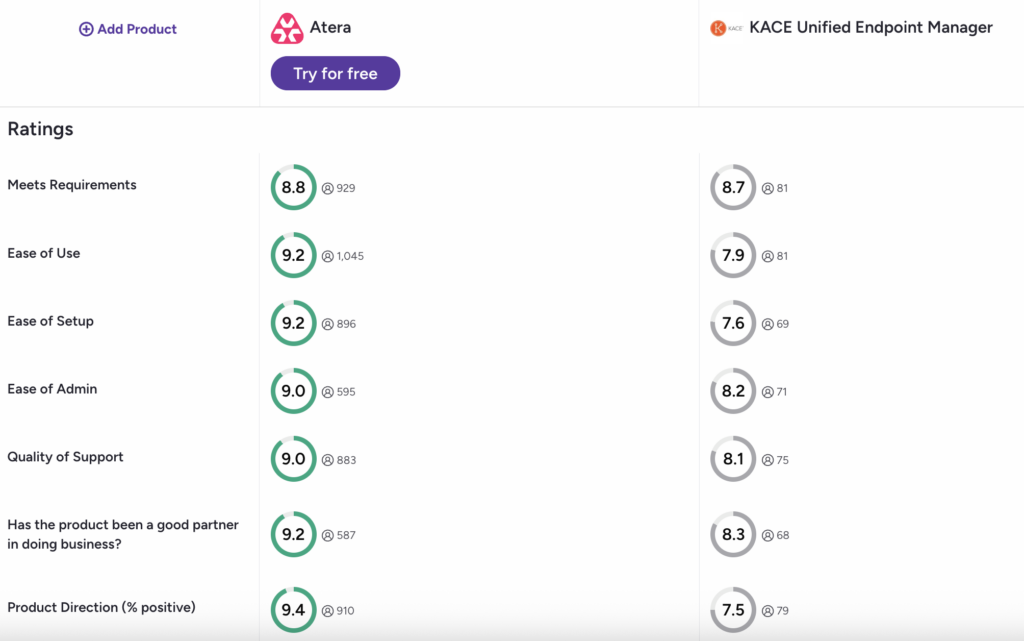
As you can see, Atera clearly has an edge across all key categories. But let’s now compare the two in more detail.
#1: Features and capabilities
Let’s start with the important one: comparing the capabilities of Atera vs. Quest KACE.
Quest KACE is a suite of endpoint management solutions designed for organizations with different needs. The four products from its suite are:
- KACE Cloud UEM: A cloud-based platform for monitoring, managing, and securing an organization’s endpoints. Deploy patches, run scripts, integrate service desk, and more.
- KACE Systems Deployment Appliance: An on-premise solution for automating the deployment of operating systems, applications, and configurations across devices.
- KACE Systems Management Appliance: An on-premise appliance for inventorying, patching, and managing endpoints across your environment.
- KACE Unified Endpoint Manager: A hybrid (on-premise/cloud) platform that combines the capabilities of the Systems Management and Deployment Appliance into one product.
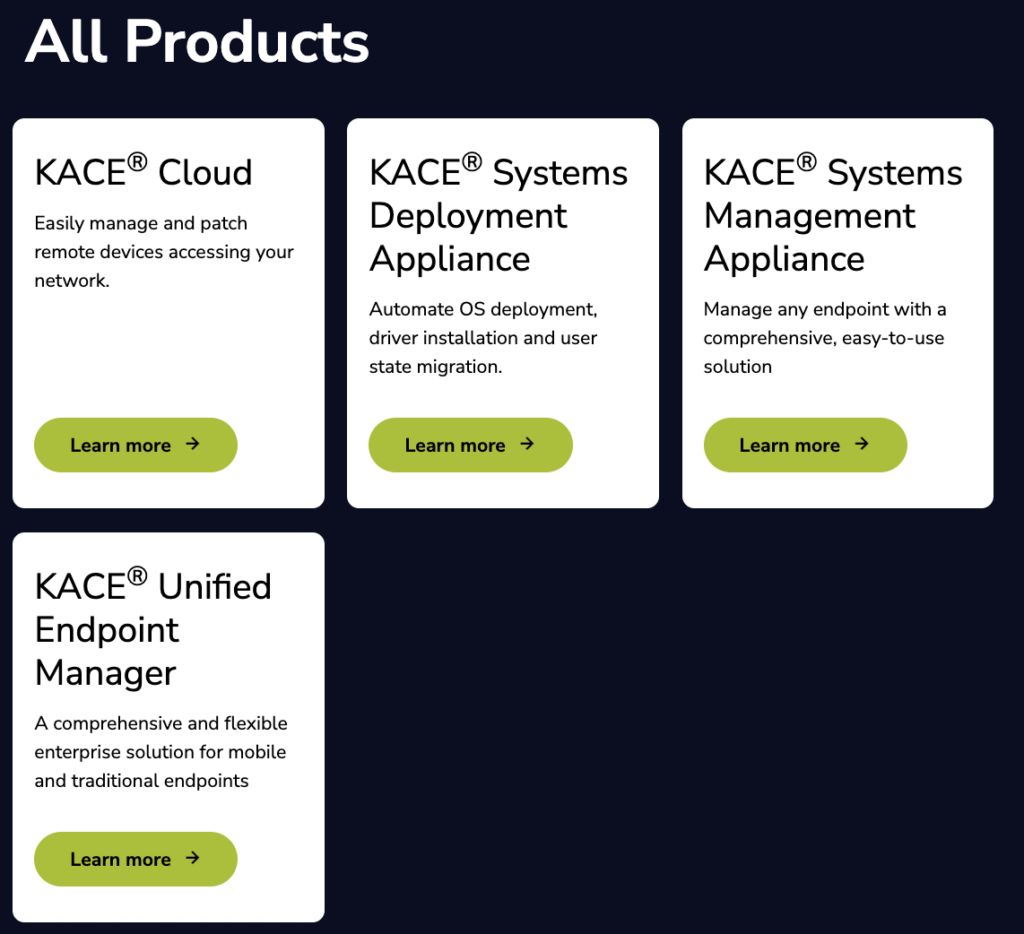
From these, KACE Cloud UEM is the closest alternative to Atera. It’s a traditional endpoint management solution with the core features: device monitoring, patching, asset tracking, reporting, and a service desk integration.
But to access the service desk, you’ll need to pay for an extra product, Kace Service Desk. Unlike with Atera, no PSA is available for MSPs, and there’s no Agentic AI for handling manual and repetitive tasks.
In comparison, Atera is an all-in-one, Agentic AI platform that covers all the essentials:
- Atera’s RMM: Monitor and secure workstations, servers, and other network devices.
- Agentic AI: Handle manual and repetitive tasks fully autonomously with Robin by Atera and AI Copilot.
- Ticketing and helpdesk: Track, organize, and resolve IT issues with Atera’s ticketing system.
- Remote access: Connect and troubleshoot devices remotely, and get remote session summaries with AI Copilot.
- Patch management: Keep Windows, Mac, and Linux devices up-to-date with the latest patches.
- Asset management and discovery: Automatically detect, track, and manage the full lifecycle of hardware and software assets on your network.
- PSA: Manage contracts, billing, SLAs, and knowledge base articles, all within Atera’s PSA tool.
Atera’s major advantage over Quest KACE is that it offers every key IT function under one product, one plan.
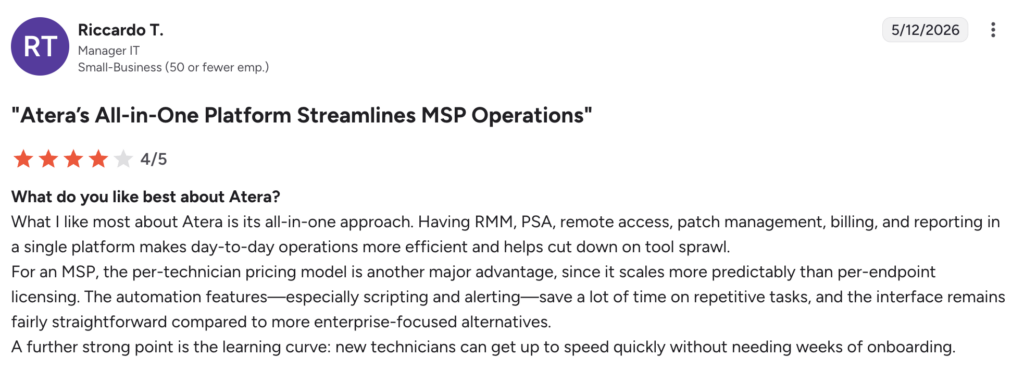
Riccardo T. liked the all-in-one aspect of Atera and said, “Having RMM, PSA, remote access, patch management, billing, and reporting in a single platform makes day-to-day operations more efficient and helps cut down on tool sprawl.”
Plus, with Agentic AI available, technicians can focus on strategic tasks that truly move the needle. More on this next.
#2: Agentic AI development
Of the two, only Atera has released Agentic AI technology, capable of eliminating manual and repetitive tasks.
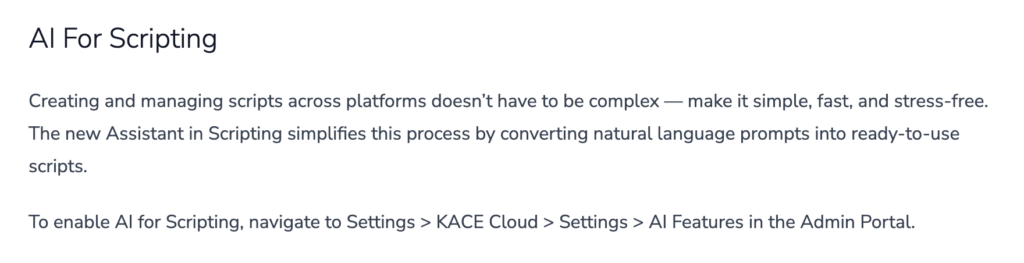
Quest KACE’s recent product release shows that they have released an AI scripting feature, but it doesn’t rely on Agentic AI technology. And other than that, no AI features are available.
In contrast, with Atera, Agentic AI is at the core of the platform, available through Robin by Atera and Atera’s AI Copilot.
Robin works in three simple steps:
1. Request intake: Robin collects requests from third-party ITSM tools, Slack, Teams, Customer Portal, email, and more. To get the full context, it detects intent and asks follow-up questions.
2. Issue resolution: Based on the issue type and company policy, Robin selects the correct resolution path. It runs actions on devices or in the cloud, including password resets, app installs, setup, and more.
3. Loop optimization: Robin closes the loop in your ITSM by updating the ticket with the resolution outcome. What’s unique, Robin detects patterns in your issue resolution and improves over time.
Atera guarantees that Robin will autonomously resolve 50% of your organization’s technical issues within 90 days, or it will waive all your fees. And over time, Robin is capable of solving up to 92% of the technical issues.
Plus, there’s AI Copilot to assist technicians, available on all Atera plans at no extra cost.
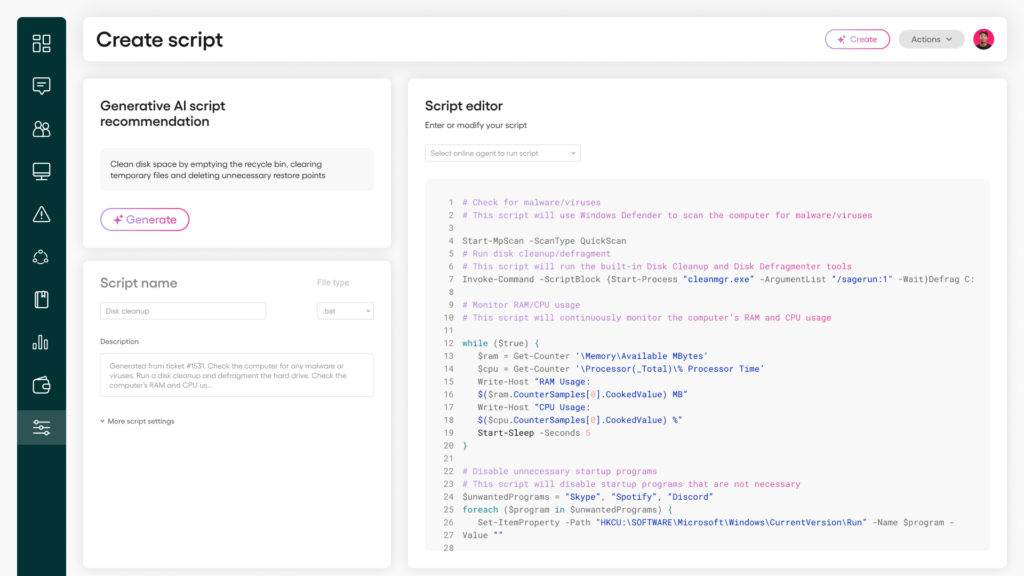
Similar to Quest KACE’s AI scripting, AI Copilot has an AI script generator, but Copilot also expands to other areas of IT, such as running health checks, summarizing tickets, generating remote session summaries, and more.
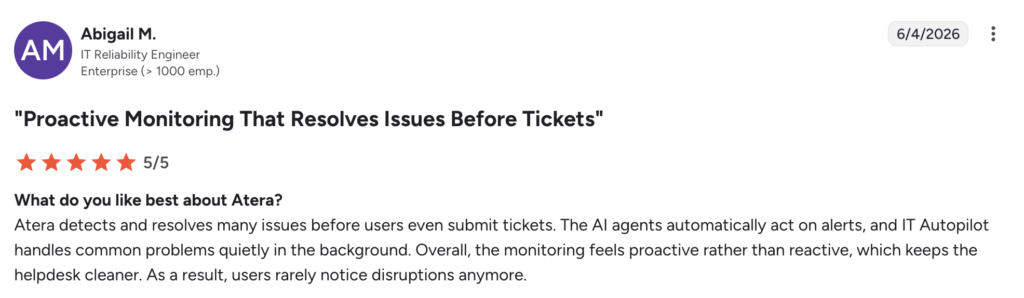
Abigail M. commented on the benefits of Atera’s Agentic AI and said:
“The AI agents automatically act on alerts, and Robin handles common problems quietly in the background. Overall, the monitoring feels proactive rather than reactive, which keeps the helpdesk cleaner. As a result, users rarely notice disruptions anymore.”
#3: Pricing and value for money
For Quest KACE, the pricing is based on a custom quotation, meaning you need to request it from their sales team.

Quest KACE pricing information
No public pricing information is available, but Reddit reviews give some clues. For Quest KACE SDA, one sysadmin mentions getting quoted $10,000/year for 200 endpoints for the first year.
With Atera, no guesswork is needed for the pricing. All of our pricing plans are publicly listed, and start from $149/month for IT departments, and $129/month for MSPs.
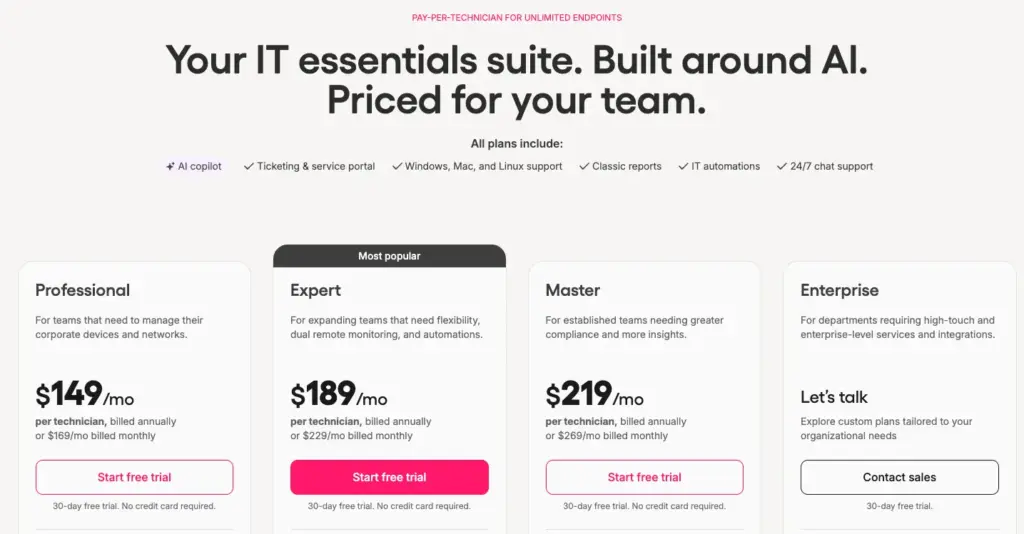
What’s unique about Atera’s pricing is that it’s pay-per-technician, meaning you can add and manage unlimited endpoints.
Riccardo T. commented on the benefit of Atera’s pricing and said, “The per-technician pricing model is another major advantage, since it scales more predictably than per-endpoint licensing.”
Plus, with Atera’s Robin and AI Copilot available for eliminating manual tasks, you’ll notice cost savings from day one.
#4: User interface and usability
The easiest way to compare usability is through real user ratings. Here’s how Atera and Quest KACE stack up across G2’s key ease of use categories:
| G2’s Ease of Use Category | 1. Atera | 2. Quest KACE |
| 1. Ease of Use | 9.2 stars (1000+ reviews) | 7.9 stars (80+ reviews) |
| 2. Ease of Setup | 9.2 stars (890+ reviews) | 7.6 stars (60+ reviews) |
| 3. Ease of Admin | 9.0 stars (590+ reviews) | 8.2 stars (70+ reviews) |
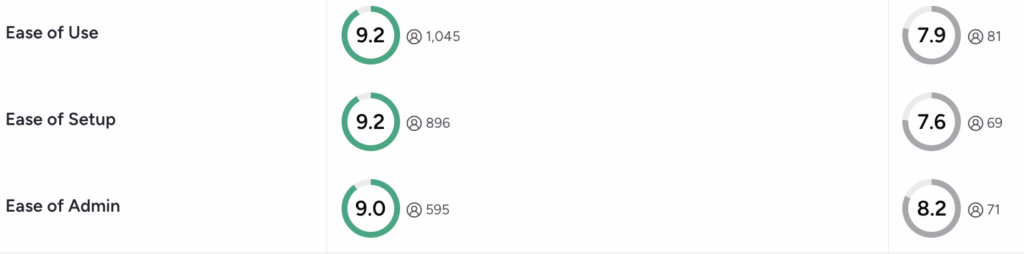
Both platforms are well-rated by users, but Atera has a clear advantage across all three categories.
This is purely thanks to Atera’s intuitive user interfaces, which make it easy for IT teams to get up and running quickly. Here’s a sneak peek into Atera’s admin dashboard:

In comparison, here’s a look at Quest KACE’s dashboard:
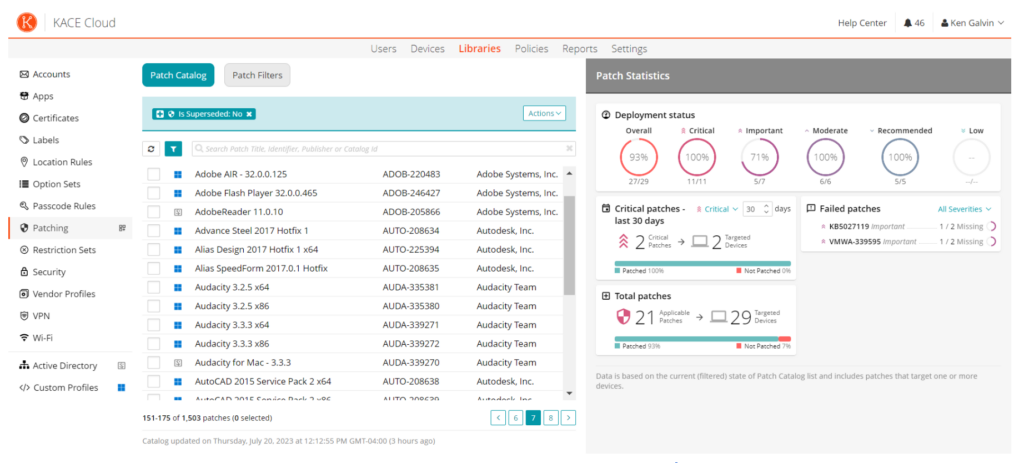
While we might be a bit biased, we truly believe most IT teams can get more value from Atera’s dashboards. And most G2 users agree with this.
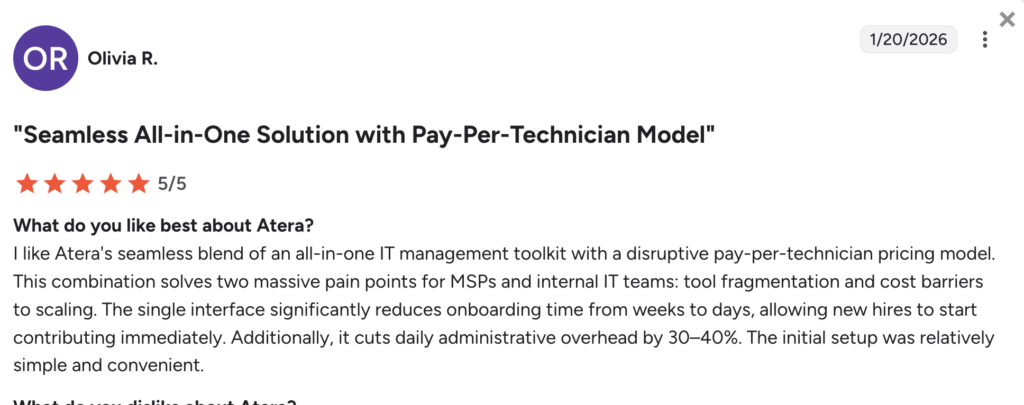
Olivia R. said, “Atera’s single interface significantly reduces onboarding time from weeks to days, allowing new hires to start contributing immediately.”
#5: Customer support and community
Quest KACE has three support levels: Standard, 24/7, and Premier.
As mentioned by them, the 24/7 and Premier support levels are paid add-ons and not available for free.
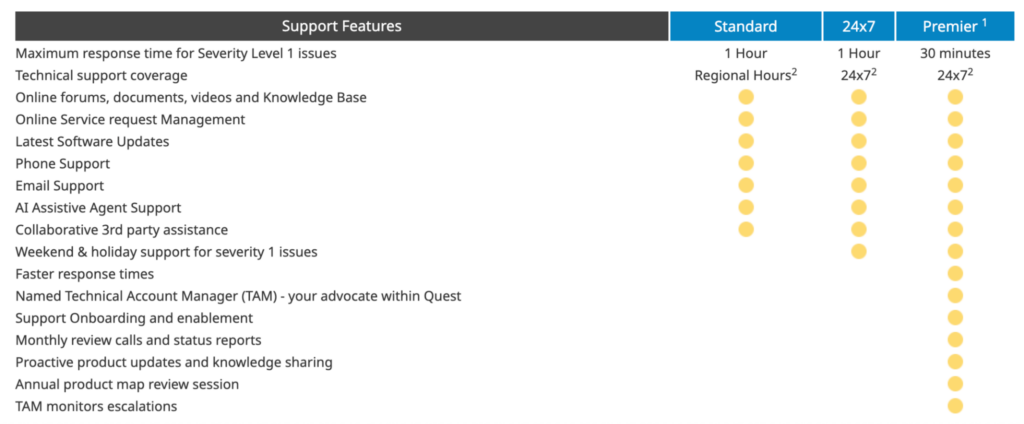
Quest KACE support information
In addition to the paid support, Quest KACE lets you reach for help through its knowledge base, online forums, documents, and videos.
In contrast, Atera offers 24/7 technical support for all users, no matter your plan, at no extra cost.
One Atera customer, Sun K., said, “Atera’s support has been good on the few occasions we needed to talk to them. They are fast and able to answer all of our questions.”
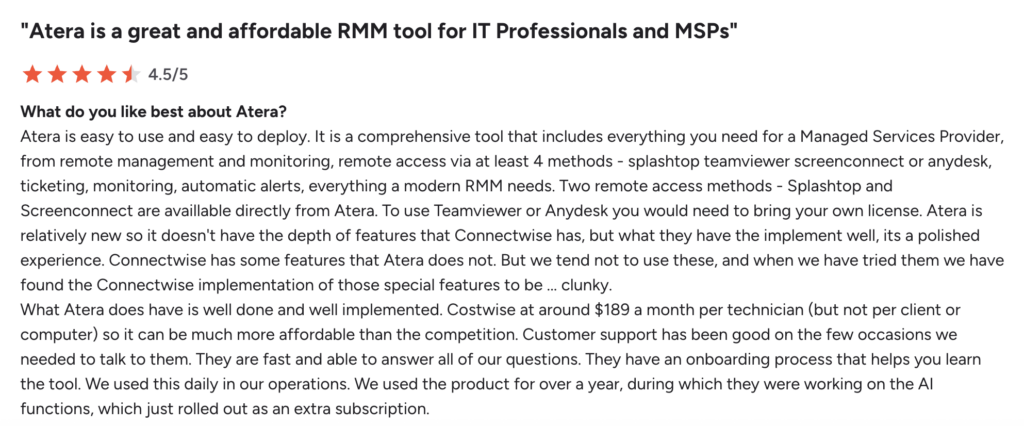
Plus, you have the option of getting help via the knowledge base, video tutorials, webinars, and Atera’s active IT community.
#6: User feedback and review
Let’s see what actual users of Atera and Quest KACE have written about the software.
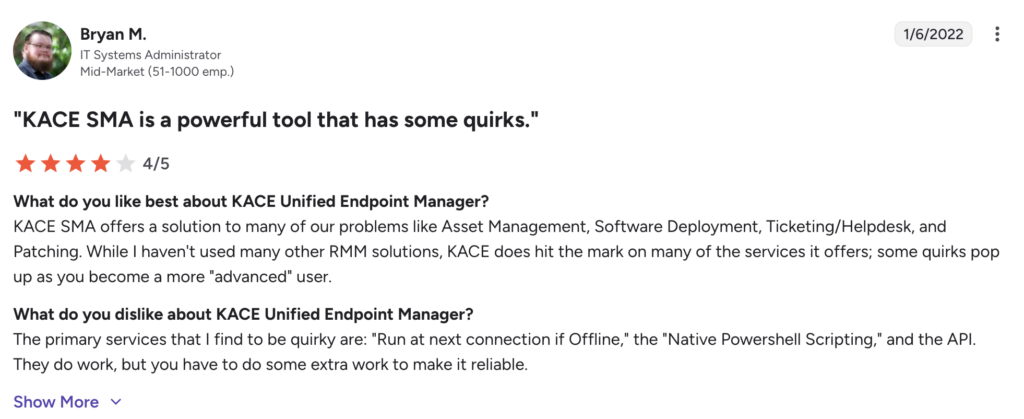
For Quest KACE, there are 95 reviews on G2, with an average rating of 4.1 out of 5.0 stars. The issue with KACE is that the latest review is from 2022, so it’s hard to get a reliable picture of how the platform holds up today.
This is what Bryan M. wrote on the latest KACE review:
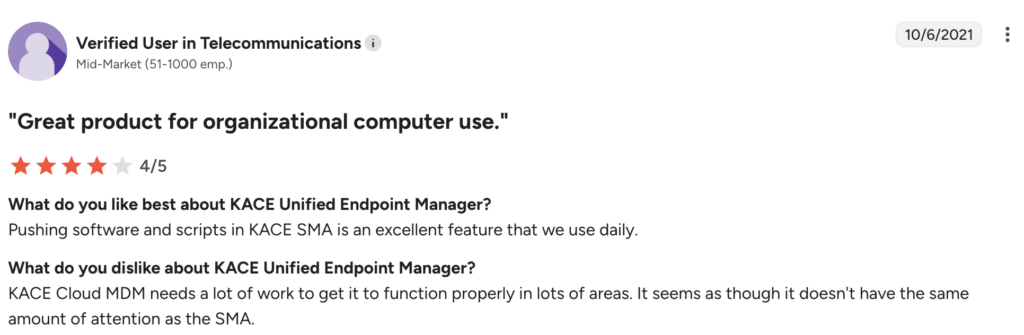
Another KACE user wrote, “Pushing software and scripts in KACE SMA is an excellent feature that we use daily.”
For Atera, there are 1100+ reviews on G2 alone, with an average rating of 4.6 out of 5.0 stars. Users often mention its ease of use, AI and automation, and all-in-one features.
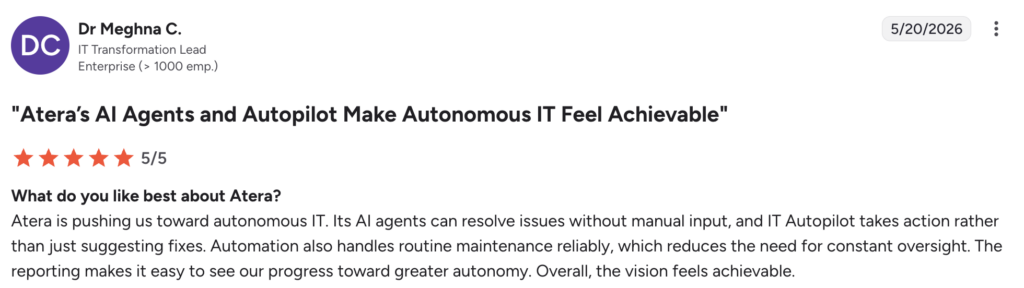
Dr Meghna C. said, “Atera is pushing us toward autonomous IT. Its AI agents can resolve issues without manual input, and Robin takes action rather than just suggesting fixes.”
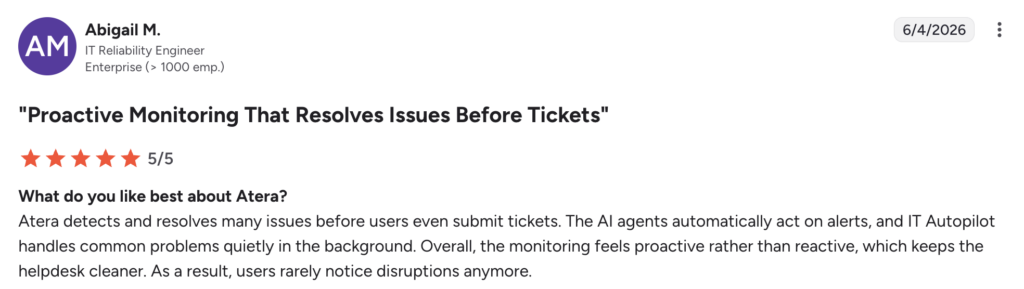
Abigail M. said, “The AI agents automatically act on alerts, and IT Robin handles common problems quietly in the background. Overall, the monitoring feels proactive rather than reactive.”
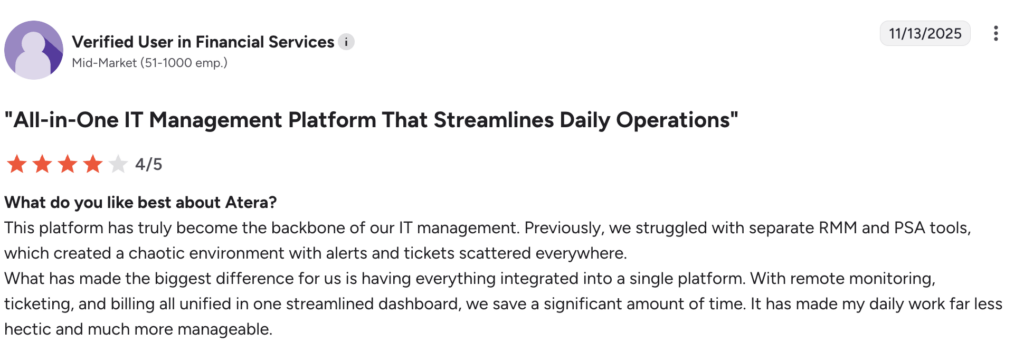
One G2 user commented on the benefits of Atera’s all-in-one feature set: “Previously, we struggled with separate RMM and PSA tools, which created a chaotic environment with alerts and tickets scattered everywhere.”
Move from automated to fully autonomous IT: Only with Atera
Atera is one of the only Quest KACE alternatives with Agentic AI technology, capable of eliminating up to 92% of technical issues over time.
With Quest KACE, most day-to-day IT tasks still fall on your technicians. Patching, scripting, ticket management, and issue resolution are largely manual processes. This is a traditional approach that works, but it keeps your technicians busy with routine work rather than higher-value tasks.
Atera changes that entirely. With Robin handling 50% of tier 1 and complex tier 2 technical tickets within 90 days, your team can shift from reactive to truly autonomous IT. If you’re ready to make that shift, start your 30-day free trial today; no credit card is required!
Frequently Asked Questions
Related Articles
Robin vs Request Resolver (Former Rovo)
Robin and Atlassian's Request Resolver (Former Rovo) both bring Autonomous IT into ITSM, but they operate at different levels. This full comparison breaks down where each one's autonomy actually reaches.
Read now
Robin vs Kaseya Intelligence
Robin by Atera and Kaseya Intelligence both talk about autonomous IT, but structure their AI technologies differently. See where each one's autonomy actually reaches and which works for your org.
Read now
Robin by Atera vs. Ivanti Neurons: comparing two very different approaches to autonomous IT
In this article, we'll compare Robin vs. Ivanti Neurons: one AI agent that resolves IT incidents end to end, and one platform that splits autonomy across two separate AI capabilities.
Read now
Robin vs Freddy AI Agent Studio
Not all agentic ITSM starts from the same place. See how Robin's deploy-ready model compares to Freddy AI Agent Studio's no-code, build-it-yourself approach.
Read nowEndless IT possibilities
Boost your productivity with Atera’s intuitive, centralized all-in-one platform