Table of contents
Generate summary with AI

Every IT team wants a management platform that’s not just powerful, but practical. Atera and Microsoft Intune are both leading IT management solutions for enterprises, but ultimately, they serve different use cases. Intune provides mainly MDM capabilities, while Atera offers an Agentic AI IT management solution for IT teams.
For IT teams navigating the complex terrain of device management, security, and operational optimization in 2026, understanding the nuanced strengths and limitations of these platforms isn’t just helpful—it’s essential.
Many Microsoft Intune users say that the lack of RMM capabilities leaves them no choice but to look for alternatives, or additional platforms to complement it, such as Atera. In fact, RMM is one area where Intune and Atera differ, but the list of differences doesn’t end there.
Below, we will review each product’s features, user interfaces, performance, pricing, security, and user feedback.
Atera vs. Microsoft Intune: A brief overview
For a brief comparison of Atera and Microsoft Intune, we created this overview table:
| Atera Features | Microsoft Intune Features | ||
| – Autonomous IT tool with built-in RMM, remote access, network discovery, and documentation – Patch management for Windows, macOS, and Linux devices – Asset management to track the lifecycle of IT assets – Agentic AI (Includes Robin, AI Copilot, AI-powered troubleshooting, scripting, ticketing, and more) – PSA for MSPs to track contracts, billing, SLAs, and more | – Endpoint management – Endpoint security (Cyber threat detection and remediation) – Mobile application management – Endpoint health metrics – Add-ons (Remote access, firmware updates, advanced analytics, and more) | ||
| Customer support | Customer support | ||
| – 24/7 email and live chat support for all customers – An extensive knowledge base, IT community, and tutorials | – Intune users can file an online support ticket from the dashboard – Extensive online documentation is available – 24/7 or live support appears to be nonexistent | ||
| Integrations | Integrations | ||
| – Integrations with 25+ cybersecurity, automation, backup, remote access, and network monitoring software – Integrations with 50+ ITSM, identity provider, CRM, office suite, and more for Robin – Access to 5,000+ apps through Zapier | – Integrations with other Microsoft products, such as Azure and Teams, as well as with third-party tools, like Asana | ||
| Pricing | Pricing | ||
| – Transparent pay-per-technician pricing, starting from $129/month – 30-day free trial available | – Pay-per-user/device pricing with different add-ons – 30-day free trial available |
Using G2 to compare Atera and Microsoft Intune, we can see that Atera beats Intune in most categories, including ease of setup, support quality, and more.
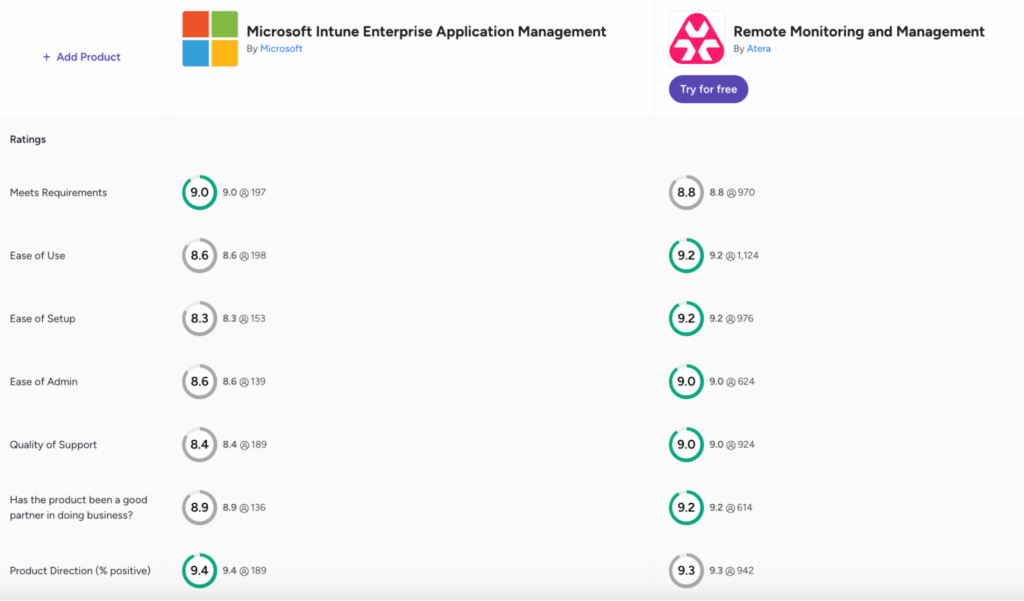
You can access the full G2 comparison here.
#1: Features and capabilities
Atera and Intune are both IT management tools, but they serve different purposes.
The main difference between Atera and Intune is that Atera is an autonomous IT platform with features like RMM, patch management, and network monitoring, all backed up with its autonomous IT agents.
In comparison, Intune is more traditional endpoint management software focused on security and compliance within the Microsoft ecosystem.
Here is a better look at Atera’s key features:
- RMM – for remotely monitoring and managing endpoints, such as workstations, network devices, servers, and other SNMP-enabled devices.
- Agentic AI – Atera is an agentic AI platform that helps resolve issues with two AI agents: Robin by Atera and AI Copilot. Robin is capable of solving up to 92% of IT incidents, while Copilot is there to assist technicians with device troubleshooting.
- Patch management – for keeping Windows, Linux, and Mac devices, as well as third-party applications, up-to-date.
- Remote access – for troubleshooting and accessing devices remotely.
- Network Discovery – Atera add-on for mapping out all devices within your network and staying on top of security risks.
- Ticketing – for handling end-user support requests. Atera’s AI-powered ticketing helps to automate this.
- PSA – for setting up contracts and billing, creating knowledge-base articles, setting up customer portals, and managing SLAs.
While Intune offers comparable capabilities, most of its features revolve around mobile device management (MDM). And the truth is that RMM can often replace MDM, but not the other way around, which is why Intune users often need to use separate RMM software on the side, like Atera.
Microsoft Intune offers native patch management for Windows and macOS devices, with Linux support still limited. It doesn’t natively support third-party app patching on any platform. Its remote access tool, Remote Help, now reaches Windows, macOS, and Android, though Windows still gets the broadest feature set.
Atera also offers industry-leading patch management for Windows, Mac, and Linux devices and remote access for the same OS.
Another key difference between the two platforms? The Agentic AI capabilities, which we’ll have a look at next.
#2: Agentic AI development
Of Atera and Intune, only Atera offers a true Agentic AI technology.
Microsoft first launched Copilot in Intune back in 2024 as a conversational, IT-admin assistant for Intune, and it reached public availability in November 2025. It answers and suggests, but doesn’t act. Since then, Microsoft introduced Intune’s Security Copilot Agents in preview at Ignite in November 2025, roughly six months after Robin’s May 2025 launch.
Intune’s agents can be categorized into two groups:
- Copilot in Intune: a conversational assistant (similar to Atera’s AI Copilot) that’s embedded in the dashboard for admin-facing device troubleshooting.
- The three Security Copilot Agents: three scenario-specific agents, the ‘Change Review’ agent (monitors approval and change requests), the ‘Policy Configuration’ agent (turns plain instructions into recommended policy settings), and the ‘Vulnerability Remediation’ agent (prioritizes Defender-sourced vulnerabilities for remediation). Per Microsoft’s own docs, Intune’s fourth agent for device offboarding was retired in June 2026.
Microsoft also says “similar agents are available across other Microsoft security products, like Entra and Defender.”
While Microsoft’s agents have their place, every one of them stops before taking action, meaning they’re not fully autonomous – the difference between generative and Agentic AI.
In contrast, Atera’s Robin is a fully autonomous IT agent that not only assists but resolves issues end-to-end directly on the device, network, or in the cloud.
Here’s the four-step process Robin uses for solving issues:
- Diagnose: Robin receives the request through Teams, Slack, email, the Atera Customer Portal, or third-party ITSM tools, verifies the user against identity providers like Okta, Azure AD, or Google, and asks follow-up questions to gather full context.
- Remediate: Robin takes the approved action directly on the device, network, or in the cloud, routing for approval only when a step requires it.
- Verify: Robin confirms the issue is actually resolved before closing anything.
- Close: Robin updates the ticket in your existing ITSM with the outcome and next steps, logging every request, action, approval, and outcome for governance and compliance.
If Robin can’t solve something, it smartly escalates the ticket to a human technician, with full context of the problem.
The ROI for Robin is backed by an independent, Forrester-commissioned TEI study: a composite 2,500-employee organization saw a 321% return over three years, $5.5 million in net present value, and payback in under six months.
Intune has its own Forrester-commissioned TEI study: an organization saw a 181% ROI over three years and net present value of $11.36 million. That figure covers the broader Intune platform rather than agent deployment.
Atera also offers its AI Copilot. It works alongside techs, expanding their human expertise and capabilities. Whether it’s troubleshooting device issues, generating scripts, handling tickets, or responding to tickets, Copilot is your trusty IT companion, ready to help instantly.
To future-proof your IT with Agentic AI, Atera is a better fit for enterprises looking to incorporate AI for IT.
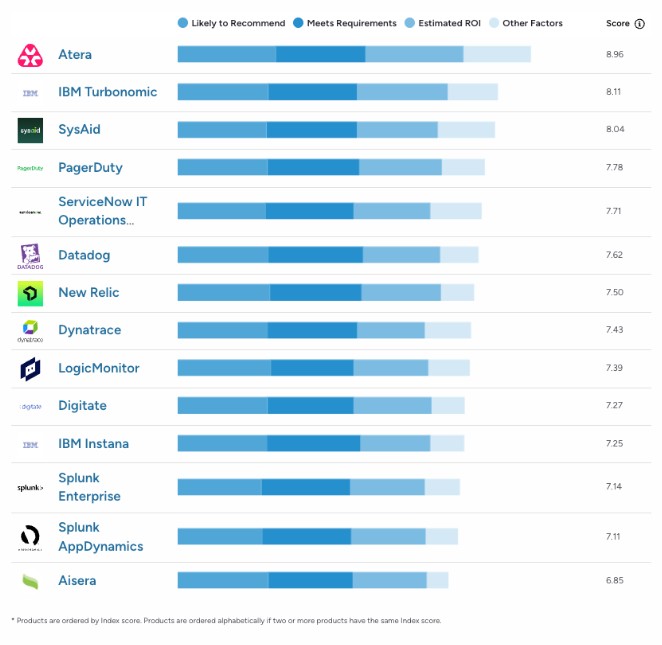
G2 even selected Atera as the #1 best AIOps tool for summer 2026, which is a testament to the impact our AI agents are having on organizations.
#3: User interface and usability
Let’s continue with an important factor: the user interface and usability of Atera and Microsoft Intune.
Based on G2’s comparison, this is how real users have rated the ease of use scores of both Atera and Microsoft Intune.
| G2’s Ease of Use Category | Atera | Microsoft Intune |
| 1. Ease of Use | 9.2 stars (1,100+ reviews) | 8.6 stars (190+ reviews) |
| 2. Ease of Admin | 9.2 stars (970+ reviews) | 8.3 stars (150+ reviews) |
| 3. Ease of Setup | 9.0 stars (620+ reviews) | 8.6 stars (130+ reviews) |
Both platforms have strong reviews, but Atera has a noticeable edge in all ease of use categories.
With intuitive user interfaces and accessible data, Atera saves IT teams time and reduces stress and vendor fatigue each and every day.

Atera’s admin dashboard
Atera’s different features, such as RMM, ticketing, Network Discovery, and AI agents, can be navigated easily from our admin interface.
In comparison, Intune has mostly received positive feedback on its admin interface, although some users report that setting it up for the first time can be difficult.
For comparison, here’s a look at Microsoft Intune’s admin dashboard:

Microsoft Intune admin dashboard (via Microsoft)
A majority of G2 reviewers agree that Atera’s platform is more user-friendly than Intune’s, as users have rated Atera higher than Intune in terms of ease of use, ease of setup, and ease of admin, which all indicate a better user experience.
#4: Performance and reliability
Reliability is a top priority in the IT field, and both Atera and Microsoft Intune are generally known for being dependable. Atera’s reliability is bolstered by our 24/7 live chat support and dedicated users within our IT community, who are always available to help troubleshoot should things go awry.
Intune has generally received positive reviews regarding reliability, but it has been criticized for lacking basic features, especially for Mac devices, which can affect platform reliability and performance. In addition, Intune doesn’t offer real-time live chat support for its customers.
#5: Pricing and value for money
Both Atera and Intune charge users per technician/user. However, a closer look at the pricing reveals some significant differences.
Atera’s IT department pricing ranges from $149 to $219 per month, and the MSP pricing plans range from $129 to $209 per month. Enterprises can request a custom quotation for more personalized services.
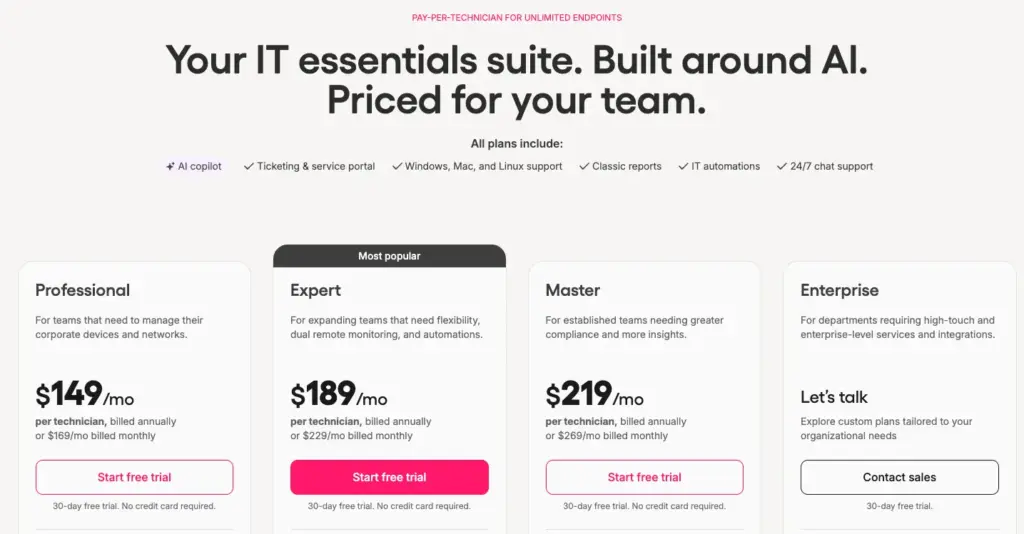
Atera’s pricing plans
In comparison, Intune has three different pricing plans: Intune Plan 1 ($8/user/month), Intune Plan 2 ($4/user/month), and the Intune Suite ($10/user/month add-on) for add-ons like Remote Help, Endpoint Privilege Management, and Cloud PKI.

Microsoft Intune’s pricing plans
As of summer 2026, Microsoft 365 E5 includes the full Intune Suite at no extra cost. E3 gets a smaller slice (Plan 2, Remote Help, Advanced Analytics) but not the rest. The change came alongside a Microsoft 365 price hike.
Microsoft Intune’s pricing plans seem affordable on the surface, but each user is only allowed to enroll up to 15 devices. This means you’ll most likely need to purchase multiple licenses to manage your entire IT environment. Plus, the different add-ons drive up the cost.
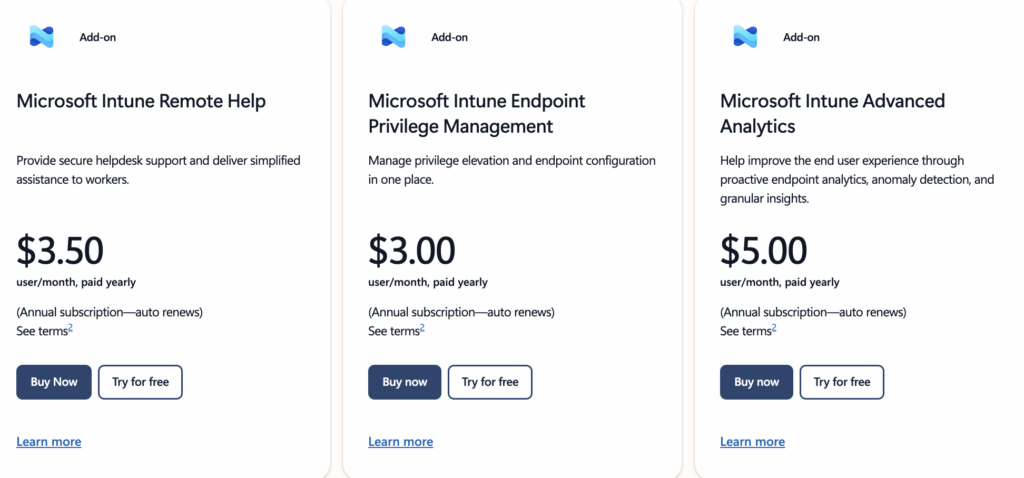
Microsoft Intune has a pay-per-device model for enterprises, but they don’t provide much information about it publicly.
With Atera, you don’t have to worry about hidden costs or extra charges, as all of our pricing plans are transparent. Plus, with per-technician pricing, you can manage unlimited devices/endpoints at no additional cost, which is a huge benefit for our users.
#6: Customer support and community
As any IT professional knows, we all need help sometimes. At Atera, we strive to provide just that – in numerous formats and options to meet your unique needs.
Atera offers 24/7 live chat and email technical support for all users, which Intune simply can’t match up with. All Atera users can easily get in touch with our support team from the admin dashboard.
With Microsoft Intune, the only way to contact technical support is to file an online support ticket. There isn’t much information available on how long it takes to get a response from their team, but customer reviews give us some clues.
Unfortunately, many Intune users state that getting a response from their support team takes a long time, such as discussed in this Reddit thread.
Both Atera and Microsoft Intune provide customers with self-serve resources, including knowledge bases, webinars, and blogs. At Atera, our extensive knowledge base has received significant praise from customers.
Both platforms also have IT communities. If you decide to choose Atera, we’re delighted to have you as part of our active IT community, where you can troubleshoot issues and share best practices with other IT professionals.
#7: Security and compliance
Microsoft Intune is perhaps best known for its security and compliance capabilities within the Microsoft ecosystem. From Intune’s dashboard, you can see device compliance at a high level and drill down to specific devices to see which compliance policies aren’t being met.
From the same page, you can remediate issues for a device, such as restarting it or starting to scan for malware. Intune integrates with Microsoft Defender for additional endpoint security.
At Atera, we similarly hold cybersecurity and network protection in high regard. We offer smart logging and reporting, and prioritize adhering to industry standards (e.g., MFA, HIPAA, and SOC 2). In addition to our logging and reporting, Atera’s real-time monitoring and alerts help your team discover and respond to issues before they escalate.
We believe in proactive IT rather than reactive IT, which means giving you the tools you need to keep your IT ecosystem secure at all times. Autonomous patch management, world-class security integrations, and industry compliance are at the core of our commitment to cybersecurity.
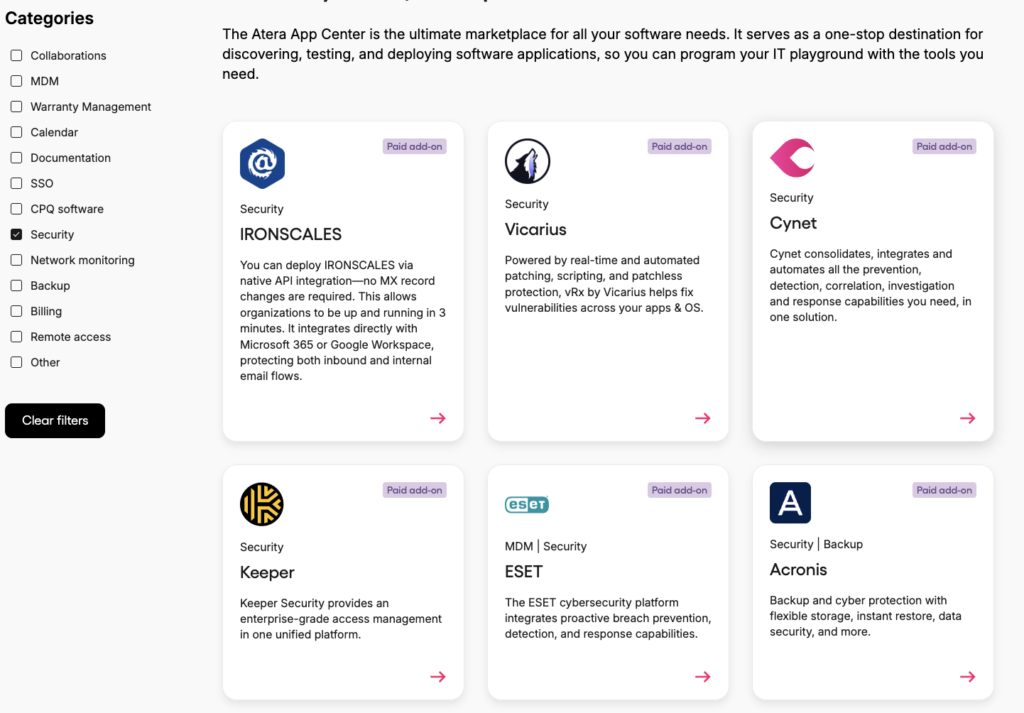
Atera integrates with security products, including Bitdefender, ThreatDown, Webroot, Emsisoft, ESET, Keeper, and Cynet, enabling enterprises to secure their IT environments further.
Plus, Atera takes AI security for Robin seriously. Robin operates under Atera’s certification to ISO 42001, which is the standard for AI management systems. With Robin, human approval is required before any high-risk action is taken, and full audit logs are kept of everything it does.
#8: User feedback and reviews
Across G2 and Capterra, Atera has received over 1,200+ reviews with an average rating of 4.6 out of 5.0 stars, while Intune has received 250+ reviews with an average rating of 4.5 out of 5.0 stars.
It’s clear that both platforms are loved by their users, but mainly for different reasons.
Atera users love the platform’s advanced RMM, per-technician pricing, and built-in AI capabilities, which enhance technician efficiency by 10X.
One Atera user on G2 said simply: “The AI agent, Robin, has been a game changer for reducing repetitive help desk work.”
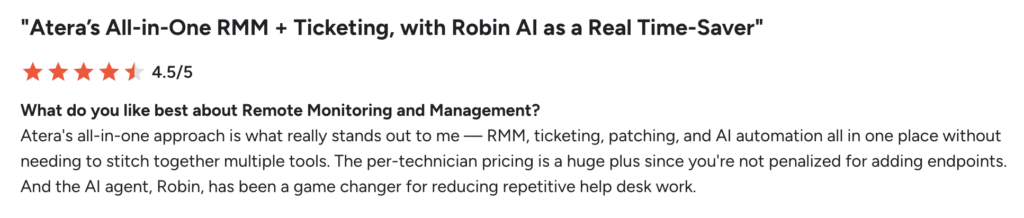
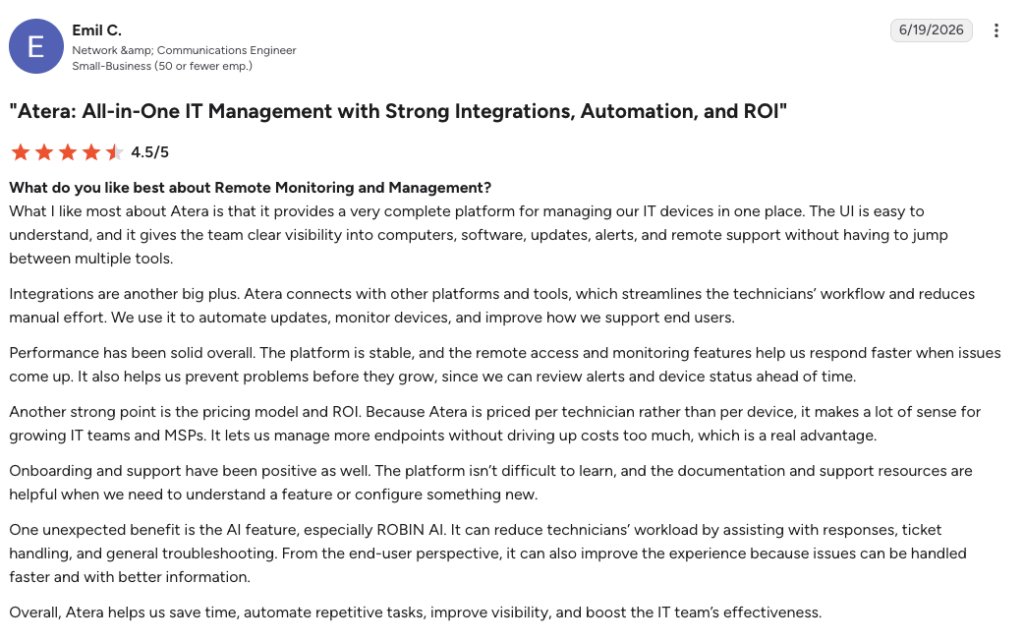
Another G2 user, Emil C., left a longer review, mentioning Robin, Atera’s UI and features, performance, integrations, pricing, ROI, and more:
In comparison, Intune users mainly appreciate the platform’s device and app management capabilities. One G2 user said, “If you are already invested in any other 365 products, Intune gives native compatibility.”
On the other hand, Intune has been criticized for not being highly compatible with tools outside of the Microsoft environment and having a narrow app catalog for patching. One G2 user said this:

Future-fit your IT capabilities with Atera’s AI-powered platform
Now that you know more about Atera and Microsoft Intune, you might wonder which is the best platform for you.
This is what we suggest:
Intune might be a good fit if you’re looking specifically for MDM capabilities within the Microsoft ecosystem. If you’re looking for an autonomous IT platform to manage your entire IT infrastructure, Atera can’t be beat.
To future-proof your IT, Atera’s platform is powered by Agentic AI, which expands across the entire platform and solves up to 92% of your IT incidents. Whether you’re handling tickets, troubleshooting devices, or generating scripts, Atera’s AI agents are ready to assist you in real time.
To see how Atera can help, contact our sales team for a custom demo or sign up for Atera’s 30-day free trial!
Related Articles
Robin vs Request Resolver (Former Rovo)
Robin and Atlassian's Request Resolver (Former Rovo) both bring Autonomous IT into ITSM, but they operate at different levels. This full comparison breaks down where each one's autonomy actually reaches.
Read now
Robin vs Kaseya Intelligence
Robin by Atera and Kaseya Intelligence both talk about autonomous IT, but structure their AI technologies differently. See where each one's autonomy actually reaches and which works for your org.
Read now
Robin by Atera vs. Ivanti Neurons: comparing two very different approaches to autonomous IT
In this article, we'll compare Robin vs. Ivanti Neurons: one AI agent that resolves IT incidents end to end, and one platform that splits autonomy across two separate AI capabilities.
Read now
Robin vs Freddy AI Agent Studio
Not all agentic ITSM starts from the same place. See how Robin's deploy-ready model compares to Freddy AI Agent Studio's no-code, build-it-yourself approach.
Read nowEndless IT possibilities
Boost your productivity with Atera’s intuitive, centralized all-in-one platform