Generate summary with AI

IT professionals rely on monitoring tools to ensure secure and high-performing networks. Simple Network Management Protocol (SNMP) monitoring software has become a crucial part of this toolkit.
The best SNMP monitoring software enables real-time monitoring of SNMP-enabled devices, proactive management, and quick issue resolution.
There are many SNMP monitoring software available, some offering SNMP capabilities only and others providing all-in-one IT management. The vast number of solutions makes it difficult to choose a suitable one, and that is why we wrote this article.
In this article, we will look at what SNMP monitoring software is, the different types available, why you should use one, and list the best SNMP monitoring software. If this sounds interesting to you, keep on reading.
The 7 best SNMP monitoring software in 2026 for effective device management
- Atera – Best all-in-one SNMP monitoring tool for IT teams
- SolarWinds NPM – Suitable for advanced network performance monitoring
- SysAid – Specialized for SNMP monitoring with built-in ITSM features
- Domotz – Suitable for easy-to-deploy SNMP monitoring
- LogicMonitor – Suitable for hybrid infrastructure SNMP monitoring
- Zabbix – A functional scalable open-source SNMP monitoring tool
- Datadog – Suitable for cloud-native SNMP monitoring and observability
1. Atera – Best all-in-one SNMP monitoring tool for IT teams

1. SNMP monitoring: Atera offers SNMP monitoring capabilities as part of its autonomous IT platform. With Atera, you can monitor SNMP-enabled devices, including printers, routers, switches, servers, workstations, and devices connected to the Internet of Things (IoT). In addition, you can monitor workstations, servers, and other network devices.
Atera’s monitoring tool gathers critical information about SNMP devices, such as CPU usage, bandwidth consumption, packet errors, device temperature, and uptime status, and notifies users when abnormalities are detected.
2. AI capabilities: One of Atera’s unique advantages is its Agentic AI technology, available through Robin by Atera and AI Copilot. While Robin resolves up to 92% of Tier-1 and complex Tier-2 requests autonomously, AI Copilot is there to assist technicians in resolving manual and repetitive tasks.
Copilot’s AI-powered OID recommendations make it easier to identify and implement the optimal object identifiers, and the insights on demand help you better understand your IT environment.
3. Third-party integrations: To extend its capabilities, Atera offers various third-party integrations with tools such as Domotz, Cynet, Keeper, Zomentum, AnyDesk, Acronis, and more. For MSPs, QuickBooks and Xero integrations are also available.
Atera also has the added benefit of its 50+ integrations for Robin. It integrates with different identity providers, ITSM, and SaaS apps, meaning you don’t need to switch tools to take advantage of it.
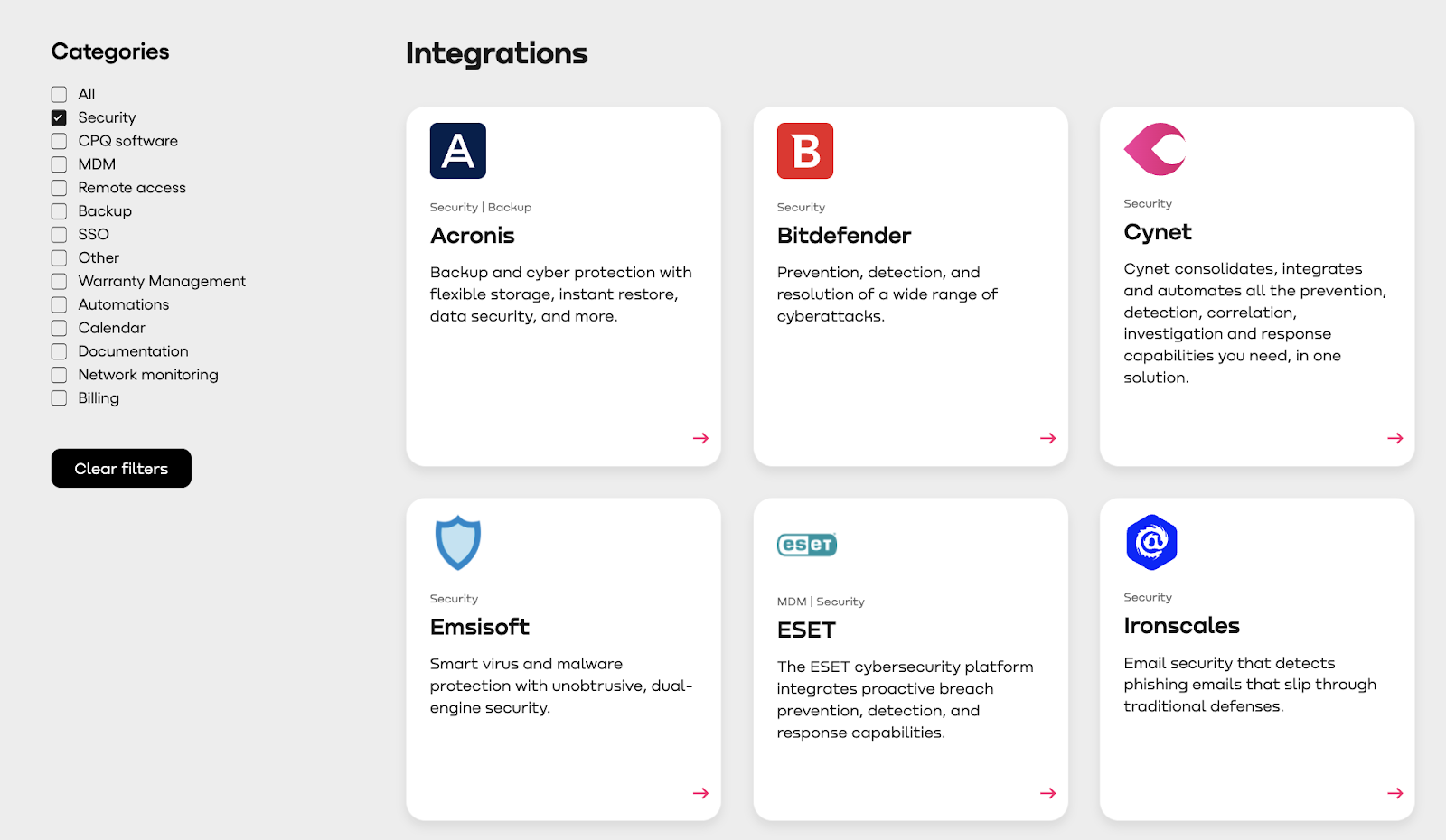
Many of Atera’s integrations, such as for Splashtop and AnyDesk for remote access, are included in the standard plans.
Tip: Read more about Atera’s SNMP-monitoring capabilities here.
Features and capabilities
Remote monitoring of SNMP and other devices is only one feature Atera’s platform. Atera also includes:
- Real-time monitoring and alerting
- Autonomous patch management
- Reporting and analytics
- Helpdesk and ticketing
- Network Discovery
- Remote access
- Professional services automation (PSA)
- AI agents
Let’s take a closer look at one of these features: Atera’s AI agents.
Robin by Atera and Atera’s AI Copilot are two AI agents built into the platform, each designed for a different use case.
Robin is an autonomous IT agent for end-user support. When someone reports an issue through Slack, Email, Teams, the Customer Portal, or third-party ITSM tools, Robin is there to fix the issue. It reaches directly to the device, network, or the cloud and executes the fix there, all without technician involvement. For network issues, Robin can:
- Check Wi-Fi and IP details
- Test DNS resolution and flush the DNS cache
- Reset a network adapter or renew an IP address
- Isolate whether a fault sits with the device, the adapter, DNS, or a proxy
Robin resolves up to 92% of Tier-1 and complex Tier-2 technical incidents autonomously, with an average resolution time of 120 seconds.
When an issue requires human attention, Robin automatically escalates it with full context involved. This is where AI Copilot comes in handy.
AI Copilot is available from anywhere within the platform, and it learns about your IT environment in real time. You can ask it account-specific questions and receive actionable insights to questions, such as:
- “Which SNMP devices in my network are experiencing high CPU usage?”
- “Are there any switches or routers with a high rate of packet errors?”
Especially useful for enterprises, the AI Filters feature helps to locate specific devices. For example, you could tell the AI Copilot to “show all SNMP devices with packet errors over the past week” or “find routers with CPU usage above 90% in the last 24 hours.”
Atera’s AI capabilities are truly a unique feature in the best SNMP monitoring software market, making it a stand-out option from the competition.
User interface and usability
Atera takes great care in designing user interfaces and dashboards that are intuitive to navigate and require less ramp-up time.
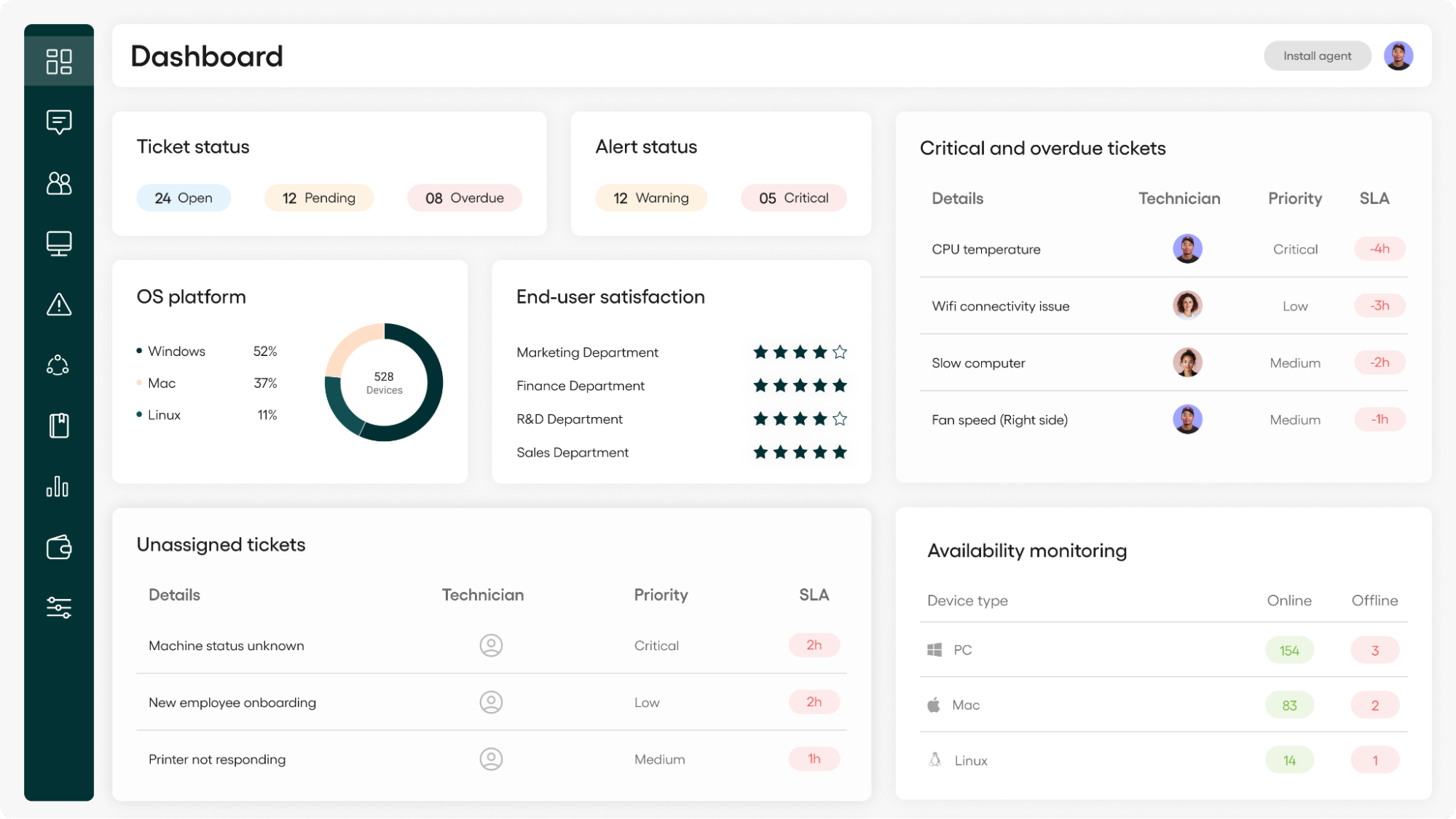
Atera admin dashboard
Atera’s users agree on the platform’s ease of use and intuitiveness, as it has won a G2 award for both ease of use and implementation.
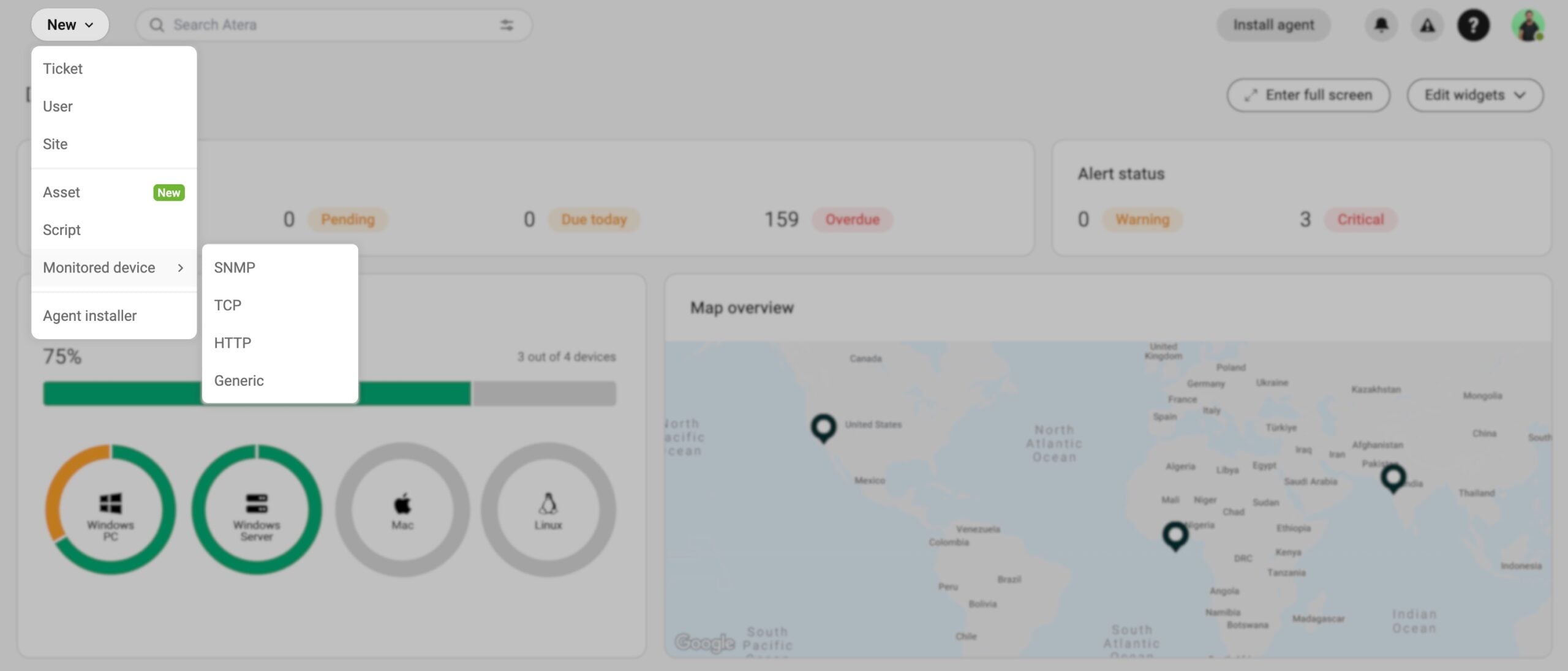
To add SNMP-enabled devices to Atera, you simply need to click the ‘New’ dropdown and then click SNMP:
Once the SNMP device is added, you will be automatically diverted to the new SNMP device page:
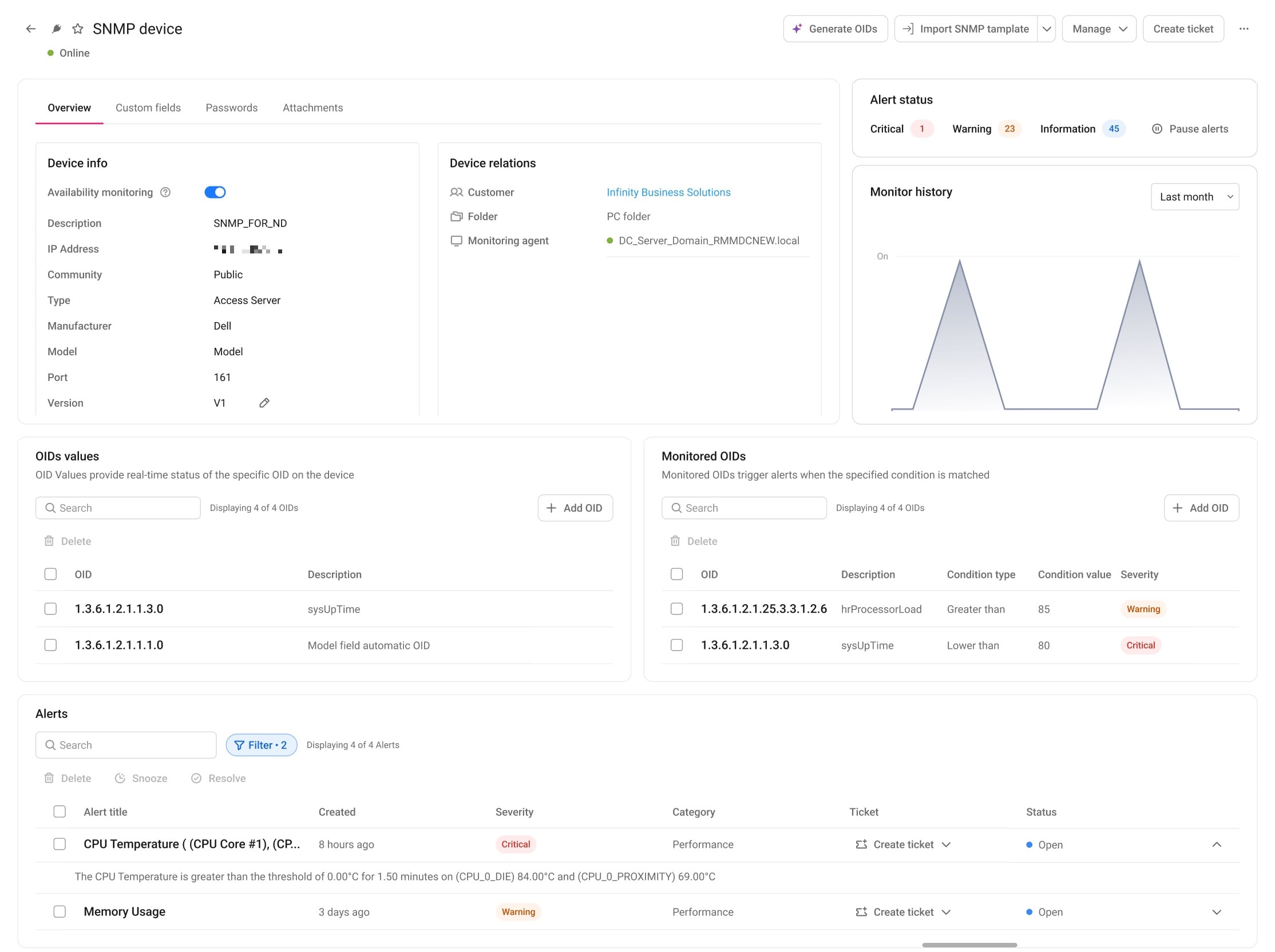
After setting up the device page, you can add and monitor Object Identifiers (OIDs), which are used to identify parameters for monitoring purposes. Atera’s AI capabilities assist with this, as we already discussed above.
Whenever you need assistance, Atera offers 24/7 live chat support for all customers. You can also find numerous self-help documents, including Atera’s extensive help center, active IT community, webinars, and numerous blog posts.
Pricing and value for money
Unlike most SNMP and RMM pricing plans, Atera offers transparent pay-per-technician pricing.
For IT departments, Atera’s pricing ranges from $149/month to $219/month, and for MSPs, from $129/month to $209/month. Enterprise clients can receive a custom quotation for more tailored services.

Often, SNMP monitoring software is priced per endpoint, which means that the price increases as more endpoints/devices are added to the platform. One of Atera’s standout offerings is its pay-per-technician pricing, which means you pay a fixed price no matter how many endpoints you add.
Atera pricing:
Atera’s pricing plans for IT departments:
- Professional: $149 per month, per technician
- Expert: $189 per month, per technician
- Master: $219 per month, per technician
- Enterprise: Custom quotation. Contact sales for pricing.
Atera’s pricing plans for MSPs:
- Pro: $129 per month, per technician
- Growth: $159 per month, per technician
- Power: $209 per month, per technician
- Superpower (Enterprise): Custom quotation. Contact sales for pricing.
Get started with Atera on a 30-day free trial with no credit card required.
Customer reviews and rating
Atera G2 rating: 4.6 out of 5.0 stars (800+ reviews)
What Atera users are saying on G2:
- “The most helpful of using Atera is that you have both RMM and PSA in one platform, and also the AI capabilities with Copilot and Robin,” Alan S. says.
- “One unexpected benefit is the AI feature, especially Robin. It can reduce technicians’ workload by assisting with responses, ticket handling, and general troubleshooting,” Emil C. says.
Atera Capterra rating: 4.6 out of 5.0 stars (400+ reviews)
What Atera users are saying on Capterra:
- “It helped to bring order to regular IT tickets and allowed me to keep track of which tasks have already been done and which require additional work,” Joanne R. says.
- “The ticketing and monitoring features are useful for keeping issues organized, while patch management helps reduce the amount of manual follow-up needed,” Stacie B. says.
2. SolarWinds NPM – Best for advanced network performance monitoring
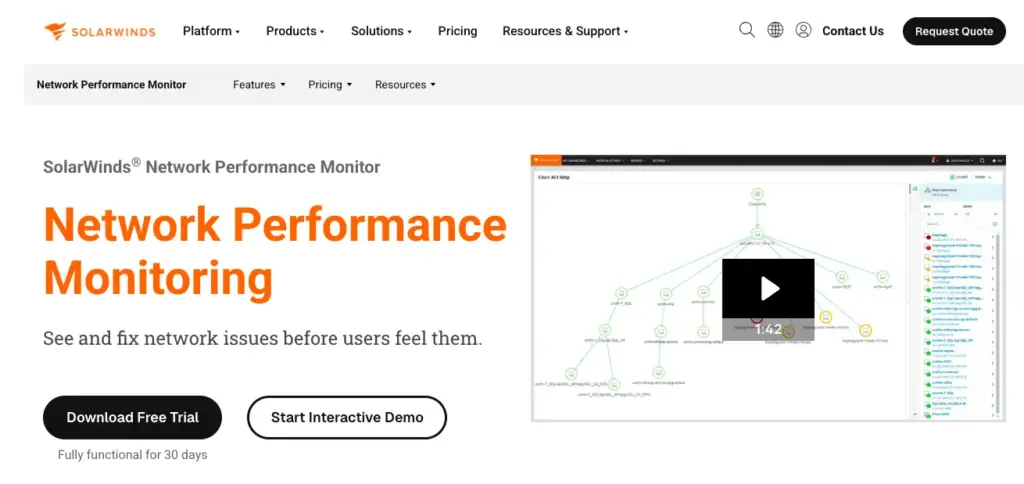
SolarWinds Network Performance Monitor (NPM) provides insights into the health and performance of networks. SNMP is one of NPM’s data polling methods for obtaining performance metrics from network devices such as firewalls, switches, and routers.
It provides insights into valuable network statistics, such as network latency, packet loss, response time, throughput, CPU memory utilization, and more. From SolarWinds NPM’s web console, you can configure alerts and view reports to understand your network health. SolarWinds has also entered the agentic AI space with its AI agents, aimed at helping organizations help resolve incidents faster.
G2 Rating: 4.3 out of 5.0 stars (870+ reviews)
Capterra Rating: 4.5 out of 5.0 stars (75+ reviews)
SolarWinds NPM Pricing:
- Subscription-based, starting at $7 per node per month. Visit their website for an exact quote.
3. SysAid – Best for SNMP monitoring with built-in ITSM features
SysAid is a decent solution for SNMP monitoring with built-in ITSM. It offers SNMP device management, so you can proactively monitor your clients’ computers and SNMP assets. To discover your SNMP devices, you can run a network scan, which gives you a complete picture of your network.
SysAid detects specific incidents in real time, and users can receive problem alerts via email or SMS. The SNMP monitoring system is paired with ITSM tools, including a ticketing system, self-service portal, and workflow automation. On the ITSM side, SysAid also offers AI features such as SysAid Copilot, an AI Agent Builder, and an AI chatbot in Microsoft Teams.
G2 Rating: 4.5 out of 5.0 stars (750+ reviews)
Capterra Rating: 4.5 out of 5.0 stars (500+ reviews)
SysAid Pricing:
- Professional: $79/agent per month
- Enterprise: Custom pricing starting at 20 agents
4. Domotz – Best for easy-to-deploy SNMP monitoring
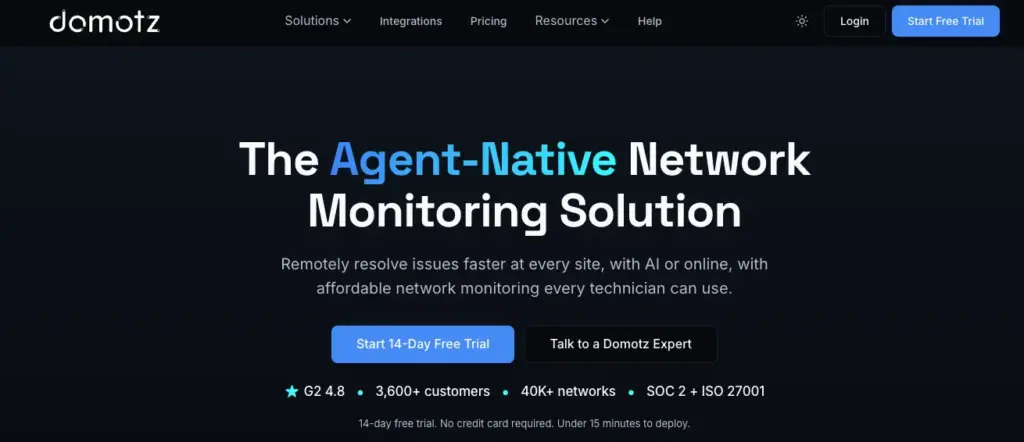
Domotz is rated as an easy-to-deploy SNMP monitoring solution. It makes it easy for users to manage SNMP-supported devices such as servers and server boards, UPS, NAS, printers, and network appliances like routers and switches. Domotz provides several pre-configured SNMP templates so you can apply SNMP monitoring to multiple devices instantly.
With the SNMP templates, you can monitor CPU utilization, memory usage, disk space, network bandwidth, and other key metrics. Domotz also launched MCP server connection, which lets you investigate alerts in plain English, apply device profiles, compare configuration backups, and more.
G2 Rating: 4.8 out of 5.0 (100+ reviews)
Capterra Rating: 4.9 out of 5.0 (120+ reviews)
Domotz Pricing:
- MSPs: $35 per home/month
- IT teams: $35 per home/month
- Commercial Integrators: $35 per home/month
- Residential Integrators: $20 per home/month
5. LogicMonitor – Best for hybrid infrastructure SNMP monitoring

LogicMonitor is a cloud-based infrastructure monitoring solution that allows real-time monitoring of IT environments. It is one of the best choices for monitoring hybrid IT environments since it supports SNMP, network, server, application, and cloud monitoring, among others.
LogicMonitor’s automatic discovery feature scans network infrastructure to identify SNMP devices, such as routers, switches, firewalls, and printers. Its AI layer, Edwin AI, was also added to automate incident triage. However, the full Edwin AI feature set is only available on the higher tiers.
G2 Rating: 4.5 out of 5.0 stars (640+ reviews)
Capterra Rating: 4.6 out of 5.0 stars (110+ reviews)
LogicMonitor Pricing:
- Essentials: $16 per Hybrid unit
- Advanced: $27 per Hybrid unit
- Signature + Edwin AI: $53 per Hybrid unit
6. Zabbix – Best open-source SNMP monitoring tool

Zabbix is an open-source SNMP monitoring tool that gives users full control over their IT infrastructure. With Zabbix, IT administrators can monitor a variety of IT components, such as servers, networks, virtual machines (VMs), and SNMP-enabled devices.
Zabbix queries the SNMP devices every minute for variables such as battery voltage and device state status. If an abnormal value is detected or a specified threshold is reached, the system will notify you. The recent Zabbix 8.0 LTS adds faster SNMPv3 data collection. MCP server is also now available for querying monitoring data in plain language.
Zabbix users on Reddit say the platform is scalable due to its flexible architecture and extensive customization.
G2 Rating: 4.3 out of 5.0 stars (200+ reviews)
Capterra Rating: 4.7 out of 5.0 stars (100+ reviews)
Zabbix Pricing:
- Zabbix has both cloud-based and self-hosted options available. The pricing for the cloud version starts at $50/month
7. Datadog – Best for cloud-native SNMP monitoring and observability
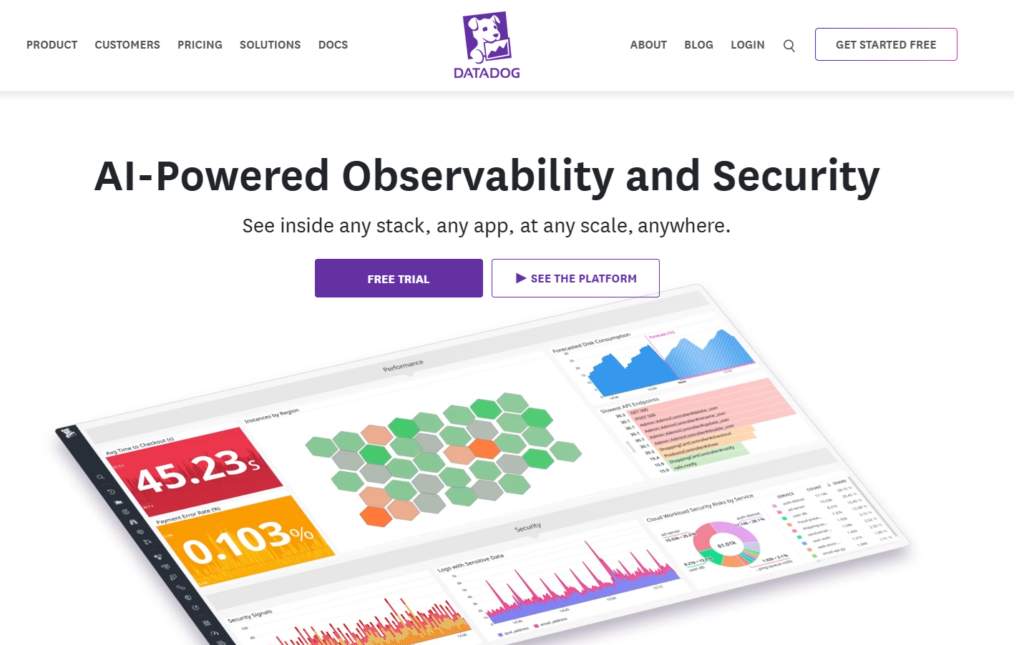
Datadog is a cloud-native solution that integrates SNMP monitoring into a comprehensive observability platform. It enables IT teams to monitor SNMP-enabled devices such as routers, switches, firewalls, and servers alongside the rest of their infrastructure. The Datadog Agent polls SNMP devices for key metrics like CPU usage, packet errors, and bandwidth utilization.
If a metric exceeds a set threshold, Datadog can trigger alerts via email, Slack, or other channels. With a centralized dashboard, automated device discovery, and machine learning-powered forecasting, Datadog provides deep visibility into network health and performance. Datadog’s Bits AI agents (launched in December 2025) can also investigate alerts automatically.
G2 Rating: 4.6 out of 5.0 stars (360+ reviews)
Capterra Rating: 4.4 out of 5.0 stars (700+ reviews)
Datadog Pricing:
- Free: Starting at $0/month, up to 5 hosts
- Pro: Starting at $15 per host, per month
- Enterprise: Starting at $23 per host, per month
- DevSecOps Pro: Starting at $22 per host, per month
- DevSecOps Enterprise: Starting at $34 per host, per month
Network Device Monitoring (SNMP) is billed as a separate add-on.
AI-powered SNMP monitoring, only with Atera
Aside from being one of the best SNMP monitoring software, Atera includes features such as PSA, helpdesk and ticketing, remote access, reporting and analytics, and third-party integrations.
Thus, instead of investing in multiple software subscriptions, Atera offers all IT management features under one platform.
But what makes Atera truly unique is its Agentic AI technology, which also extends to SNMP monitoring. When Robin detects a network issue, it diagnoses the root cause and fixes it directly on the device or network. This could mean issues like resetting a network adapter or renewing an IP address. Robin resolves up to 92% of technical incidents autonomously, all without a technician involved.
Ready to see Robin in action? Contact our sales team for a demo. Or, Atera also offers a 30-day free trial with no credit card required.
What is SNMP monitoring software?
SNMP (Simple Network Management Protocol) monitoring software is a crucial tool for managing and monitoring the health and performance of network devices and infrastructure. Although SNMP is not supported by all devices, many do, including printers, routers, switches, servers, workstations, and devices connected to the Internet of Things (IoT).
Since SNMP isn’t supported by all devices, it’s typically integrated with a more comprehensive IT management platform, enabling monitoring of other devices, such as workstations.
Types of SNMP monitoring software
The best SNMP monitoring software falls into four categories: standalone, unified, open-source, and cloud-based. Let’s look at each option in detail next.
1. Standalone SNMP monitoring software
Standalone SNMP monitoring software focuses exclusively on monitoring SNMP-enabled devices. These tools come with features such as real-time device monitoring, automated network discovery, alert thresholds, detailed performance analysis, and third-party integrations.
IT organizations that just need SNMP monitoring capabilities may find standalone solutions most suitable. Because the features are entirely devoted to SNMP monitoring, they’re often highly customizable to suit your needs. If you need features other than SNMP monitoring, standalone solutions are not the best option since their capabilities will quickly fall short.
2. Unified network monitoring software
Unified network monitoring software integrates SNMP monitoring with other network management functionalities, providing a holistic view of the entire network. With a unified solution, you can manage devices other than SNMP, such as computers and servers.
The best unified network monitoring tools often include features such as real-time monitoring and alerting, patch management, remote access, reporting and analytics, network discovery, and more.
3. Open-source SNMP monitoring software
Open-source SNMP monitoring tools provide a flexible and cost-effective solution for monitoring networks. These solutions often rely on community contributions for updates and maintenance. Open-source tools can be suitable if you need highly customizable options and have technical expertise.
Open-source SNMP monitoring software has several advantages, but its main downsides include a lack of support and security risks due to the lack of a dedicated development team. If you have no experience with open-source solutions, getting started with them can turn out to be difficult.
4. Cloud-based SNMP monitoring software
Cloud-based SNMP monitoring software is hosted on cloud servers, providing flexibility, scalability, and remote access. With features such as real-time monitoring, alerting, remote access, network discovery, and reports, cloud-based solutions are ideal for organizations with a remote workforce or distributed networks.
Some cloud-based solutions, like Atera, also enable autonomous endpoint management, where AI agents can resolve issues on their own, without a technician in the loop.
Why SNMP monitoring software is key to optimal network device performance
SNMP monitoring software ensures optimal network device performance and offers a range of other advantages, such as:
- Proactive issue detection
- Enhanced network security
- Streamlined network management
- Significant cost savings
- Superior operational efficiency
Let’s examine each one in more detail.
1. Proactive issue detection
One key benefit of SNMP monitoring software is its ability to detect potential problems before they escalate. SNMP monitoring software with Agentic AI can diagnose the root cause and resolve the issue on its own, often before end users notice anything is wrong.
This proactive approach reduces the risk of network downtime and improves overall network reliability by taking preventative measures.
2. Enhanced network security
SNMP-enabled devices are prone to SNMP security vulnerabilities, which monitoring tools protect against. These tools help detect unusual activity, unauthorized access, and potential security breaches in real time.
A few solutions also offer autonomous patch management capabilities, which help to apply security patches and updates automatically. Efficient and timely patch management is crucial for maintaining a strong defence against cyber threats.
3. Streamlined network management
SNMP monitoring software simplifies network management by providing a centralized platform for monitoring and managing all SNMP-enabled devices. This also helps IT staff focus on more strategic initiatives and increases productivity.
A few unified network monitoring solutions, such as Atera, take this even further by covering all aspects of IT management in one place. Unified IT management solutions make network management simpler by eliminating the need to switch between different software applications.
4. Significant cost savings
The best SNMP management software ensures that IT resources are used efficiently. These tools prevent overspending on underutilized assets by allocating resources based on actual needs and usage patterns.
In addition, SNMP monitoring software helps to prevent network downtime and reduces the time spent on IT troubleshooting and manual monitoring.
5. Superior operational efficiency
SNMP monitoring handles many routine tasks you’d otherwise do manually, such as checking device status.
Agentic AI takes this efficiency even further. Instead of just assisting technicians, AI agents like Robin can resolve routine issues autonomously, so fewer incidents reach technicians in the first place. In a commissioned Forrester Total Economic Impact study, organizations using Robin saw a 321% ROI and paid back their investment in under six months.
Why should you trust our reviews? ⚖️
We don’t just list any tools in our reviews; we do our own research and look at verified reviews on platforms like G2, Capterra, and Reddit to see what other IT professionals use and recommend.
To be as unbiased as possible, we explain what each tool is best at, its key features, customer reviews, and pricing so you can make the best decision for your IT team.
Frequently Asked Questions
Related Articles

The 5 Best Remote Support Software for 2026
Compare the 5 best remote support software for 2026. See how Atera, AnyDesk, Splashtop, TeamViewer, and ScreenConnect compare on features, AI, pricing, and ratings.
Read now
The 7 best autonomous IT support tools in 2026
A side-by-side look at the 7 best autonomous IT support tools for 2026. See the pros and cons, features, pricing, and what users really think.
Read now
Best cloud-based help desk for large-scale operations
Modern cloud-based help desk platforms can move fast, scale massively, and save IT teams hours of time with smart automation. But they aren’t all created equal. See which features to explore to make sure the cloud help desk tool you choose can truly automate IT support with AI, streamline both employees’ and IT teams’ work, and stay under budget even as operations scale.
Read now
6 Best Firewall Appliances in 2026
Discover the best firewall appliances, backed up by other IT managers. Find out the pros and cons, features, pricing, and performance of each firewall.
Read nowEndless IT possibilities
Boost your productivity with Atera’s intuitive, centralized all-in-one platform