Table of contents
Generate summary with AI

Both Atera and SolarWinds stand out when comparing IT solutions, but for different reasons.
Both platforms have core IT management features, but each has its own strengths. To find out which platform is the best fit for your IT department, you’ll need to create a complete picture of your needs, use cases, and budget.
In this article, we will present a side-by-side comparison of Atera and SolarWinds, giving you an in-depth overview of the strengths and weaknesses of these two platforms and considering Atera as a SolarWinds alternative.
As the team working behind the scenes on one of the largest IT management platforms, we know what’s critical when it comes to this big decision.
Atera vs. SolarWinds: An overview
For a quick look into the differences between Atera and SolarWinds, we have created the following table:
| Atera Features | SolarWinds Features | ||
| – Autonomous IT tool with built-in RMM, remote access, network discovery, and documentation – Robin by Atera for autonomously resolving up to 92% of IT incidents – Patch management for Windows, macOS, and Linux devices – Asset management to track the lifecycle of IT assets – Agentic AI (Includes Robin, AI Copilot, AI-powered troubleshooting, scripting, ticketing, and more) – PSA for MSPs to track contracts, billing, SLAs, and more | – Real-time monitoring and alerting – Incident management – Asset management – Network Discovery – Patch management – Service desk – Network configuration manager – SW1 (AI Agent) for AI-generated insights, root cause suggestions, and incident triage across the platform | ||
| Customer support | Customer support | ||
| – 24/7 email and live chat support for all customers – An extensive knowledge base, IT community, and tutorials | – – Phone, email, and ticket support- Product roadmap available – IT community & self-help materials, such as technical documents | ||
| Integrations | Integrations | ||
| – Integrations with 25+ cybersecurity, automation, backup, remote access, and network monitoring software – Integrations with 50+ ITSM, identity provider, CRM, office suite, and more for Robin – Access to 5,000+ apps through Zapier | – Integrations with ITSM, productivity, infrastructure, Azure, and database tools | ||
| Pricing | Pricing | ||
| – Transparent pay-per-technician pricing, starting from $129/month – 30-day free trial available | – Pay-per-endpoint/GB/user pricing, depending on the SolarWinds product – 30-day free trial available |
Let’s also look at G2’s user satisfaction rating comparison of Atera and SolarWinds. The rating considers factors like how easy the software is to use, whether it meets user requirements, and the quality of available features.
We can quickly see that Atera beats SolarWinds in every category:

You can access the full G2 user satisfaction comparison here.
Next, let’s go into a more in-depth part of the Atera vs. SolarWinds comparison.
#1: Features and capabilities
SolarWinds offers solutions for small businesses and enterprise clients — and while this diversity can be the right fit for some users, most IT teams prefer the streamlined tools that Atera provides.
Atera is designed to meet the diverse needs of enterprises and comes with industry-leading features, including complete remote monitoring and management (RMM), autonomous IT agents, patch management, Network Discovery, PSA, helpdesk, IT security, and many native integrations to expand your capabilities seamlessly.
Atera’s AI agents are the key thing that differentiates it from SolarWinds and other providers in the IT management space.
With Robin and Atera AI Copilot 3.0, released recently, Atera has positioned itself at the forefront of the AI revolution in the IT industry.
Comparatively, SolarWinds offers features that include observability, network management, systems management, database management, IT service management, application management, service desk, and IT security.
SolarWinds features are split between different products, such as SolarWinds Observability and SolarWinds Service Desk.
#2: Agentic AI technology
SolarWinds has a real, actively developing Agentic AI story, but what’s live today is AI recommendations and insights, not autonomous execution.
SolarWinds is clear about this in their press release for SW1 in April 2026, saying ‘autonomous issue resolution’ is one of the upcoming enhancements to SW1.
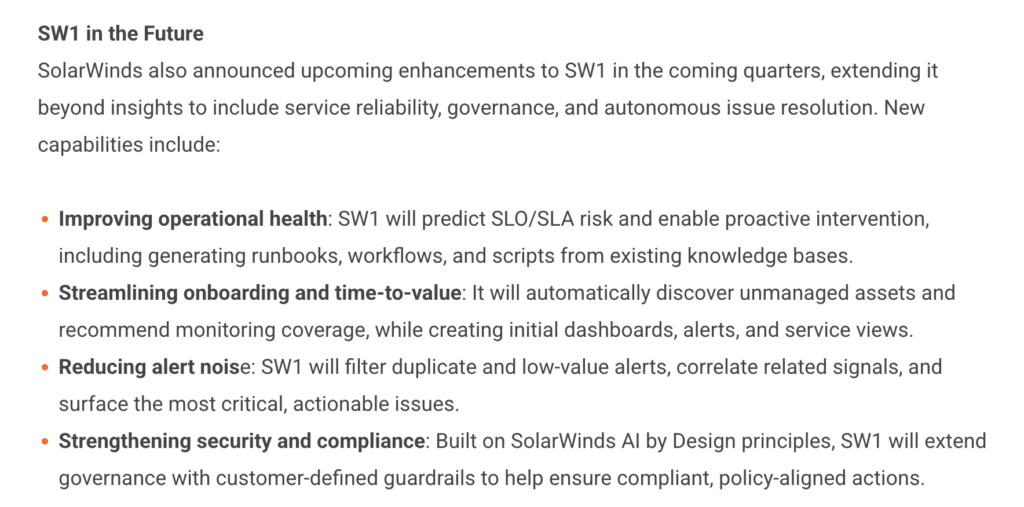
SolarWinds simply says these features come ‘in the coming quarters’, but there’s no specific timeline for when these new AI features will be shipped.
The AI features currently available cover four areas of the platform:
- ITSM: Recommends triage and remediation steps inside the ticket, plus case summarization and AI-generated runbooks. A technician reads the suggestions and approves them.
- Incident Response: The ‘Similar Past Incident’ function pulls in historical context, and ‘Suggested Action’ recommends what to do next.
- Database: Helps DBAs fine-tune slow queries, and anomaly detection flags database issues before they escalate.
- Monitoring and observability: Helps to narrow down probable root causes and helps to forecast resource needs ahead of time.
While extremely useful, the lack of autonomous execution means every one of these actions still needs a technician: reading the suggestion and running the fix by hand.
This is also the main difference to Robin by Atera. Robin is a fully autonomous IT agent that operates within its approved scope, without needing a technician or the employee to confirm each action before it runs.
Robin was launched in May 2025 as IT Autopilot (nearly a year before SW1’s April 2026 debut), before being rebranded to Robin in March 2026.
It follows a four-step process to execute fixes autonomously:
- Diagnose: Robin gathers context and identifies the root cause itself, without waiting on a technician to confirm the diagnosis.
- Remediate: Robin executes the fix directly on the device, in the identity system, or on the network, instead of just providing suggestions to a technician on how to fix it.
- Verify: Robin checks that the issue is actually resolved before it closes anything.
- Close: Robin updates the ticket in your ITSM with the outcome and logs every action for audit and compliance.
Robin’s resolution rate sits at up to 92% of Tier-1 and complex Tier-2 technical incidents, with a 120-second average resolution time. SolarWinds hasn’t published resolution rates for its AI agents.
As for Robin’s ROI, a Forrester TEI study commissioned by Atera found a composite 2,500-employee organization saw a 321% return over three years, with payback in under six months.
While Robin is end-user-facing, there’s also Atera’s AI Copilot for technicians, available at Atera plans at no extra cost. Copilot operates similarly to SolarWinds’ AI capabilities, giving technicians insights, suggesting next steps, and helping to resolve more complex issues that Robin hands off.
For example, Leeds United was able to achieve a 35% reduction in tickets, which helped them maintain strong service delivery while having limited staff.
One Capterra user commented on Atera’s AI, “I love the integration of AI within the ticketing and scripting sides. It makes everything easier to do and helps you out whenever you forget that one command to make progress.”
#3: User interface and usability
Both Atera and SolarWinds offer a range of capabilities: remote monitoring and management (RMM), patch management, ticketing, security features, and more.
While some of the features are similar, the two platforms are comprised of entirely different dashboards and user interfaces, making their usability quite distinct from one another.
Here is a look at SolarWinds’ admin dashboard:

Screenshot of SolarWinds (via G2)
While some users appreciate the comprehensive nature of the SolarWinds dashboard, many have noted that the setup process is difficult and requires technical expertise. One G2 user points out, “one of the biggest challenges is that you have to programmatically configure everything you want to monitor, which takes a lot of time.”
SolarWinds’ high customizability is often complimented, but many find a long learning curve with it. In fact, ‘significant learning curve’ is one of the main cons of SolarWinds:

In contrast, Atera’s dashboards are up-to-date and modern. It was designed with ease of use in mind, and navigating between the different tools is effortless.

Atera’s admin dashboard
Looking at G2’s ease of use scores, we can see both Atera and SolarWinds have strong reviews from real users. But Atera has a slight edge in all ease-of-use categories:
| G2’s Ease of Use Category | 1. Atera | 2. SolarWinds |
| 1. Ease of Use | 9.2 stars (1,120+ reviews) | 9.0 stars (710+ reviews) |
| 2. Ease of Setup | 9.2 stars (970+ reviews) | 8.6 stars (570+ reviews) |
| 3. Ease of Admin | 9.0 stars (620+ reviews) | 8.9 stars (550+ reviews) |
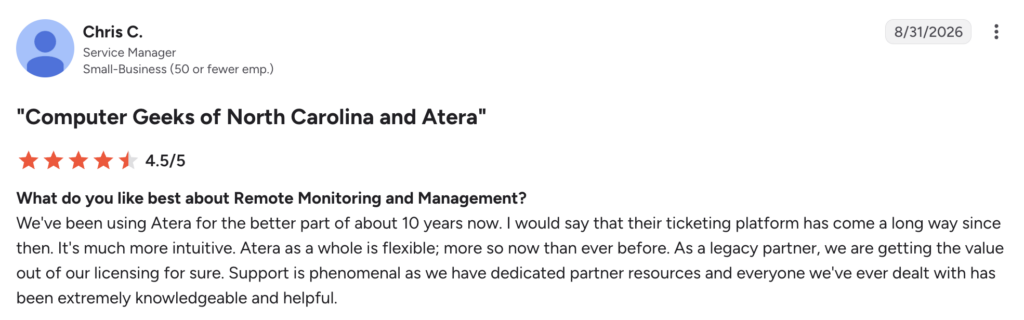
One long-time Atera user, Chris C., described how the platform has evolved and said, “I would say that their ticketing platform has come a long way since then. It’s much more intuitive. Atera as a whole is flexible; more so now than ever before.”
#4: Performance and reliability
As any IT professional knows all too well, performance and reliability are key when it comes to choosing the best IT management tool for you. Excessive downtime can be a thorn in your side, leading to more security risks and problems down the line — that’s why you need to ensure that your next IT investment will protect you from these stressors.
Both Atera and SolarWinds offer fully encrypted data backups to the cloud, while we also offer the option of a local backup at Atera. Equally important to backing up your data, recovering your data with both Atera and SolarWinds is easy.
Both platforms also offer reliable support teams (24/7 live chat for Atera) that you can reach out to if you face issues.
At Atera, we’ve earned a 9.17 likelihood of recommendation score via our GetApp.com reviews due to the reliability of our platform. SolarWinds’ reviews display a slightly lower but still impressive 8.74/10 likelihood of recommending the platform.
#5: Pricing and value for money
Budget is a key consideration when comparing Atera vs SolarWinds.
At Atera, we’re big advocates of transparent pricing. We want you to fully understand what you will be paying and our value proposition. Plus, with our unique per-technician pricing model, we make growth and scalability possible without breaking the bank.
Atera’s pay-per-technician pricing starts at $149/month per technician for IT departments. There are different tiers to our services, ranging from professional to enterprises:
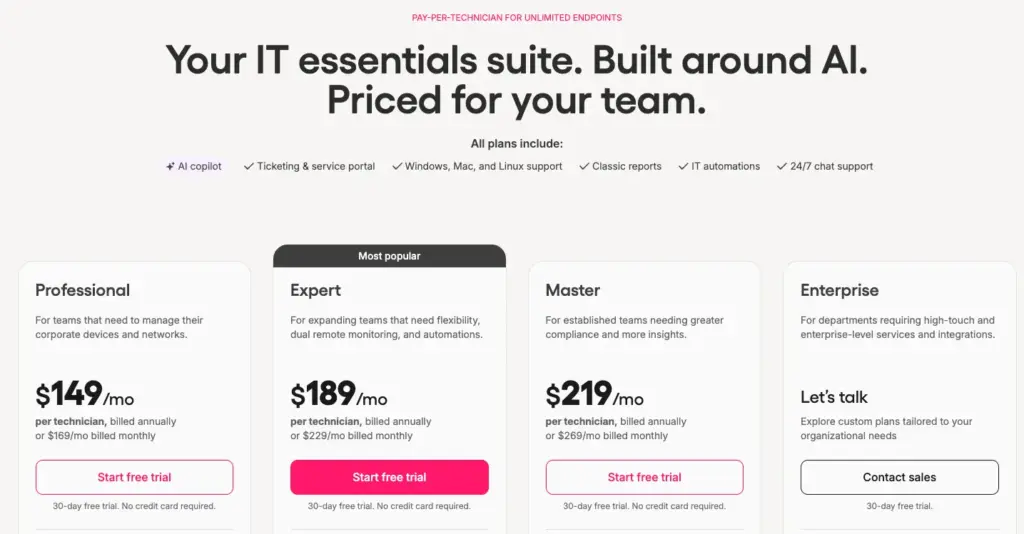
Tip: Learn about Atera’s IT department pricing and MSP pricing.
At SolarWinds, you can also find options for pay-per-technician pricing, as the pricing for SolarWinds Service Desk starts at $39/month and at $15/month for Incident Response. For SolarWinds Observability, the pricing starts at $8/month per node.
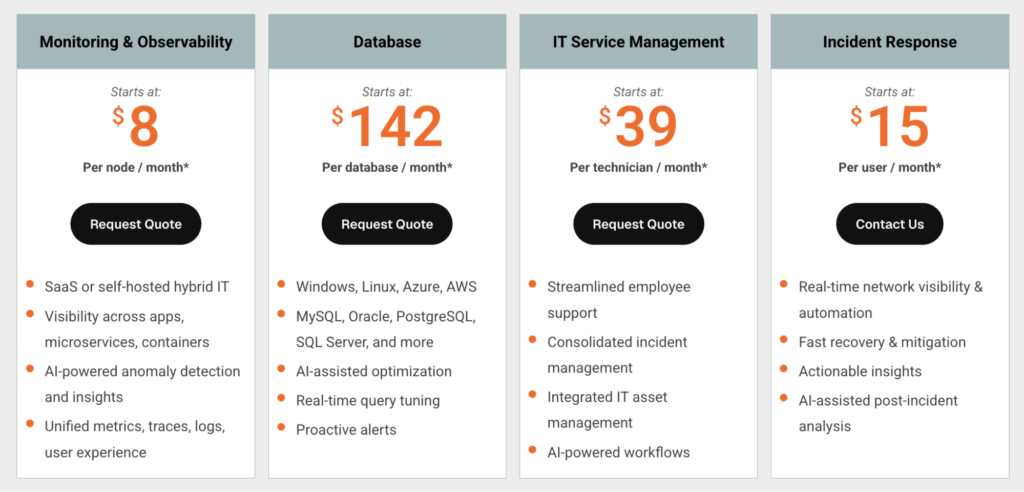
SolarWinds Observability pricing
Since each SolarWinds product has its own pricing structure, the total cost can add up very quickly. For example, a 10-technician team running Service Desk, Incident Response, and Observability with 50 nodes would pay nearly $940/month before any add-ons.
This is also the major difference between Atera’s and SolarWinds’ pricing. Atera’s standard plans include RMM, ticketing, patch management, and remote access under one price.
At Atera, our pricing is all-inclusive. You won’t need to handle numerous add-on charges and different packages to get our full capabilities. Instead, you will get everything you need in one fell swoop.
As evidenced by many of our customer reviews, offering a more all-inclusive RMM pricing model ends up saving our customers time and money.
#6: Customer support and community
We already covered the importance of reliability in relation to IT products, and customer support is a crucial piece of the reliability equation. Both Atera and SolarWinds have strong online resources, blog posts, guides, and knowledge bases that users can access at any time of day (or night).
Where Atera shines, however, is in our active IT community of users who support each other around the clock. Our community has received plentiful praise from users, who find it an excellent place to troubleshoot issues and receive feedback from others who have dealt with similar situations.
We are incredibly proud of the tight-knit Atera community of IT professionals, and we look forward to welcoming you into the Atera family should you choose our product. With 24/7 help available from live agents as well as the user community, plus numerous digital resources to harness self-serve learning and assistance, you are sure to find help whenever you need it.
SolarWinds also has a strong community branch of its organization, known as THWACK. It even has a forum where you can constantly find users discussing best practices for managing their IT network.
#7: Security and compliance
SolarWinds has a reputation as a solution that focuses on cybersecurity, but that reputation has been semi-upended in recent years, especially with the infamous SolarWinds hacking incident in 2020.
Hackers were able to enter SolarWinds’ Orion system, impacting numerous customers across both the private and public sectors for months to come. Since then, SolarWinds has continued to develop its security offerings, but this incident has marred user perception of the product.
After this incident, many SolarWinds users on Reddit have kept discussing whether the software is trustworthy enough for IT management:

SolarWinds review via Reddit
At Atera, we are increasingly focused on our commitment to compliance and security. With smart logging and reporting, as well as adherence to industry standards like MFA, we can give our customers the ultimate peace of mind so that they know your organization is not under fire from malevolent actors.
Another important part of maintaining security in the IT space is patch management. Ensuring your networks and endpoints are up-to-date with the latest patches helps ensure that nobody can take advantage of any deficits. With Atera’s automated patch management capabilities, it is easier than ever to ensure that your systems are safe and sound.
Our automation settings allow you to create customized patch management schedules for each endpoint. Not only this, Atera’s AI agents also add a layer of security (see Atera’s AI security info here). With real-time health checks, anomaly detection, Robin’s capability to autonomously remediate issues, you can resolve incidents before they escalate.
But don’t just take our word for it. Check out this review from a Capterra user who switched from SolarWinds to Atera due to reliability issues:

Review via Capterra
The reviewer also mentioned, “Atera has consistently delivered, and the 24/7 support has been wonderful and efficient.”
#8: User feedback and reviews
Generally speaking, users have found Atera to be an incredibly robust suite of IT solutions. With best-in-class pricing, Atera appeals to both start-up and enterprise customers. Plus, with a quick learning curve, the setup time associated with Atera’s products is much shorter than what you might see with other platforms.
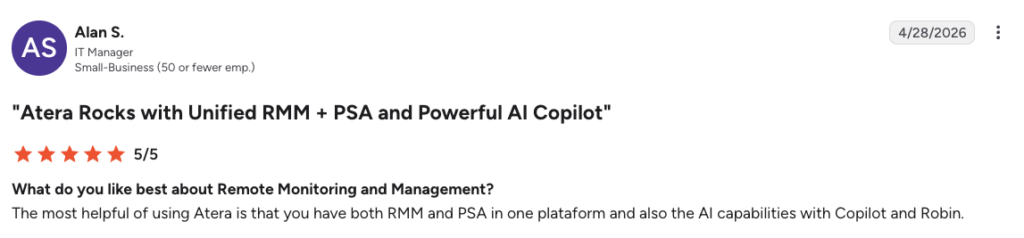
Another thing G2 reviewers often compliment is Atera’s Agentic AI capabilities. Alan S. on G2 commented on Atera’s unified features and AI capabilities:
- “The most helpful of using Atera is that you have both RMM and PSA in one platform and also the AI capabilities with Copilot and Robin.”
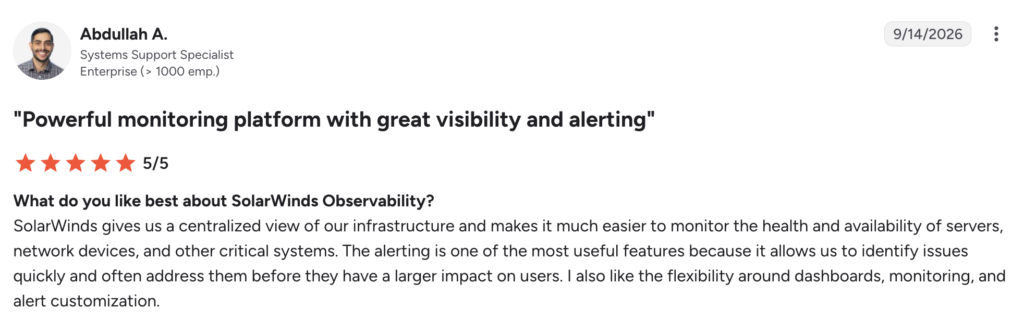
Compared to SolarWinds, customer reviews mostly relate to the platform’s monitoring capabilities, alerting, and ability to configure custom actions for fixing device issues.
For example, this is what one G2 user, Abdullah A., commented:
Atera is the ultimate solution for future-proofing your IT
We hope you’ve found this guide helpful in comparing Atera vs. SolarWinds.
While the platforms have similar pricing models, Atera offers an enhanced range of features, increased functionality, and an Agentic AI technology, capable of resolving up to 92% of your Tier-1 and complex Tier-2 technical incidents.
Users also enjoyed Atera’s robust online community of fellow IT professionals, who can help with troubleshooting — plus the live support available via live chat. Overall, Atera offers a strong alternative to SolarWinds and can meet the needs of enterprises and growing organizations at every stage in their growth journeys.
While you make your final decision about which IT software to purchase, it’s important to conduct thorough research. We encourage you to request demos, sign up for free trials, and speak with company representatives to gain an even fuller picture of each platform’s capabilities. Where to start? Get in touch with Atera’s sales team today!
Frequently Asked Questions
Related Articles
Robin vs Request Resolver (Former Rovo)
Robin and Atlassian's Request Resolver (Former Rovo) both bring Autonomous IT into ITSM, but they operate at different levels. This full comparison breaks down where each one's autonomy actually reaches.
Read now
Robin vs Kaseya Intelligence
Robin by Atera and Kaseya Intelligence both talk about autonomous IT, but structure their AI technologies differently. See where each one's autonomy actually reaches and which works for your org.
Read now
Robin by Atera vs. Ivanti Neurons: comparing two very different approaches to autonomous IT
In this article, we'll compare Robin vs. Ivanti Neurons: one AI agent that resolves IT incidents end to end, and one platform that splits autonomy across two separate AI capabilities.
Read now
Robin vs Freddy AI Agent Studio
Not all agentic ITSM starts from the same place. See how Robin's deploy-ready model compares to Freddy AI Agent Studio's no-code, build-it-yourself approach.
Read nowEndless IT possibilities
Boost your productivity with Atera’s intuitive, centralized all-in-one platform