Table of contents
Table of contents
- Atera vs. Halo: An overview
- Find the right IT tools for your needs
Generate summary with AI

If you’re looking for a professional services automation (PSA) tool in the IT space, you may be feeling overwhelmed by all of the options on the market. Today, we’ll try to simplify your decision by highlighting the similarities and differences between Atera and Halo.
These two platforms might initially seem similar, but upon further investigation, you will find significant differences in their features, interfaces, customer support, and more.
We’ve become experts in comparing reviews, performance, and other important factors to help you make an informed decision about the PSA tool that is right for you.
Atera vs. Halo: An overview
To quickly see the differences between Atera and Halo, take a look at the following overview table:
| Atera’s Features | Halo’s Features | ||
| – RMM (Real-time monitoring and alerting) – PSA (Ticket management, automation, knowledge base articles, and more) – Autonomous IT (ticket summaries and AI troubleshooting with Copilot & autonomous incident resolution with Robin by Atera) – Patch management – IT automation – Remote access – Customizable reporting – Backups | – Service desk (ticket management) – Asset management & CMDB – Incident and request management – Self-service portal – Project management – Sales & CRM – Supplier management – Reporting and analytics – Marketing campaign management – AI agents | ||
| Customer support | Customer support | ||
| – 24/7 live chat & email support- Active IT community & extensive knowledge base – Public product roadmap | – Email and phone support available – Public product roadmap | ||
| Integrations | Integrations | ||
| – Security, backup, MDM, remote access, & billing integrations – Integrations with 50+ ITSM, identity provider, CRM, office suite, and more for Robin | – Security, asset management, alerting, CRM, documentation, and other platform integrations available | ||
| Pricing | Pricing | ||
| – Pay-per-technician pricing, starting at $129/month – 30-day free trial available | – Per-agent pricing, starting at $99/month – 30-day free trial available |
Below, we’ll jump into the more in-depth part of our review.
#1: Features and capabilities
Atera and Halo both offer PSA services for managed service providers (MSPs), but it doesn’t stop there for Atera.
Atera’s autonomous IT tool offers a broader range of features, including:
- RMM – to monitor and manage devices, diagnose and troubleshoot device issues autonomously, and more.
- PSA – to maintain contracts and billing, create customer portals, handle SLAs, and manage and resolve tickets automatically using our AI helpdesk software.
- AI agents – to tackle manual and repetitive tasks, such as troubleshooting devices, resolving tickets, or generating scripts, fully autonomously.
- Patch management – to keep OS and third-party apps up-to-date
- Remote access – to access devices remotely for troubleshooting.
- Network Discovery -to discover new devices and keep track of the entire lifecycle of assets.
One area where Atera’s RMM capabilities are highly useful is scripting. Our scripting setup allows our users to automate processes between applications and devices within their networks.
What’s best, Atera’s AI script generator allows you to easily create the right scripts for fixing device issues, like slow device performance or concurrent application crashes. You only need a simple prompt to tell Copilot what you want.
Plus, we have the most robust scripting library in the industry (many of these scripts are even provided by our community!)
In comparison, Halo had a big update recently as it rebranded from a standalone PSA tool into “Halo,” a single platform that covers ESM, ITSM, CSM, and CRM under one license. PSA is now just one of its modules.
Halo covers the key features on its ‘Capabilities’ page:
- Incident management
- Omnichannel ticketing
- Knowledge management
- Self-service portal
- Reporting & analytics
- Project management
- Contract management
- Finance
- Time tracking
While Halo’s feature set is truly impressive for running a service desk, it still doesn’t cover RMM, patch management, or remote access – the tools Atera bundles natively into one platform.
#2: Agentic AI technology
Agentic AI represents a paradigm shift in the IT industry, so it’s important to compare Atera and Halo in this area.
Halo has also recently started developing its AI agent offerings, with the launch of its ‘Platform Intelligence’ and ‘AI Agents’. Platform Intelligence refers to the layer that learns from ticket and knowledge base data over time and improves its troubleshooting capabilities.
Halo divides its AI Agents into two groups:
- Conversational Agents: Work across web chat, Teams, Slack, and your self-service portal, guides users through issues, and escalates to the right person with full context if needed.
- Process Agents: Works beyond the chat interface behind the scenes and auto-resolves known issues, flags service degradation, and coordinates multi-step changes from request to release.
Where Robin by Atera pulls ahead is where the agent actually executes. Halo’s Conversational and Process Agents work within Halo’s own service management data: tickets, CRM, PSA, and knowledge base records. Halo’s AI agents don’t actually reach the device, server, or network where the fix is needed.
Robin works differently. It’s meant to act directly on the infrastructure layer itself, taking real autonomous actions on devices, servers, and networks.
It does this by following a four-step process:
- Diagnose: Robin receives the request through Teams, Slack, email, the Atera Customer Portal, or a third-party ITSM tool, verifies the user against an identity provider, and asks follow-up questions to gather the context it needs.
- Remediate: Robin takes the approved action directly on the device, network, or in the cloud, routing for approval only when a step requires it.
- Verify: Robin confirms the issue is actually resolved before closing anything. If it isn’t, it escalates to a technician with full context.
- Close: Robin updates the ticket in the existing ITSM with the outcome and next steps, logging every request for governance and compliance.
Robin resolves up to 92% of Tier-1 and complex Tier-2 technical incidents autonomously, with a 120-second average resolution time. Halo hasn’t published a comparable resolution rate for its AI Agents.
For technicians dealing with manual and repetitive tasks, Atera also offers its AI Copilot, part of every plan at no extra cost. Atera Copilot is your go-to IT companion for running health checks, diagnosing, suggesting actions, and resolving issues on your macOS and Windows devices.
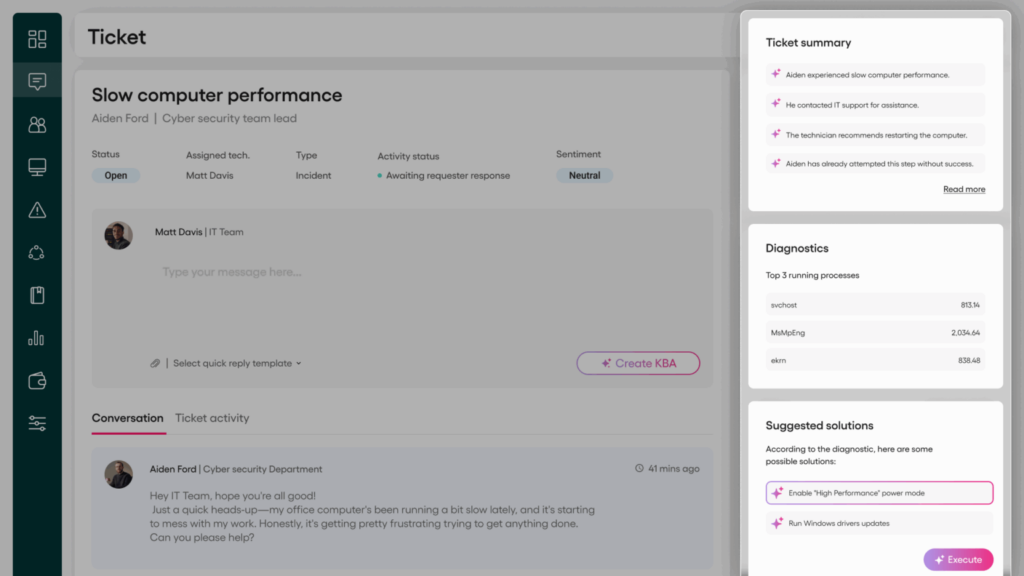
One of Atera’s customers, Leeds United, was able to reduce its tickets by 35% using Copilot, which is a drastic drop for an enterprise organization.
#3: User interface and usability
When it comes to the usability of Atera and Halo, this is how actual users have rated the two platforms across G2’s ease of use categories:
| G2’s Ease of Use Category | 1. Atera | 2. Halo Service Desk |
| 1. Ease of Use | 9.2 stars (1,100+ reviews) | 9.4 stars (14 reviews) |
| 2. Ease of Setup | 9.2 stars (970+ reviews) | 8.0 stars (10 reviews) |
| 3. Ease of Admin | 9.0 stars (620+ reviews) | 8.1 stars (9 reviews) |
Halo has an edge in ease of use, while Atera leads noticeably in the ease of setup and admin categories. Atera’s dataset is also much larger.
To give you an idea of what Atera’s dashboard looks like, here is a screenshot of it:

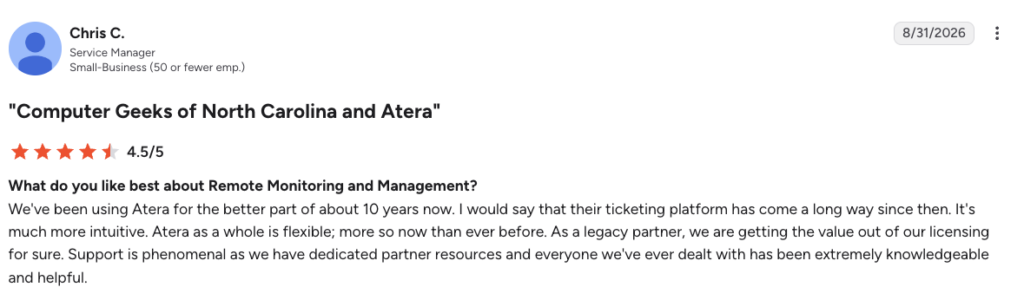
One long-time Atera user, Chris C., commented on the usability and said:
- “We’ve been using Atera for the better part of about 10 years now. I would say that their ticketing platform has come a long way since then. It’s much more intuitive. Atera as a whole is flexible; more so now than ever before.”
At Atera, we also work hard to request and implement feedback from our growing user base to make sure we never fall behind. We even have a public product roadmap and continuously keep our users updated with the latest innovations.
For comparison, Halo’s dashboard looks like this:
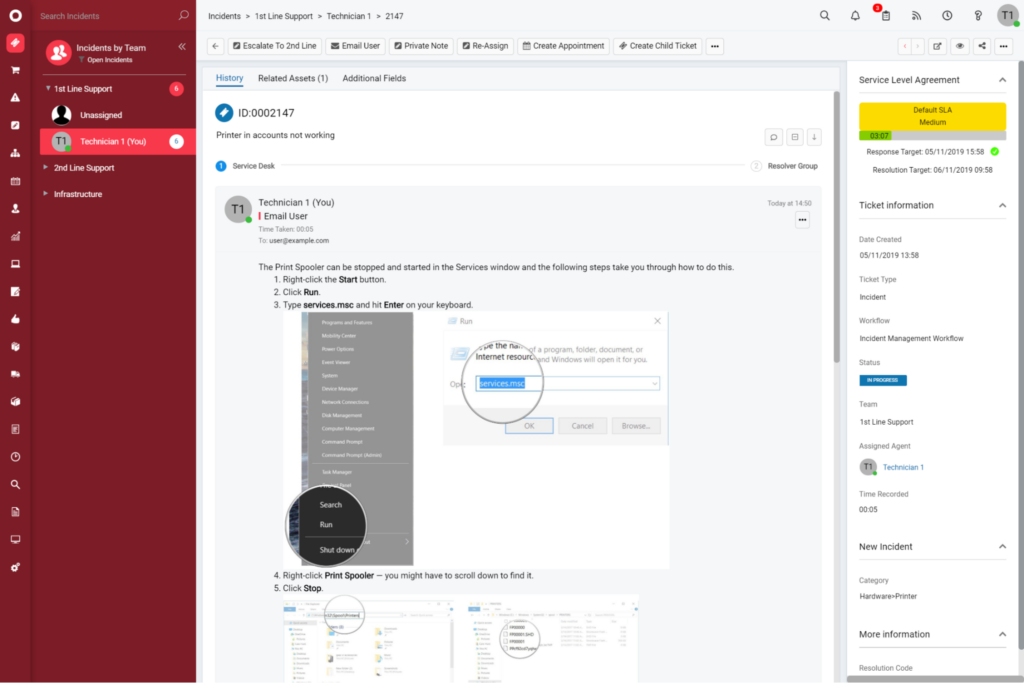
When it comes to usability and learning curve, Halo has received mixed reviews. Many users comment that the platform is very complex, and paying for an onboarding service is a must to get a grasp of the software.
#4: Performance and reliability
As any IT professional knows, performance and reliability are the keys to success. That’s why, at Atera, we have put in the work to ensure that our performance and reliability scores remain high, and we work to prevent downtime constantly.
Plus, if you ever do run into problems with our product, our live, 24/7 support (available in several languages) is here to help. Our commitment to expanding our support offerings includes our huge collection of digital resources (such as an extensive knowledge base, our popular blog, a thriving online community, and support from live agents). We’re always here to support YOU.
Another big difference in this category between the two comes down to functionality. Not only is the Atera platform itself reliable, but it also helps your entire IT environment prevent downtime. We offer features like autonomous patch management, native security integrations, and live chat support to ensure you are always up and running.
There are so many better uses for your talented IT technicians’ time! With Atera, nobody has to worry about downtime – not you and not your IT environment users, either.
#5: Pricing and value for money
At Atera, being transparent with our pricing is important to us – and it should be important to you, too. Fully understanding the costs associated with our IT platform makes it easier for you to predict costs and budget effectively as an MSP or IT service provider.
Atera’s pricing plans for MSPs start at $129 per month per technician, and pricing for IT departments starts at $149 per month per technician. Our plans include integrations like Splashtop at no additional charge.
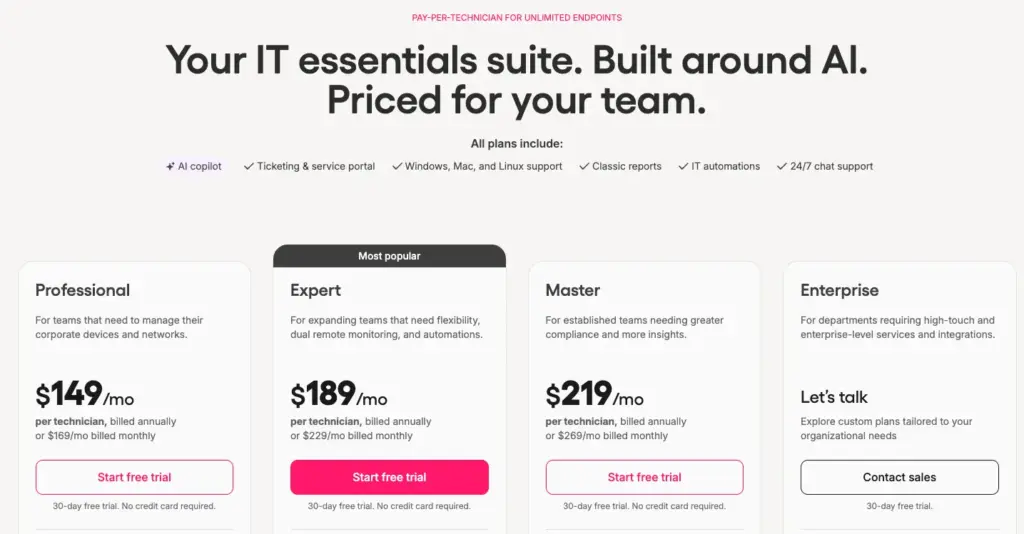
Atera’s IT department pricing
At Atera, we offer pricing tailored to both MSPs and IT departments. The two have different needs, so by having separate plans for each, we can better serve them both.
In comparison, Halo offers a one-set pricing package, starting from $99/month per agent. Depending on the number of agents you have, the price goes up.
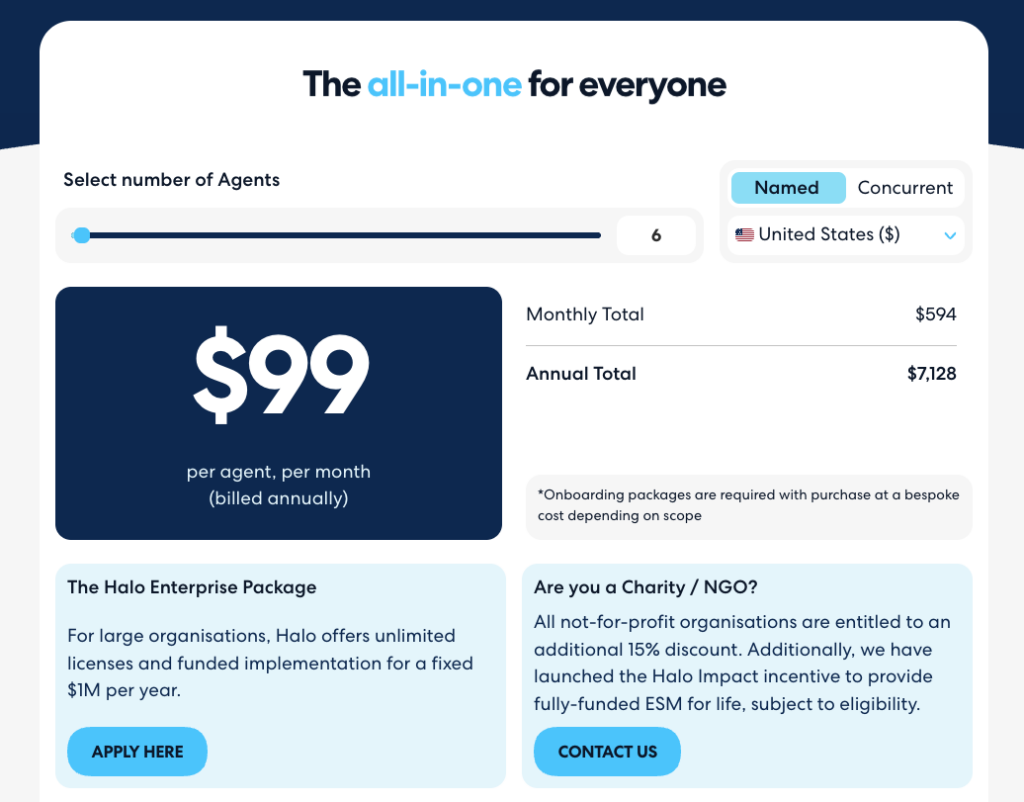
While this pricing is attractive for MSP clients, IT departments may be disappointed to find out that Halo is not built with their needs in mind. Halo misses key features IT teams may need, such as RMM, and investing in a third-party RMM will increase the total cost of Halo.
#6: Customer support and community
Customer support and a sense of community are important to the success of any IT software, and especially one that you rely on to perform your day-to-day work.
At Atera, we offer a thriving community of users who support each other around the clock. We love our close-knit community of IT professionals – and if you choose Atera, we are excited to welcome you into our online family.
But that’s not all! We also have countless blog posts, recorded webinars, and other resources for you to turn to when you prefer asynchronous help. If you want to talk to a real human, we are available 24/7 in several languages.
Don’t believe us? See what our customers say on G2:
- “Their chat support answered immediately, and within just a couple of minutes the issues were fixed.”
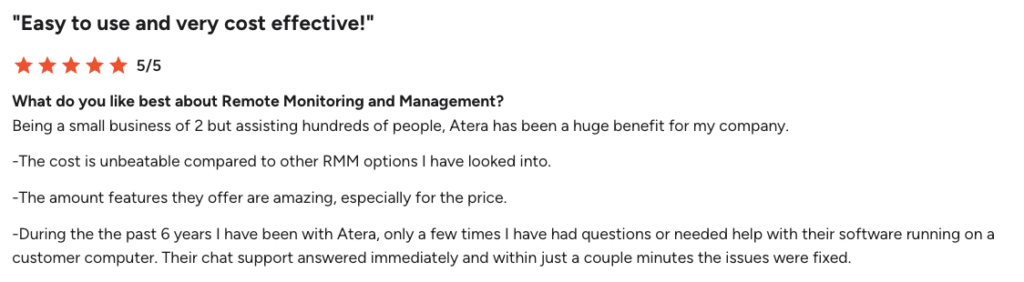
But how does Halo stack up? While the software gets the job done for many IT service providers, Reddit users have shared that the support from the company does not meet their expectations and can be slow to respond.
#7: Security and compliance
We can all agree that security and compliance are essential for any IT provider’s success.
At Atera, security is at the core of everything we build. With cyberattacks happening more and more frequently, our commitment to compliance and security hasn’t slowed down. With smart logging and reporting, as well as strict adherence to all industry standards, we give our customers unmatched peace of mind that their organizations are safe from the growing threat of malicious third parties.
Atera also takes AI security seriously for its AI agents.
In addition, Atera’s integrations with cybersecurity tools, such as Cynet, Acronis, Bitdefender, Emsisoft, ESET, Ironscales, Keeper, and ThreatDown, further strengthen our security offerings.
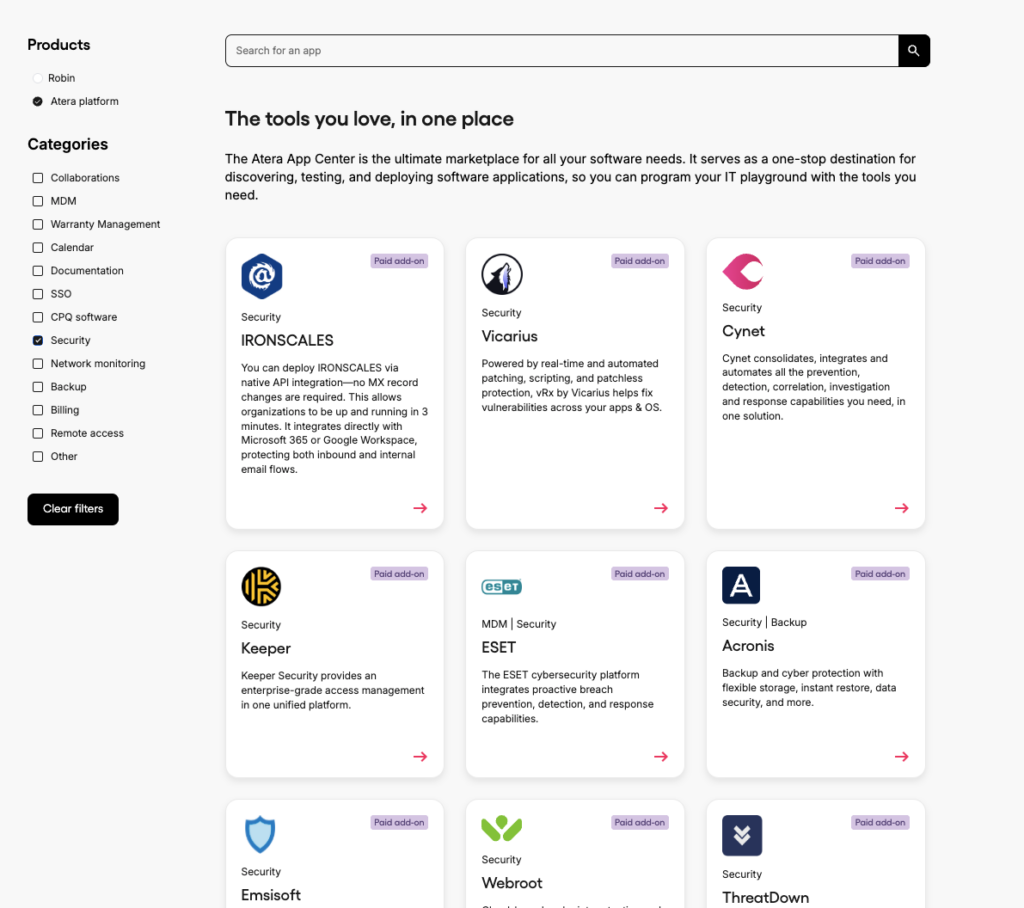
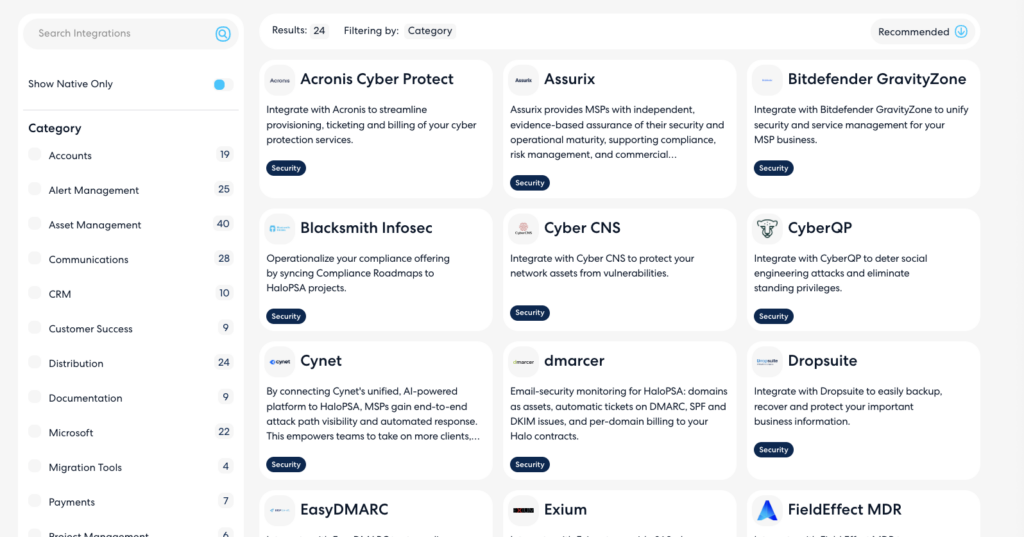
Halo also offers integrations with 24 security platforms, including Acronis, Bitdefender, Cynet, Splunk, EasyDMARC, and more. Halo also has an official integration with Atera for teams wanting to bundle the two together.
#8: User feedback and reviews
Both Atera and Halo are loved by many on user review sites, such as Reddit, G2, Capterra, and Gartner.
Across G2 and Capterra, Atera has received 1,200+ reviews, with an average rating of 4.6 out of 5.0 stars. In comparison, Halo Service Desk has received 17 reviews with a 4.5-star rating, and HaloITSM has received 22 reviews with a 4.7-star rating.
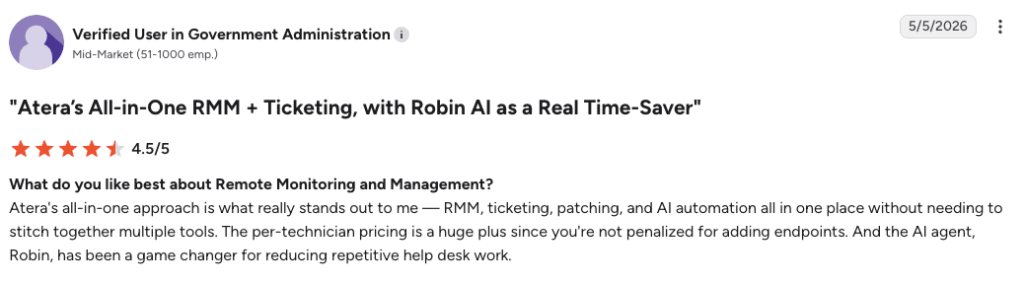
For Atera, many users compliment the AI agents, including Robin, which helps to resolve up to 92% of technical incidents on its own.
One G2 user said, “The AI agent, Robin, has been a game changer for reducing repetitive help desk work.”
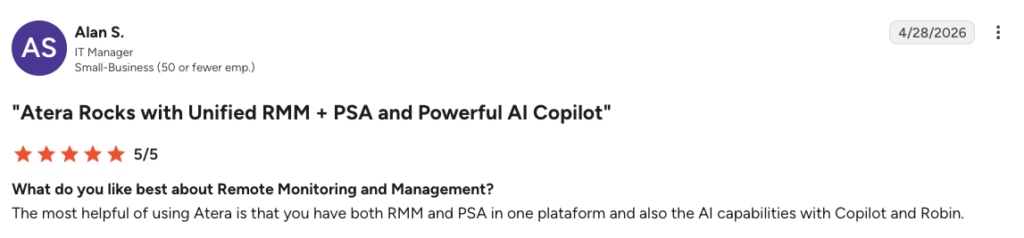
Alan S. loved Atera’s unified RMM and PSA + AI capabilities and said:
“The most helpful of using Atera is that you have both RMM and PSA in one platform and also the AI capabilities with Copilot and Robin.”
With transparent pricing that simplifies growth and scaling, Atera provides accessible solutions for both enterprise and start-up customers looking for Halo alternatives.
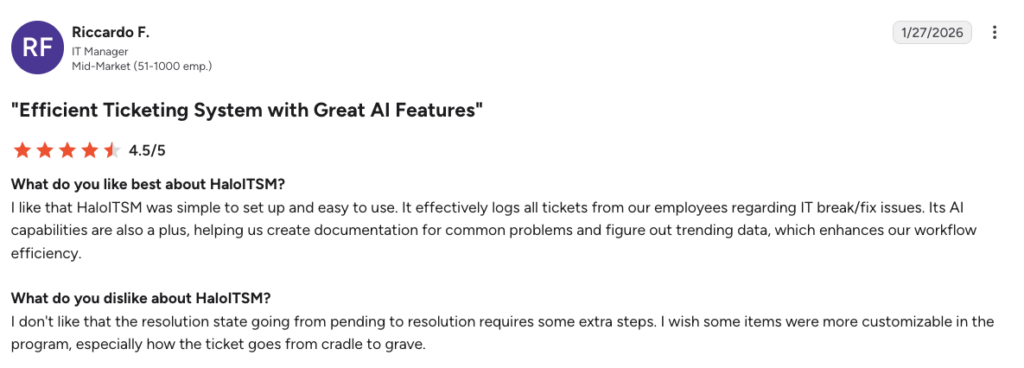
For many MSPs, Halo meets CRM, billing, helpdesk, and broader service management needs – and its customer reviews from places like TrustRadius, G2, and Capterra reflect that.
For example, one Halo user on G2 shared this:
Find the right IT tools for your needs
If you just need a tool for service management, Halo’s offering can be enough. If you’re part of an IT team needing more robust features for RMM, patch management, remote access, and truly autonomous IT, Atera is the only option of the two for that.
Both platforms have free trials, so it’s worth testing each against your own workflows before committing. Want to see how Robin can autonomously resolve your first tickets? Book a demo with our sales team to learn more.
Frequently Asked Questions
Related Articles
Robin vs Request Resolver (Former Rovo)
Robin and Atlassian's Request Resolver (Former Rovo) both bring Autonomous IT into ITSM, but they operate at different levels. This full comparison breaks down where each one's autonomy actually reaches.
Read now
Robin vs Kaseya Intelligence
Robin by Atera and Kaseya Intelligence both talk about autonomous IT, but structure their AI technologies differently. See where each one's autonomy actually reaches and which works for your org.
Read now
Robin by Atera vs. Ivanti Neurons: comparing two very different approaches to autonomous IT
In this article, we'll compare Robin vs. Ivanti Neurons: one AI agent that resolves IT incidents end to end, and one platform that splits autonomy across two separate AI capabilities.
Read now
Robin vs Freddy AI Agent Studio
Not all agentic ITSM starts from the same place. See how Robin's deploy-ready model compares to Freddy AI Agent Studio's no-code, build-it-yourself approach.
Read nowEndless IT possibilities
Boost your productivity with Atera’s intuitive, centralized all-in-one platform