Table of contents
Generate summary with AI

When comparing the best IT management tools out there, Atera and Syncro are two that come up often. These two platforms have many similarities and differences, and in this article, we will take a closer look at what sets Atera and Syncro apart.
We’ve done in-depth research on your behalf and reviewed the features, AI innovations, pricing, and support of both Atera and Syncro. After reading this article, you’ll have a better idea of which of the two leading IT management platforms is the best RMM software for your specific needs. Let’s begin.
Atera vs. Syncro: An overview
Before going into more detail, we’ve created an overview table of Atera vs. Syncro:
| Atera Features | Syncro Features | ||
| – Autonomous IT tool with built-in RMM, remote access, network discovery, and documentation – Patch management for Windows, macOS, and Linux devices – Asset management to track the lifecycle of IT assets – Agentic AI (Includes Robin, AI Copilot, AI-powered troubleshooting, scripting, ticketing, and more) – PSA for MSPs to track contracts, billing, SLAs, and more | – RMM to remotely monitor Windows, macOS, and Linux devices – PSA to manage tickets, create contracts and invoices, track SLAs, and more – Microsoft 365 multi-tenant management – Ticketing automation to automatically categorize tickets – Patch management – Billing and invoicing – Syncro AI for ticket summaries, triage and dispatch, and guided resolution – MCP server to connect outside AI tools to your Syncro data | ||
| Customer support | Customer support | ||
| – 24/7 email and live chat support for all customers – An extensive knowledge base, IT community, and tutorials | – 24/5 email and phone support – Knowledge base articles – Community forum | ||
| Integrations | Integrations | ||
| – Integrations with 25+ cybersecurity, automation, backup, remote access, and network monitoring software – Integrations with 50+ ITSM, identity provider, CRM, office suite, and more for Robin – Access to 5,000+ apps through Zapier | – Integrations with cybersecurity, accounting & remote access software | ||
| Pricing | Pricing | ||
| – Transparent pay-per-technician pricing, starting from $129/month – 30-day free trial available | – Transparent pay-per-technician pricing – 14-day free trial available |
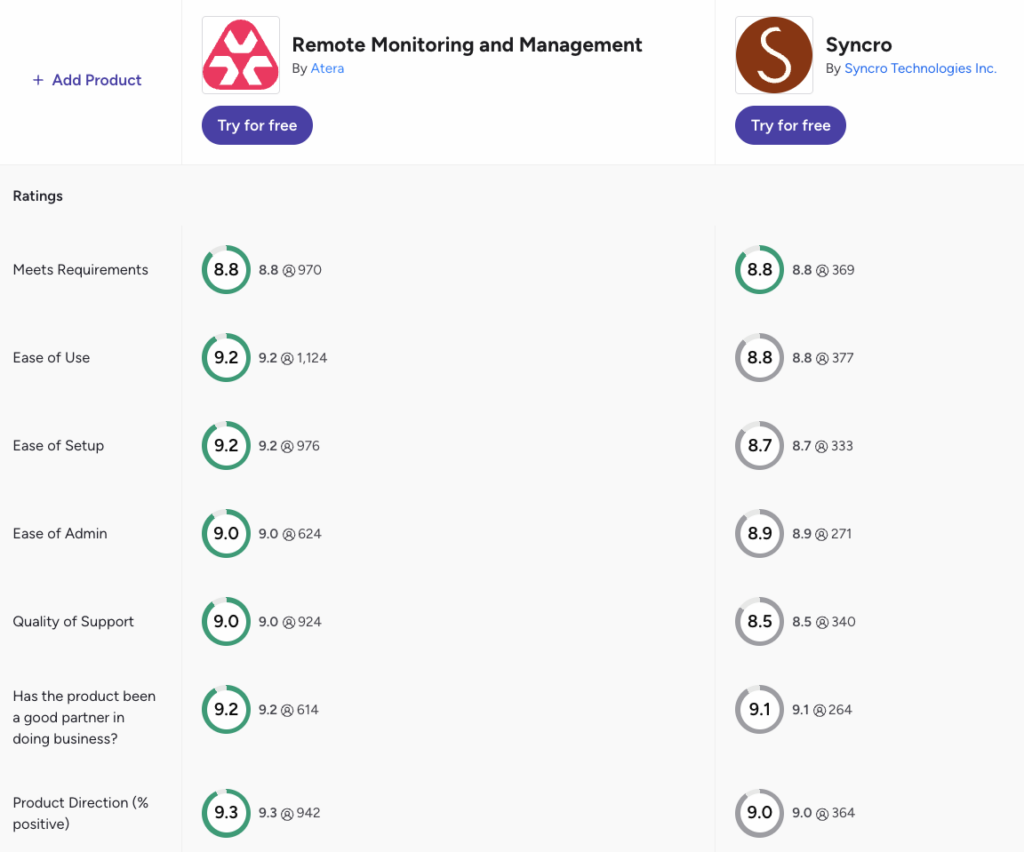
Using G2 to compare user satisfaction, ease of use, quality of support, and features, we can see that Atera beats Syncro in every category:
Let’s now move on to the in-depth part of our comparison article:
#1: Features and capabilities
Atera and Syncro share similar features and capabilities, such as RMM software, patch management, ticketing, and analytics.
While Syncro is mainly used by smaller MSPs, Atera caters to both enterprises and SMBs with its broad features and Agentic AI technology.
In addition to these, both Atera and Syncro offer various IT integrations, including with antivirus, remote access, automation, and accounting software. Some of the integrations that both platforms offer include Webroot, Bitdefender, Emsisoft, and Splashtop.
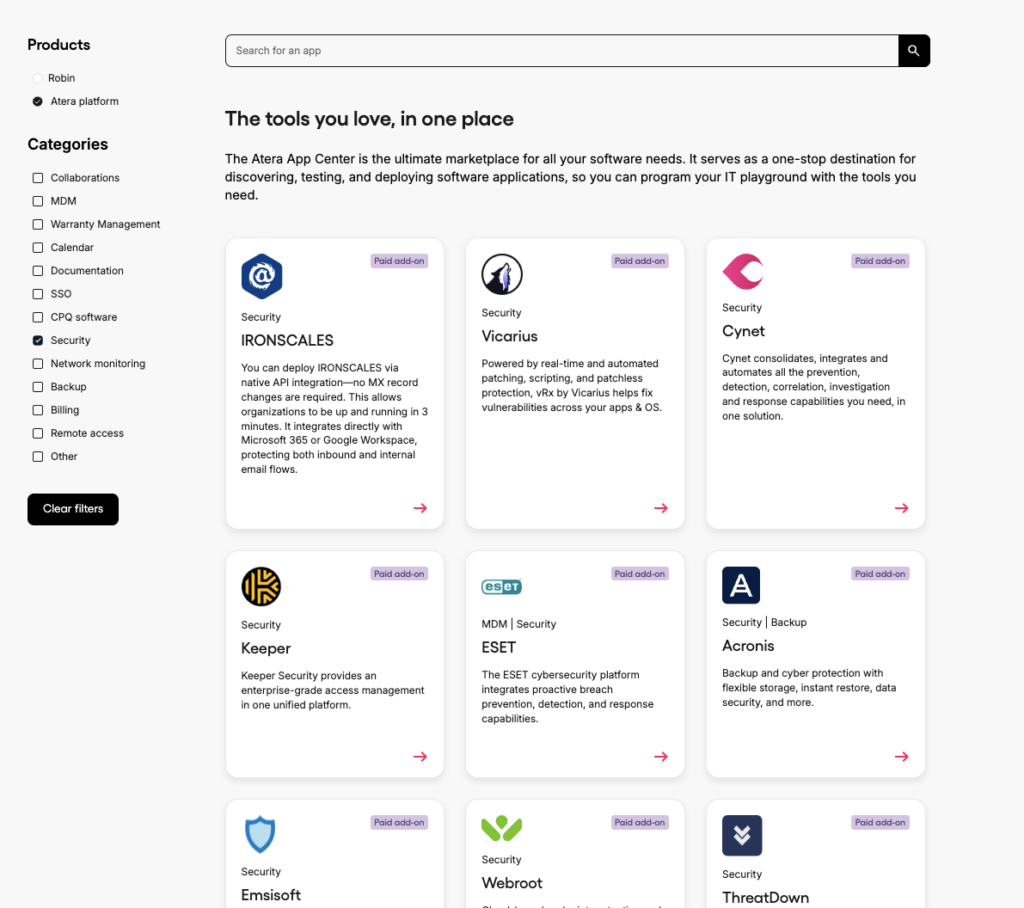
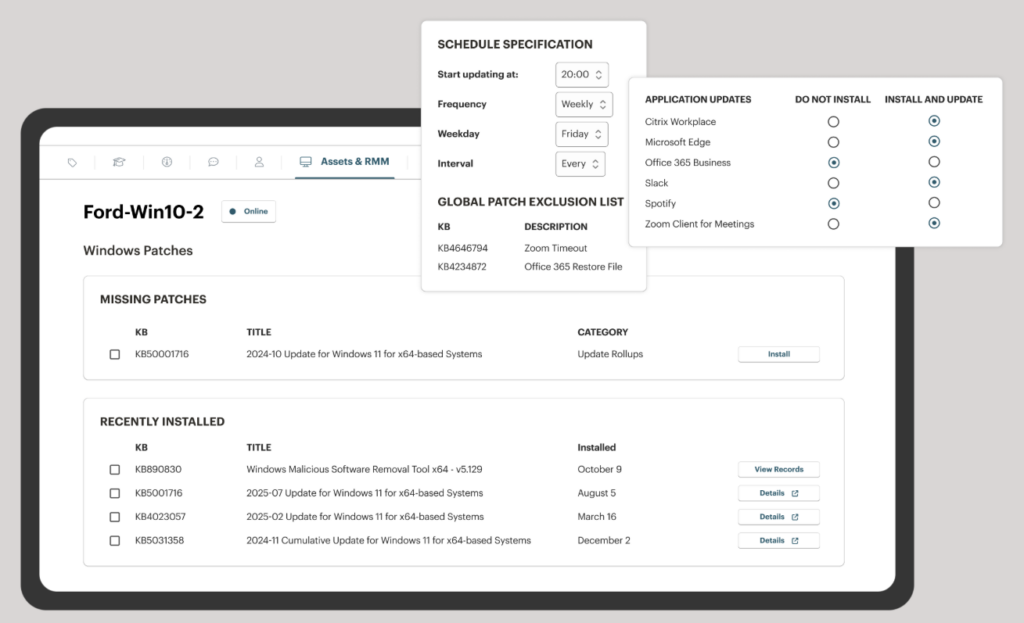
Both Atera and Syncro have automation for making patch schedules, running scripts, and doing other maintenance tasks.
#2: Agentic AI development
Agentic AI is changing how IT environments are managed. Both Atera and Syncro have developed their Agentic AI offerings, but to a different extent.
Syncro built its AI out gradually in 2026. AI ticket summarization was launched first in May, and the Syncro MCP Server followed in August. Two more pieces, ‘Automated Ticket Triage’ and ‘Guided Ticket Resolution ’, were announced for September.
Syncro’s AI breaks down into two pieces:
- Agentic service delivery: Built into Syncro’s ticketing workflow, you get AI ticket summaries (recap of the ticket’s issue and history), automated ticket triage (new tickets are automatically routed), and guided resolution (matches known issues to an approved fix).
- Syncro MCP Server: With the MCP connection, technicians can ask questions about their IT environment directly in Claude, ChatGPT, or Copilot.
Most of what these features do is summarize and recommend. Syncro’s automation is optional and configurable per action, but it doesn’t publish which tasks can run fully hands-off. And this is the main difference with Atera’s Robin.
Robin by Atera is a single AI agent that resolves the issue directly, with a clear use cases page for the issues it resolves. Where Syncro’s AI supports a technician working a ticket, Robin resolves the issue itself, in four steps:
- Diagnose: Robin takes the request, verifies the user, and asks the follow-up questions it needs to understand the issue.
- Remediate: Robin takes the approved action directly on the device, network, or in the cloud, routing for approval only when a step requires it.
- Verify: Robin confirms the issue is actually resolved before closing anything.
- Close: Robin updates the ticket in your existing ITSM with the outcome, and logs every action for governance and compliance.
Robin’s autonomous resolution rate is up to 92% of Tier-1 and complex Tier-2 technical incidents, at an average of 120 seconds each.
Syncro publishes a narrower number: it says its AI helps technicians resolve tickets up to 25% faster. This number measures how much quicker a technician gets through a ticket, not how many tickets get resolved without a technician at all.
Robin is designed to resolve up to 92% of technical IT incidents, but Atera also has AI Copilot for technicians, part of each plan at no extra cost. You can use Atera’s AI Copilot to:
- Troubleshoot devices: Run health checks, diagnose, suggest actions, and resolve issues on your macOS and Windows devices.
- Generate scripts: Turn plain-text instructions into powerful scripts in seconds. No coding needed, whether you’re solving complex issues or automating maintenance tasks.
- Get insights: Ask Copilot for insights about your IT environment. For example, you can ask it to “list all devices with low disk space” or “show all endpoints that haven’t been patched in the past 30 days.”
- Create remote session summaries: Get clear summaries of your remote sessions automatically. See the actions performed on the end-user’s Windows device.
Atera’s enterprise customers, like Leeds United, have reduced tickets by 25-35% using Copilot, freeing technicians for more strategic tasks.
#3: User interface and usability
User interface and usability are another important area, so let’s compare Atera and Syncro here.
At Atera, we’ve built our dashboards to be easy to use and navigate. No matter your team’s size, onboarding new technicians and end-users is easy and can be done in minutes, not days or weeks.
Here’s a look at Atera’s admin dashboard:

In comparison, here’s what Syncro’s admin dashboard looks like:
Both Atera and Syncro also extend access through mobile apps. This means technicians can take on tickets or any other IT task that comes up right from their phones. You can even remotely connect to devices, making it a highly convenient option for monitoring your network.
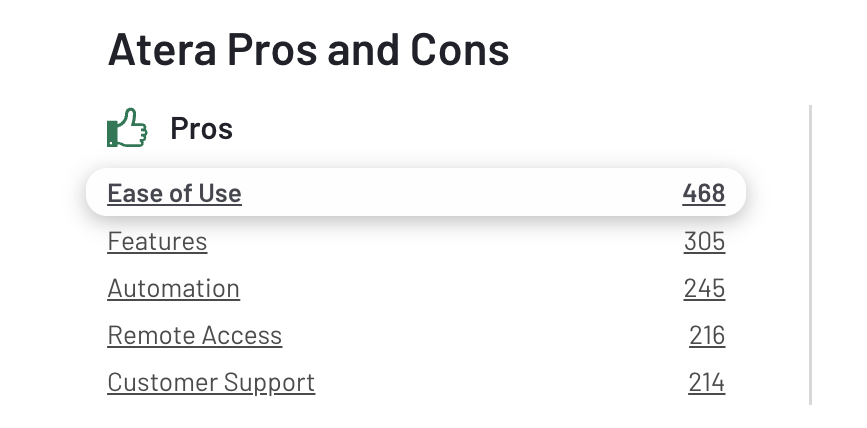
At Atera, we’ve received much praise for how easy our user interfaces are to use. In fact, users have rated “Ease of Use” as Atera’s main pro on G2:
G2 also has a section that compares Atera and Syncro’s ease of use, based on real user reviews. While both got strong reviews, we can see that Atera takes the lead:
| G2’s Ease of Use Category | 1. Atera | 2. Syncro |
| 1. Ease of Use | 9.2 stars (1,100+ reviews) | 8.8 stars (370+ reviews) |
| 2. Ease of Setup | 9.2 stars (970+ reviews) | 8.7 stars (330+ reviews) |
| 3. Ease of Admin | 9.0 stars (600+ reviews) | 8.9 stars (270+ reviews) |
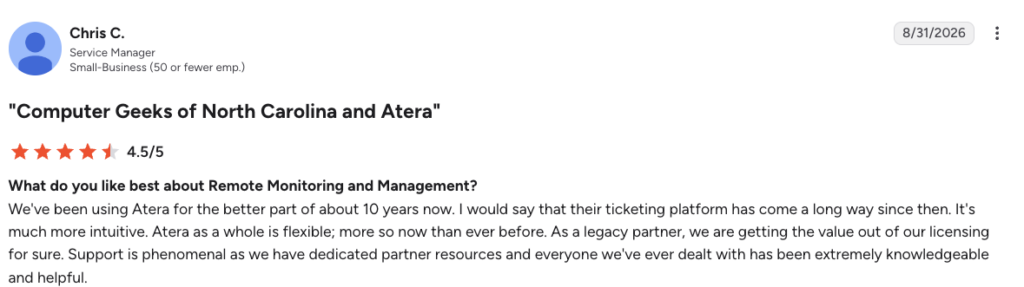
For example, this is what one long-time Atera user, Chris C., said:
- “We’ve been using Atera for the better part of about 10 years now. I would say that their ticketing platform has come a long way since then. It’s much more intuitive. Atera as a whole is flexible; more so now than ever before.”
#4: Performance and reliability
Both Atera and Syncro work hard to maintain consistent reliability in their systems to ensure smooth operation and business continuity.
Effective customer service is one major component of high performance and reliability. At Atera, we are incredibly proud of our top-tier customer service offerings and quick response times.
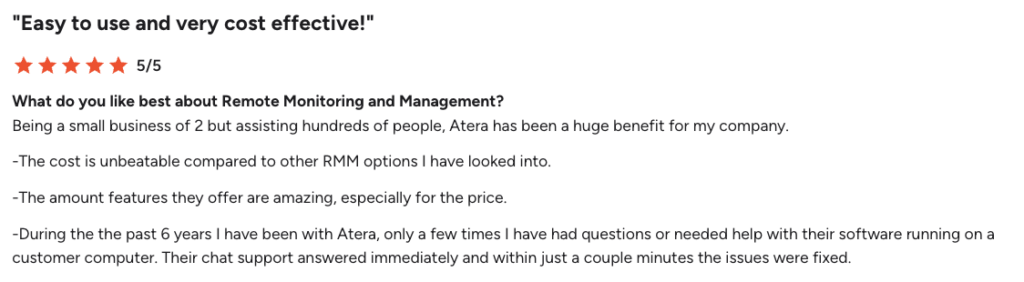
One G2 user concluded Atera’s support by saying:
- “During the past 6 years I have been with Atera, only a few times I have had questions or needed help with their software running on a customer computer. Their chat support answered immediately, and within just a couple of minutes the issues were fixed.”
Syncro reviews on support quality are generally good, but there’s also some criticism, with some users leaving Syncro due to bad support:

#5: Pricing and value for money
Atera and Syncro share similarities in pricing. Unlike most RMM pricing options, both Syncro and Atera charge per-technician, meaning you can add unlimited endpoints for a fixed cost.
Atera’s pricing ranges from $149 to $219/month for IT departments and from $129 to $209 for MSPs. Atera is a big advocate of transparent pricing, so you’ll always know what you’re paying for, with no hidden fees.
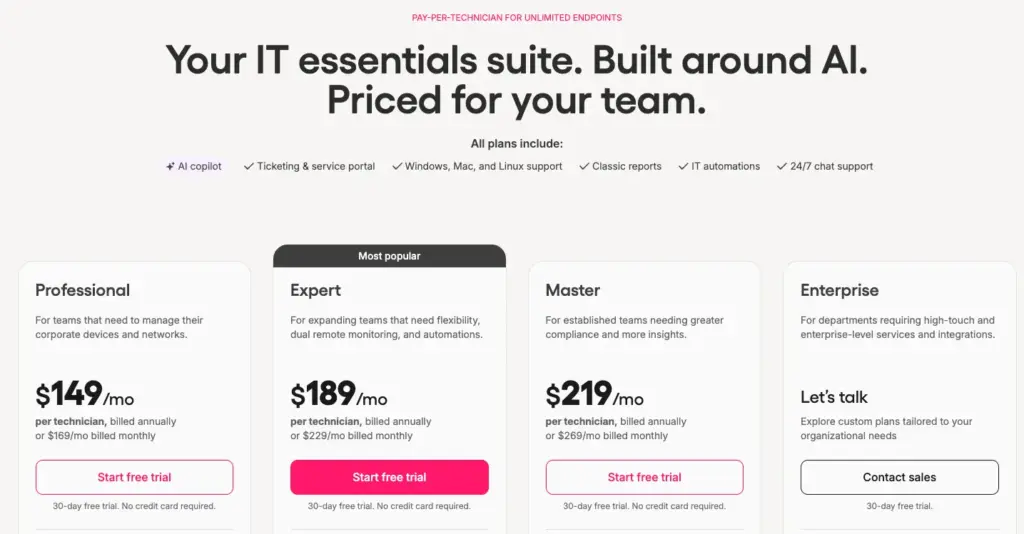
Atera’s IT department pricing plans
Many of Atera’s integrations, such as Splashtop, Homebrew, and Chocolatey, are part of its plans at no additional cost.
Syncro offers two pricing plans: Core Plan ($159/month, per user) and Team Plan ($209/month, per user). A new enterprise plan (custom quotation) is also available.
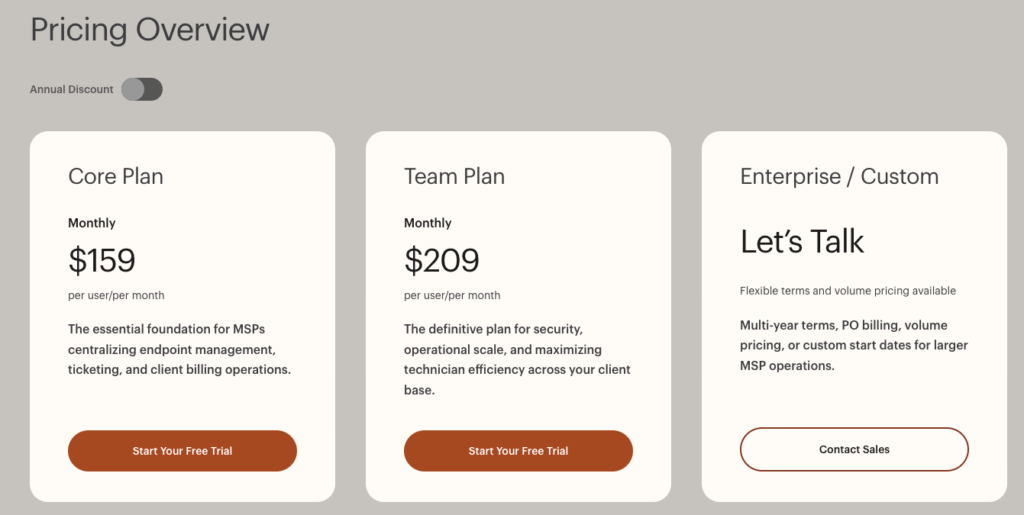
The features of the two core plans are similar, but the Team Plan has network discovery, ticket automations, security baselines, and more.
#6: Customer support and community
IT support is one of the most (if not the most) important parts of a good IT management platform. When issues arise, help should be available immediately. To solve this, Atera offers 24/7 live chat and email support for all users, while Syncro has 24/5 customer support available.
Both platforms also offer self-help resources. These include tutorials, discussion boards, and script libraries.
At Atera, we’re also incredibly proud of our active Atera Community. This community is a forum where countless Atera users interact, sharing tips, tricks, and helpful hints, and asking for support when they need it. We hold regular events and webinars (such as the recent Ateraverse 2026) for our community to discuss how to make the most of our product and explore industry trends and insights.
To help you improve end-user support, Atera Robin is available. It empowers end-users to solve issues on their own by resolving up to 92% of technical incidents autonomously, right where they already work: Teams, Slack, email, or the Atera Customer Portal.
#7: Security and compliance
Atera and Syncro follow industry-standard security compliance with features like MFA (multi-factor authentication). Atera is also SOC II Type II certified!
Atera’s Network Discovery tool allows for real-time tracking of devices on your network. It helps you easily maintain security across your network by helping you spot unauthorized devices, safely onboard new devices, and develop data backup and disaster recovery plans.
Additionally, we are constantly increasing our commitment to compliance and security. Our smart logging and reporting capabilities, as well as insights from our innovative AI agents, help you stay ahead of threats before they impact IT operations. You can read more about Atera’s AI security practices here.
Atera also offers a range of security integrations for enterprises: Acronis, Bitdefender, Cynet, Emsisoft, ESET, Ironscales, ThreatDown, Vicarius, and more.
Syncro has similar integrations, but only with four security platforms, including Bitdefender, Emsisoft, Huntress, and Webroot.
#8: User feedback and reviews
On G2 alone, Atera has gained 1,200+ reviews with an average rating of 4.6 out of 5.0 stars. In comparison, Syncro has an average rating of 4.5 out of 5.0 stars with 550+ reviews.
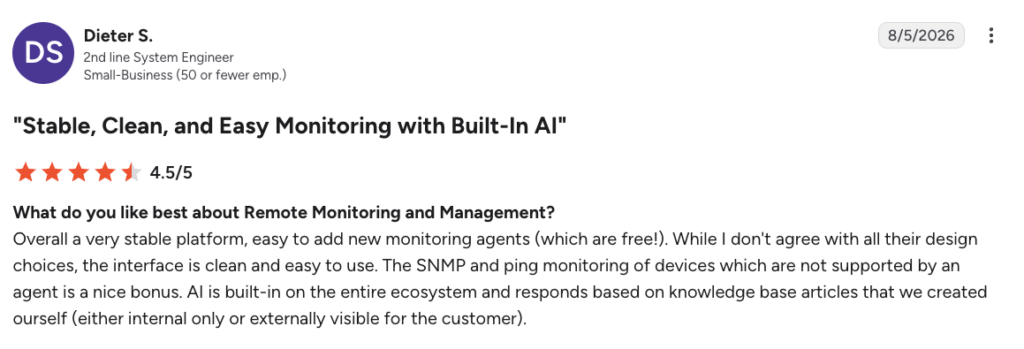
One area Atera users often compliment is its AI agents, since they help to reduce IT workload. For example, Dieter S said this:
- “AI is built-in on the entire ecosystem and responds based on knowledge base articles that we created ourselves (either internal only or externally visible for the customer).”
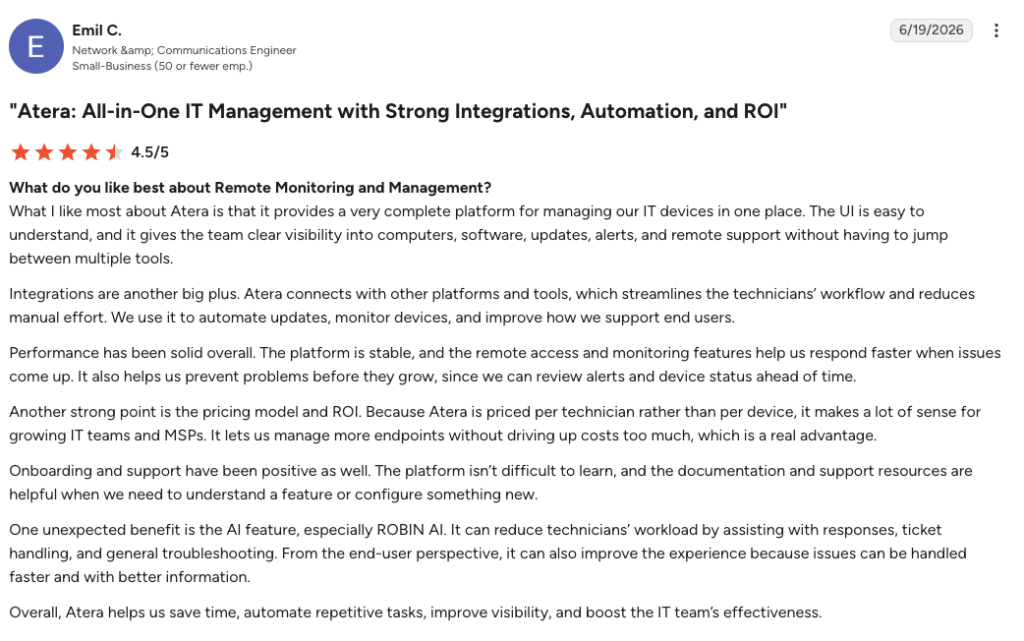
Another Atera user, Emil C. on G2, left a longer review on Atera’s advantages:
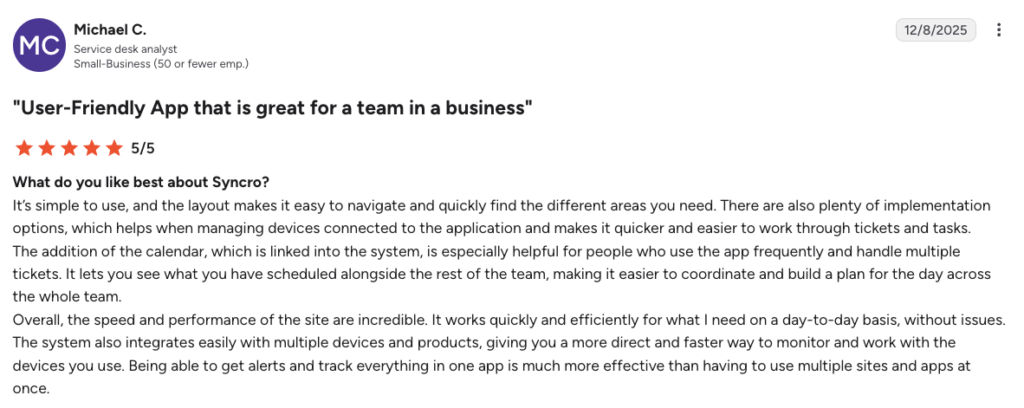
In comparison, Syncro users commonly write about the platform’s ease of use and features, such as the RMM software and PSA.
One G2 user, Michael S., said this about Syncro:
More often than not, Atera surpasses Syncro in its ability to meet the needs of an IT department and support its users when they need assistance. This is likely linked to our commitment to getting real feedback from our users to help us update the platform.
Atera’s Agentic AI platform is the right choice for most IT teams
The core features of Atera and Syncro are similar, but Atera has one distinct advantage: its Agentic AI technology.
Agentic AI represents a paradigm shift in how IT operates, and Atera is at the forefront of it with Robin that resolves up to 92% of technical incidents autonomously.
IT teams running Robin are seeing:
- Up to 92% of Tier-1 and complex Tier-2 technical incidents resolved autonomously, at a 120-second average resolution time
- 1.5 hours of technician time saved on every ticket Robin closes on its own
- A 321% ROI over three years, with payback in under six months (based on the Forrester TEI study)
See how Robin can autonomously resolve your first tickets; book a demo with our sales team today.
Frequently Asked Questions
Related Articles
Robin vs Request Resolver (Former Rovo)
Robin and Atlassian's Request Resolver (Former Rovo) both bring Autonomous IT into ITSM, but they operate at different levels. This full comparison breaks down where each one's autonomy actually reaches.
Read now
Robin vs Kaseya Intelligence
Robin by Atera and Kaseya Intelligence both talk about autonomous IT, but structure their AI technologies differently. See where each one's autonomy actually reaches and which works for your org.
Read now
Robin by Atera vs. Ivanti Neurons: comparing two very different approaches to autonomous IT
In this article, we'll compare Robin vs. Ivanti Neurons: one AI agent that resolves IT incidents end to end, and one platform that splits autonomy across two separate AI capabilities.
Read now
Robin vs Freddy AI Agent Studio
Not all agentic ITSM starts from the same place. See how Robin's deploy-ready model compares to Freddy AI Agent Studio's no-code, build-it-yourself approach.
Read nowEndless IT possibilities
Boost your productivity with Atera’s intuitive, centralized all-in-one platform