Table of contents
Generate summary with AI

MSP software keeps growing in importance – more and more businesses are looking to outsource their IT management. The global managed services software market was valued at $8.6 billion in 2025 and is projected to grow to $15.3 billion by 2035.
Plus, with new technologies like Agentic AI, MSPs that adopt the right tools have the opportunity to pull ahead of those that don’t.
Here are the 7 best MSP software platforms for scaling in 2026.
The 7 Best MSP Software for scaling in 2026
| Rank | Platform | Best For… | Philosophy |
| 1 | Atera | Scaling, Profitability & Autonomous IT | Unified RMM, PSA, and helpdesk with Agentic AI |
| 2 | Pulseway | Mobile workforce | Manage everything from your phone |
| 3 | Datto (Kaseya) | Security Integration | Embedded within the Kaseya security ecosystem |
| 4 | HaloPSA | Best-of-breed flexibility | Powerful PSA paired with RMM |
| 5 | ConnectWise | Enterprise customization | Large-scale ops with complex business logic |
| 6 | Syncro | MSPs starting out | All-in-one basics for lean operations |
| 7 | NinjaOne | Ease of Use | Modern, easy-to-use RMM-first platform |
Below is a more detailed review of each.
1. Atera – Best overall MSP software with Agentic AI
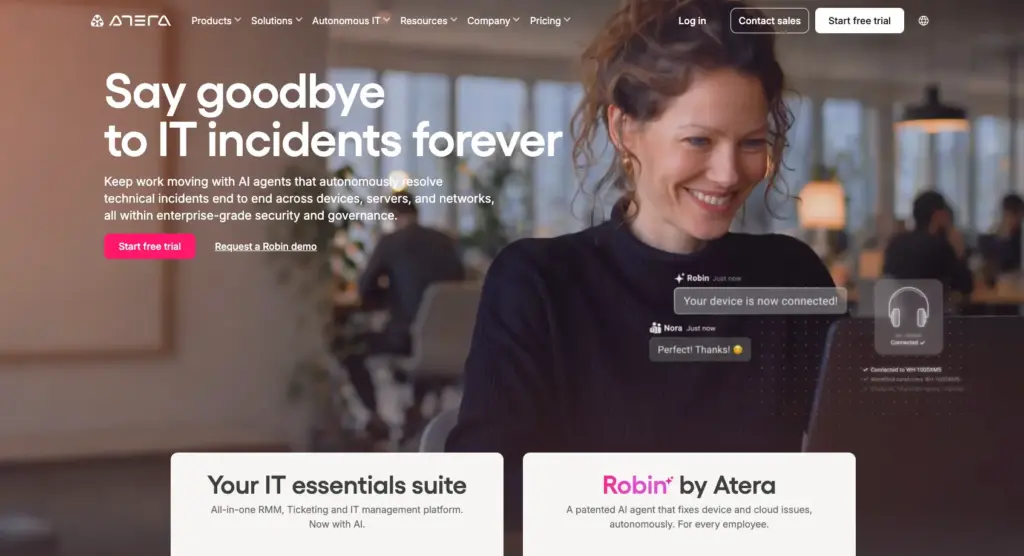
Atera combines all key MSP software features into one – RMM, PSA, remote access, patching, reporting – and powers the entire platform with industry-leading Agentic AI.
It’s the ideal choice for MSPs wanting to future-proof their IT with autonomous AI agents, while scaling without limits on endpoints.
- Atera’s RMM: Full remote monitoring and management across Windows, Mac, and Linux endpoints.
- AI agents: Robin by Atera resolves up to 92% of technical issues autonomously, and Atera’s AI Copilot assists technicians with manual and repetitive tasks.
- Patch management: Automated patching across all OS and third-party applications.
- PSA: Integrated ticketing, time tracking, contract management, SLA monitoring, and billing.
- Remote access: To remotely access end-users’ devices. Works via Splashtop and AnyDesk integrations, no separate licensing required.
- Reporting and analytics: Customizable reports that cover ticket volume, SLA performance, technician efficiency, client health, and more.
Pros & cons:
| Pros | Cons |
| Agentic AI that resolves issues autonomously | The all-in-one feature set can be overkill for small operations |
| Per-technician pricing with unlimited endpoints | 24/7 live support is currently available in English only |
| All-in-one platform (RMM, PSA, helpdesk) – no need to stitch different tools together | Per-technician pricing works best at scale; MSPs with only a few devices may find it less cost-efficient |
| Intuitive user interface and 24/7 support for any technical issues | The mobile app is still developing compared to the cloud version |
Pricing:
Unlike most MSP software, Atera uses per-technician pricing with unlimited endpoints.
Atera’s MSP pricing plans are:
- Pro: $129/month, per technician
- Growth: $179/month, per technician
- Power: $209/month, per technician
- Superpower: Custom quotation
Atera’s IT department pricing plans are:
- Professional: $149/month, per technician
- Expert: $189/month, per technician
- Master: $219/month, per technician
- Enterprise: Custom quotation
Each plan comes with a 30-day free trial.
What users are saying:
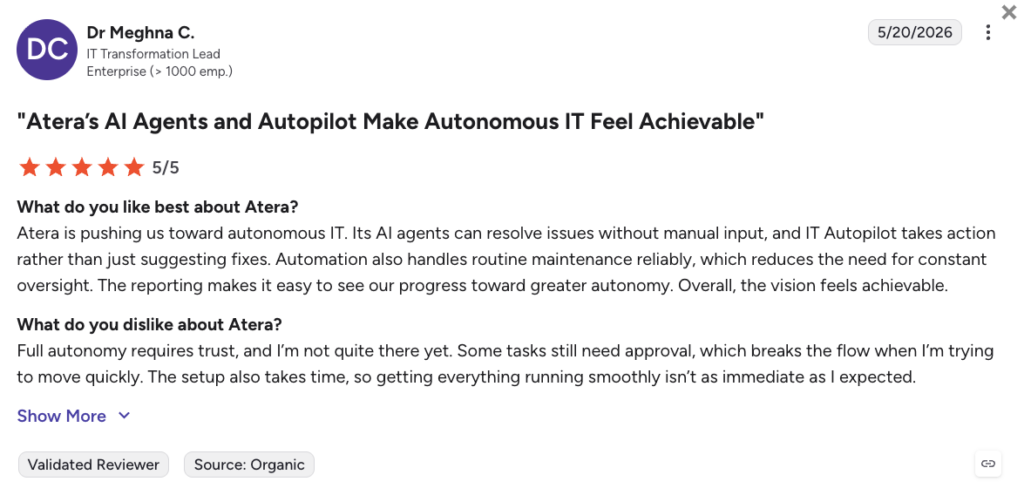
Atera users love the all-in-one functionality, fair per-technician pricing, and the impact its AI agents and automation are having on organizations. Read more Atera’s G2 reviews here.
Dr. Meghna C. commented on Atera’s AI agents: “Atera is pushing us toward autonomous IT. Its AI agents can resolve issues without manual input, and IT Robin takes action rather than just suggesting fixes.”
2. Pulseway – A practical tool for mobile-first teams
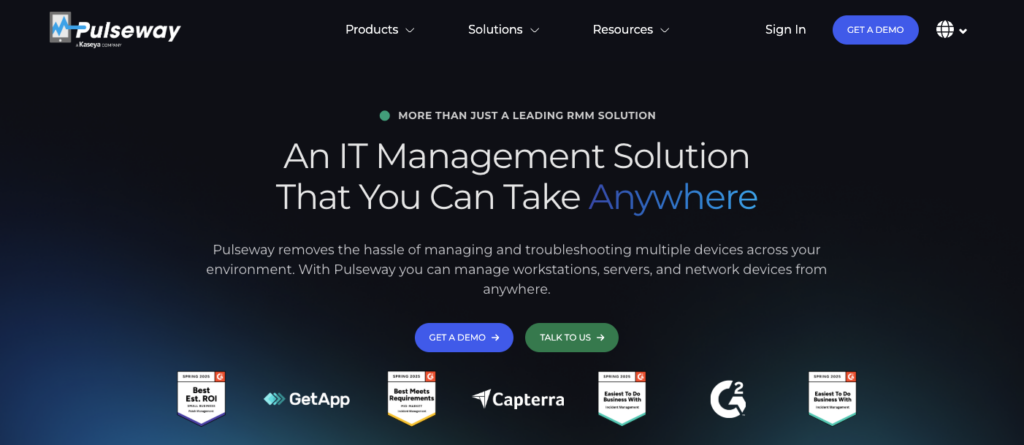
Pulseway is an RMM platform with a strong mobile app for both Android and iOS users. If you like to monitor and respond to alerts directly from your phone, it’s a good choice.
Key features:
- Full-featured mobile app for iOS and Android
- Remote monitoring and alerting
- Patch management and scripting
- Endpoint management and reporting
- Integrations with PSA tools
Pros & cons:
| Pros | Cons |
| Full-featured mobile app | Decline in support quality since the Kaseya acquisition |
| Straightforward setup | Per-endpoint pricing |
| Automation and scripting workflows | Web dashboard feels dated |
| Built-in RMM, remote access, and PSA | No Agentic AI |
Pricing:
Pulseway previously had a pricing calculator on its website, but now requires you to request a demo via its website for pricing.
What users are saying:
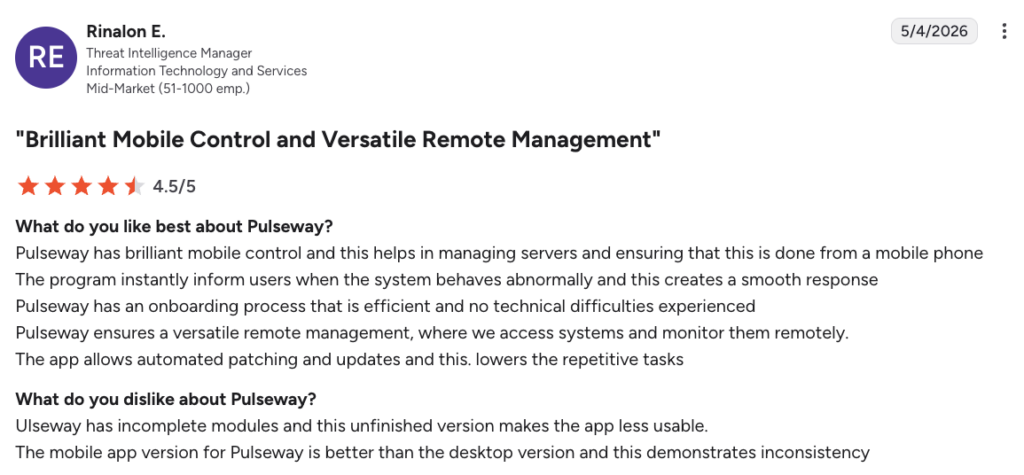
Most users on G2 agree that Pulseway’s mobile app is strong and the software is easy to implement, though the web dashboard lags behind.
Rinalon E. said, “Pulseway has brilliant mobile control, and this helps in managing servers. But it has incomplete modules, and this unfinished version makes the app less usable.”
3. Datto (Kaseya) – A solid option for security integration
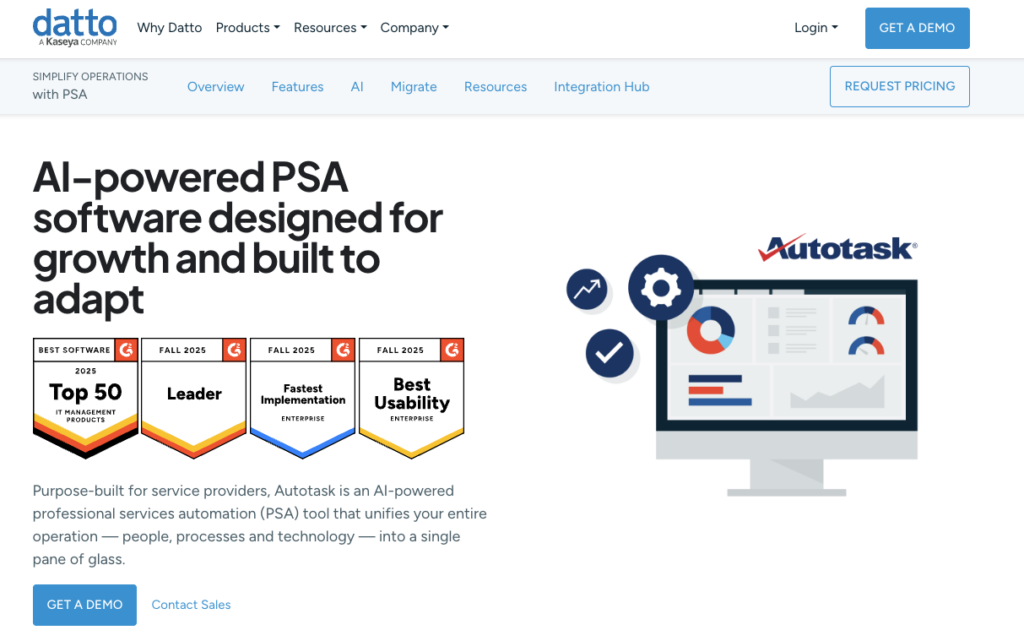
Datto (owned by Kaseya) offers two main products for MSPs: Datto RMM and Autotask PSA.
If you already operate in the Kaseya Ecosystem and need RMM and PSA capabilities with tight integration with tools like IT Glue, it’s a solid option.
Key features:
- RMM capabilities
- Autotask PSA for ticketing, billing, and SLA management
- Integration with IT Glue for documentation
- Security-focused monitoring tied into the Kaseya ecosystem
- Automated patching and endpoint management
Pros & cons:
| Pros | Cons |
| Advanced RMM capabilities | Navigation can get difficult to manage as your environment grows |
| Easy integrations with IT Glue and Autotask PSA | Product quality has been declining in recent years |
| Strong remote management and endpoint visibility | Support has slowed down, according to some users |
| Ease of use and implementation initially | Patching can be inconsistent |
Pricing:
Datto’s pricing is based on a custom quotation. Contact their sales team for exact pricing.
What users are saying:
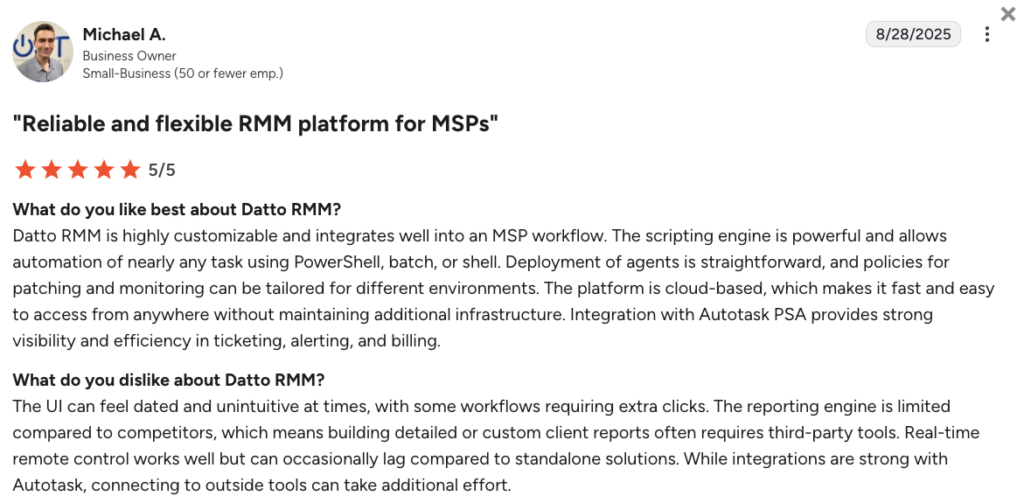
Users value Datto RMM’s customizability and ecosystem integrations, but there are complaints about declining support quality and UI difficulties.
Michael A. specifically says, “Datto RMM is highly customizable and integrates well into an MSP workflow. The UI can feel dated and unintuitive at times, with some workflows requiring extra clicks.”
Read more about Datto pros and cons here.
4. HaloPSA – A reliable pick for mixed-platform setups
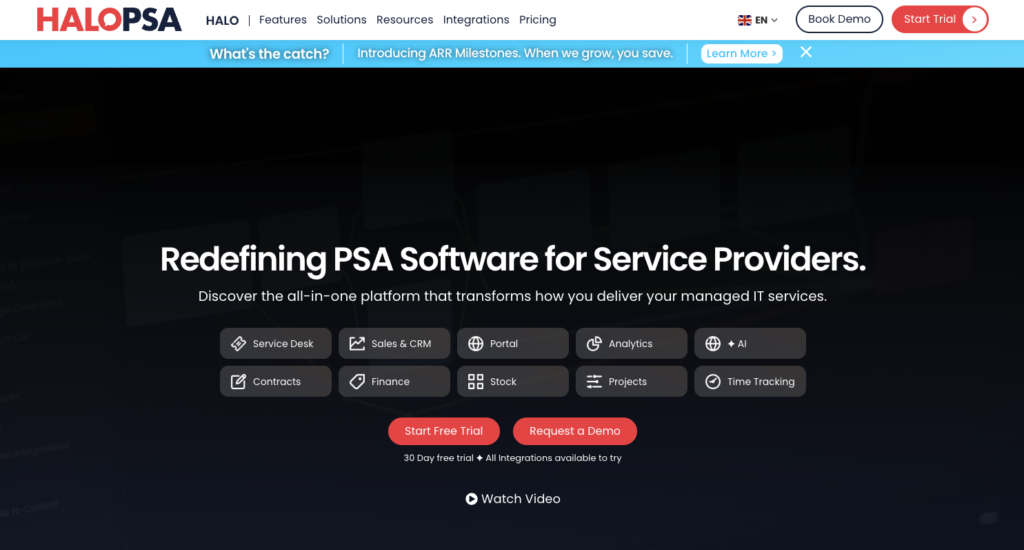
HaloPSA is a PSA platform known for its ticketing system with strong customization options.
Since HaloPSA is entirely PSA-focused, it works best for MSPs that pair it with a dedicated RMM tool, such as Atera.
Key features:
- Ticketing and service desk management
- Contract, SLA, and billing management
- Highly customizable workflows
- Integrations with tools like Atera, IT Glue, Microsoft 365, and more
- Reporting and asset management
Pros & cons:
| Pros | Cons |
| Highly customizable ticketing system | The mobile app is not fully-fledged |
| Responsive support available | Users report billing issues – syncing into QuickBooks doesn’t work well |
| Broad range of integrations with RMM products | Entirely a PSA platform – lacks RMM, remote access, and patch management |
| Strong community behind the product | Limited AI compared to competitors like Atera |
Pricing:
HaloPSA has a pricing calculator on its website – pricing starts from $89/agent, per month. The more agents you have, the cheaper it gets.
A 30-day free trial is available. Each new customer is required to pay a $4000 minimum onboarding fee.
What users are saying:
HaloPSA users appreciate the deep customization, though the steep learning curve is a common drawback, reported by G2 users.
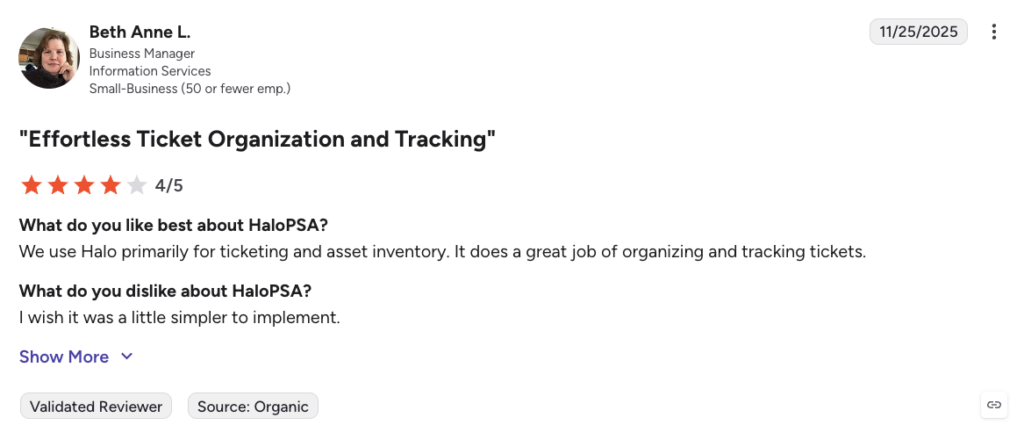
Beth Anne L. concluded her experience with HaloPSA and said, “HaloPSA does a great job of organizing and tracking tickets. I wish it were a little simpler to implement.”
5. ConnectWise – Standard option for enterprise customization
ConnectWise is a long-standing MSP platform with features covering RMM, PSA, and security.
These are spread across different products, such as ConnectWise PSA, Automate, and ScreenConnect.
Key features:
- PSA with ticketing, billing, and contract management
- RMM and remote access via ScreenConnect
- Extensive third-party integrations
- Advanced reporting and custom field creation
- Security and compliance tooling
Pros & cons:
| Pros | Cons |
| Good integrations with ConnectWise products and 3rd-party software | Steep learning curve |
| Extensive feature set | Lacking customer support |
| Highly customizable product | Performance issues due to feature bloat |
| Once you get the hang of it, ConnectWise PSA is easy to use | Expensive pricing if you stack up different ConnectWise products |
Pricing:
ScreenConnect’s pricing starts at $30/month. Other ConnectWise products require a custom quote, and each product has its own pricing structure. The cost can add up significantly.
A 14-day or 30-day free trial is available, depending on the ConnectWise product.
What users are saying:
Most users on G2 agree that ConnectWise is capable of a lot, and it has useful integrations, but it also comes with a steep learning curve.
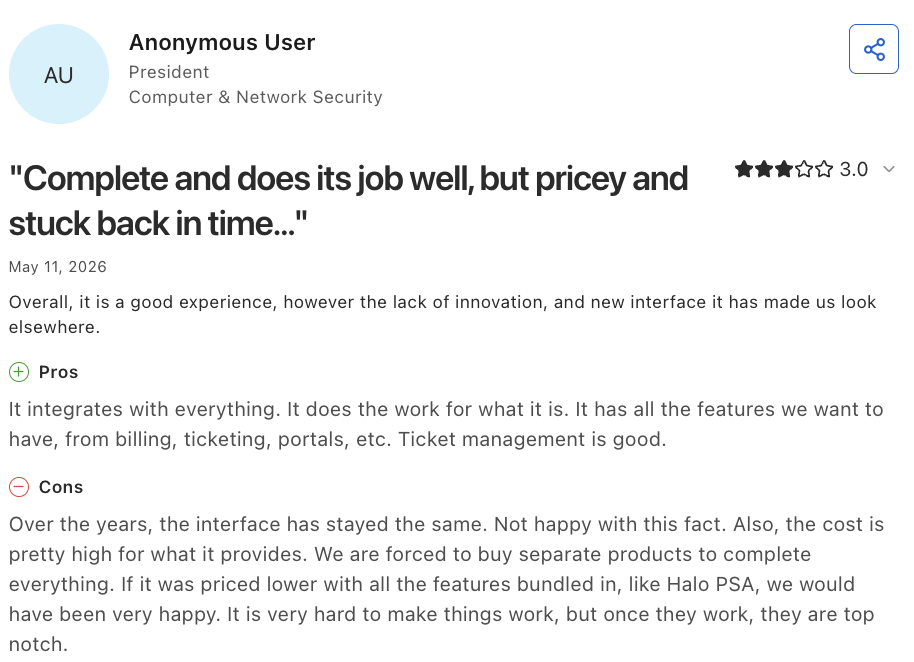
One user on Capterra said, “It integrates with everything. It does the work for what it is. Over the years, the interface has stayed the same. Not happy with this fact.”
6. Syncro – A simple all-in-one for smaller operations
Syncro’s MSP platform combines RMM and PSA basics into a single tool. Like Atera, it uses per-technician pricing and is one of the most affordable options.
If you only need the core MSP functionality without complex pricing or setup, it’s a good option.
Key features:
- RMM with remote access via Splashtop
- Ticketing and PSA basics
- Scripting and software deployment
- Billing and invoicing
- Asset management for Windows and Mac devices
Pros & cons:
| Pros | Cons |
| Affordable per-technician pricing | Users report outgrowing it quickly |
| Easy to use for smaller MSPs | Support can be hit or miss |
| Covers the key PSA and RMM features | Limited capabilities for non-Windows/Mac devices |
| Built-in billing system | AI features need significant improvement, as reported by users |
Pricing:
Syncro’s month-to-month pricing plans start from $209/month, per technician. A 14-day free trial is available to try out the platform.
What users are saying:
Users like how Syncro combines key IT management features into one platform, though its lack of standout features becomes noticeable as teams grow.
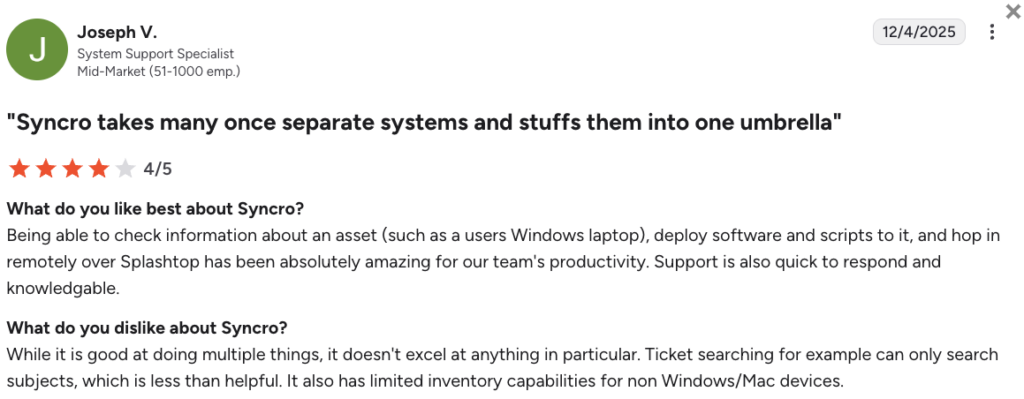
Joseph V. concludes his experience, “Syncro covers the essentials well: remote access, software deployment, and scripting, but doesn’t excel in any one area, with limited ticket search and inventory capabilities holding it back.”
7. NinjaOne – Suitable for MSPs prioritizing ease of use
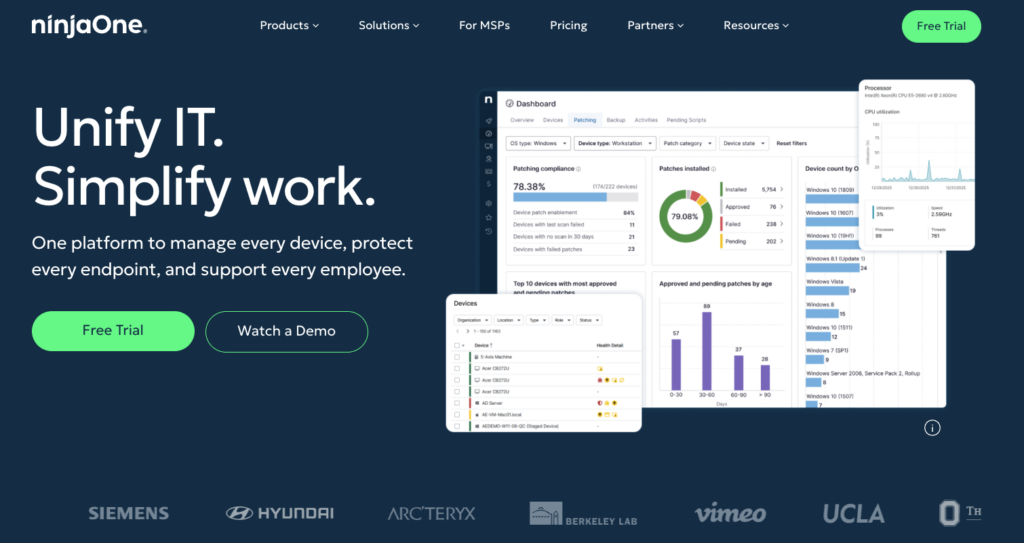
NinjaOne is known as an RMM platform built for MSPs and IT teams that need endpoint management capabilities without a steep learning curve.
If you value a clean interface, quick implementation, and strong support during onboarding, it can be a suitable option.
Key features:
- Endpoint monitoring and management (Windows, Mac, Linux)
- Automated patch management across all devices
- Remote access via built-in Splashtop or ScreenConnect
- Scripting and automation for routine tasks
- Backup and MDM as add-on modules
Pros & cons:
| Pros | Cons |
| Ease of use | Pricing requires a custom quote (no public tiers available) |
| Ongoing feature improvements | Can get expensive when scaling (per-endpoint RMM pricing) |
| Strong patch management and automation | “Half-baked PSA module”, according to some Reddit users |
| Highly rated support | Missing features (e.g., Agentic AI) |
Pricing:
Per-device pricing, based on a custom quotation. NinjaOne users on Reddit say the base price is $180/month for 50 endpoints.
You need to contact NinjaOne’s sales team for the exact pricing. A 14-day free trial is available.
What users are saying:
Users on G2 like NinjaOne for its ease of use and strong automation, though many note the ticketing system falls short, and some features lack depth.
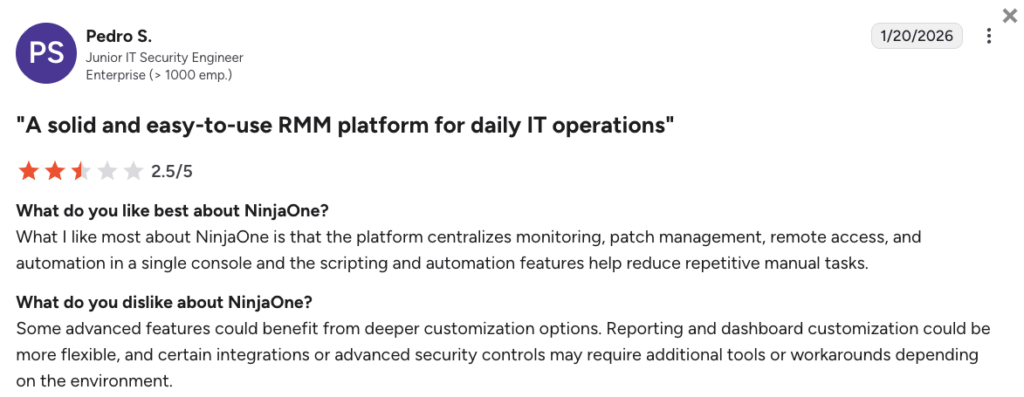
Pedro S. specifically liked how NinjaOne centralized monitoring, but said that “some advanced features could benefit from deeper customization.”
10 key features to look for in an MSP software
1. RMM: The core of any strong MSP software
RMM software helps your MSP to monitor, maintain, and secure your clients’ IT systems, servers, and networks remotely.
The standard RMM features to look for are:
- Visibility of client endpoints (servers, desktops, laptops, IoT devices)
- Proactive maintenance (spot endpoint issues, e.g, failing drives and trigger alerts)
- Automated remediation (fix issues for users in the background with scripts)
Modern RMM software goes beyond basic monitoring – platforms like Atera can automatically remediate issues before a technician ever gets involved.
2. Agentic AI: To automate manual & repetitive tasks
Gartner predicts that by 2029, Agentic AI will autonomously resolve 80% of all customer service issues.
For MSPs, that shift is already underway, and Atera’s Robin is an example of this.
Robin autonomously resolves 50% of your technical issues within the first three months, with the potential to reach up to 92% over time, freeing technicians for higher-value work.
3. Scripting & automation: For remediating issues automatically.
Scripting lets your technicians run commands, deploy software, and fix common issues across all endpoints at once.
A few MSP software also offer AI-powered scripting, meaning you can generate scripts from a simple prompt, saving technicians time.
4. Patch management: For keeping devices up-to-date
Exploited vulnerabilities are the reason for 29-32% of ransomware attacks. Patch management is your first line of defense.
Patch management in your MSP software discovers unpatched software, schedules and deploys updates across all Windows, Mac, and Linux devices.
5. Network discovery: To map and monitor clients’ environments
Network discovery automatically scans and identifies all devices connected to a client’s network.
Not only does this save your time as an MSP, but it also surfaces devices that could pose a security risk.
6. Asset management: To keep track of clients’ IT assets
With an asset management tool, you get a full inventory of hardware and software in your client environments.
Asset management helps MSPs with:
- Tracking hardware lifecycle
- Monitoring software usage
- Identifying vulnerable endpoints
- Preventing over-purchasing
7. Remote access: To remotely access end-user devices
With remote access, you can securely connect to clients’ devices or networks over the internet.
It’s standard in today’s MSP software, so look for standout features, like AI-powered remote session summaries.
8. PSA: For managing tickets, contracts, billing, SLAs, and more
With PSA in your MSP software, you should be able to:
- Manage and assign IT issues to technicians
- Log time against specific tickets and projects
- Automate billing by pulling tracked hours and retainer agreements
- Track contracts and service-level agreements (SLAs)
- Maintain client information and communication logs
9. Reporting software:
Reports in MSP software help prove service value and track technician efficiency. You should be able to create:
- Client reports (uptime, resolved tickets, SLA compliance)
- Technician performance reports (response times, ticket volume, resolution rates)
- Audit reports (change logs, patch status, and compliance summaries)
10. Integrations: To connect your existing tools
Your MSP software should connect with the tools you already use, whether it’s accounting, documentation, security, or communication app.
Related Articles

The 7 best autonomous IT support tools in 2026
A side-by-side look at the 7 best autonomous IT support tools for 2026. See the pros and cons, features, pricing, and what users really think.
Read now
Best cloud-based help desk for large-scale operations
Modern cloud-based help desk platforms can move fast, scale massively, and save IT teams hours of time with smart automation. But they aren’t all created equal. See which features to explore to make sure the cloud help desk tool you choose can truly automate IT support with AI, streamline both employees’ and IT teams’ work, and stay under budget even as operations scale.
Read now
6 Best Firewall Appliances in 2026
Discover the best firewall appliances, backed up by other IT managers. Find out the pros and cons, features, pricing, and performance of each firewall.
Read now
6 Best VoIP Hardware for IT Departments: 2026’s Comparison
Find out what Atera’s experts (and other IT managers) recommend for the best VoIP hardware. Learn about the different VoIP hardware you need for efficient operations.
Read nowEndless IT possibilities
Boost your productivity with Atera’s intuitive, centralized all-in-one platform