Generate summary with AI

Even the most modern and up-to-date personal computers (PCs) and operating systems (OS) experience performance decline over time. Higher software demands, resource-intensive applications, increased CPU usage, or hidden issues like malware can all cause systems to slow down or stop altogether.
When such issues arise, IT professionals can turn to PC performance monitoring software. These products enable users to track system resources in real time, identify bottlenecks, and detect any underlying issues affecting performance.
For IT professionals who want to keep personal computers running smoothly, investing in PC monitoring software is a no-brainer. But what are the best available tools for monitoring PC performance? In this article, we’ll review the top options.
The 8 best PC performance monitoring software
The eight best PC performance monitoring software for 2026 are:
- Atera
- Paessler PRTG
- SolarWinds NPM
- Kaseya VSA
- Pulseway
- ManageEngine
- Domotz
- Datto RMM
Below is a detailed review of each of these options.
1. Atera

Atera’s autonomous IT platform makes it easy for organizations to monitor the performance of PCs and other network devices. With Atera’s RMM, users can monitor performance levels including CPU load, memory usage, disk space, network bandwidth, and more.
Not only does Atera offer RMM, but also:
- Patch management for Windows, Mac, Linux
- Remote access for troubleshooting
- Asset management
- Network Discovery
- Help desk and ticketing
- Professional services automation (PSA)
- Atera’s two AI agents
Atera integrates with third-party software, such as Splashtop for remote access, Cynet for security, and Domotz for network monitoring. Accounting software integrations are available for MSPs. Atera also supports API integrations.
Atera’s added benefit is its 50+ integrations for Robin, with different ITSM, identity provider, and SaaS applications. This means it works wherever your IT already lives in.
Features and capabilities
Threshold-based alerts are a key component of any strong software for PC performance monitoring. Atera’s threshold-based alerts provide early warning of potential threats and help protect against them.
Users can set the Atera agent to monitor CPU load, memory usage, network bandwidth, and more.
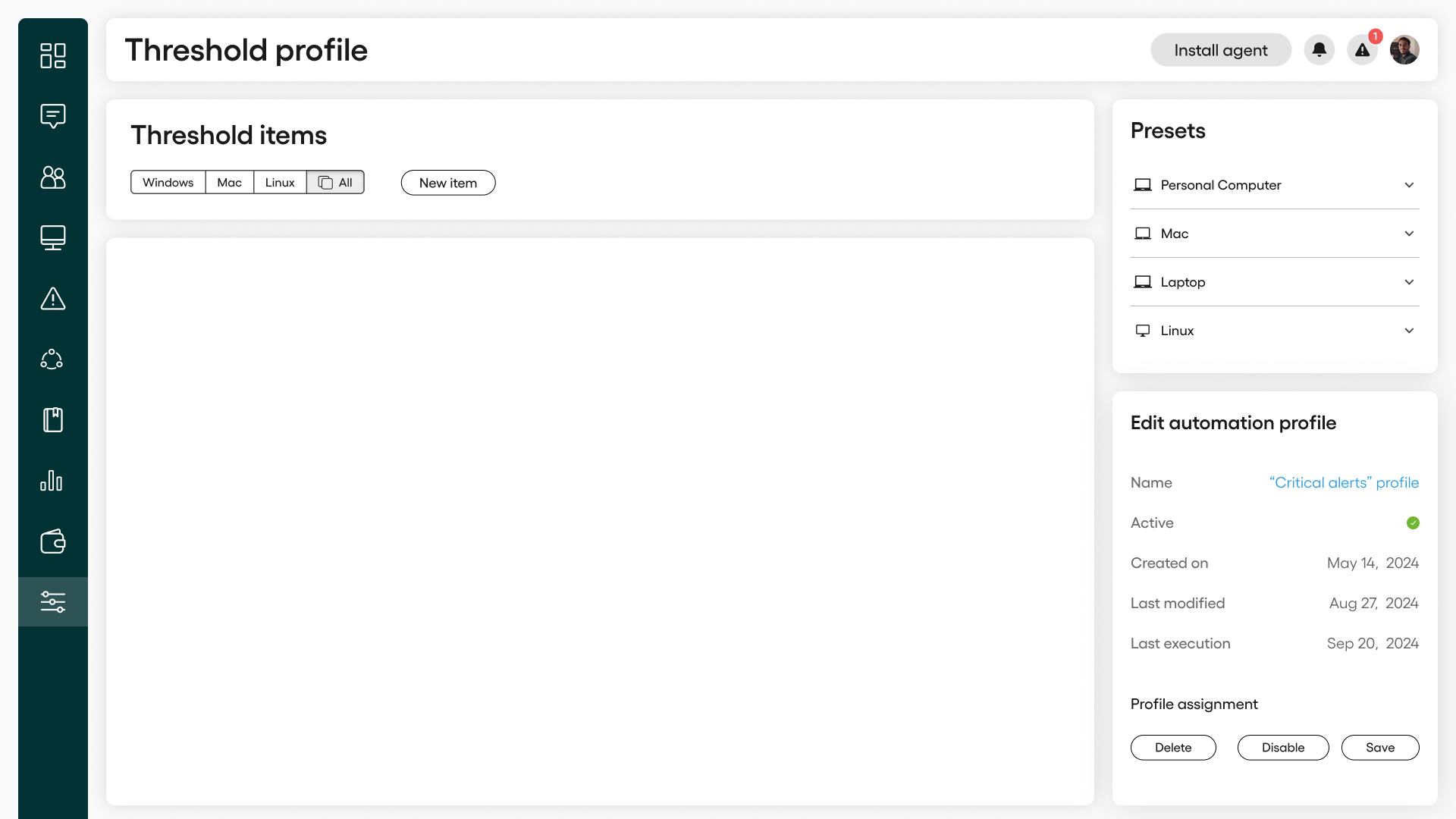
Atera Threshold profiles
Once a certain threshold is reached, users can drill down to the individual device to see what tasks/processes/programs are causing the issue.
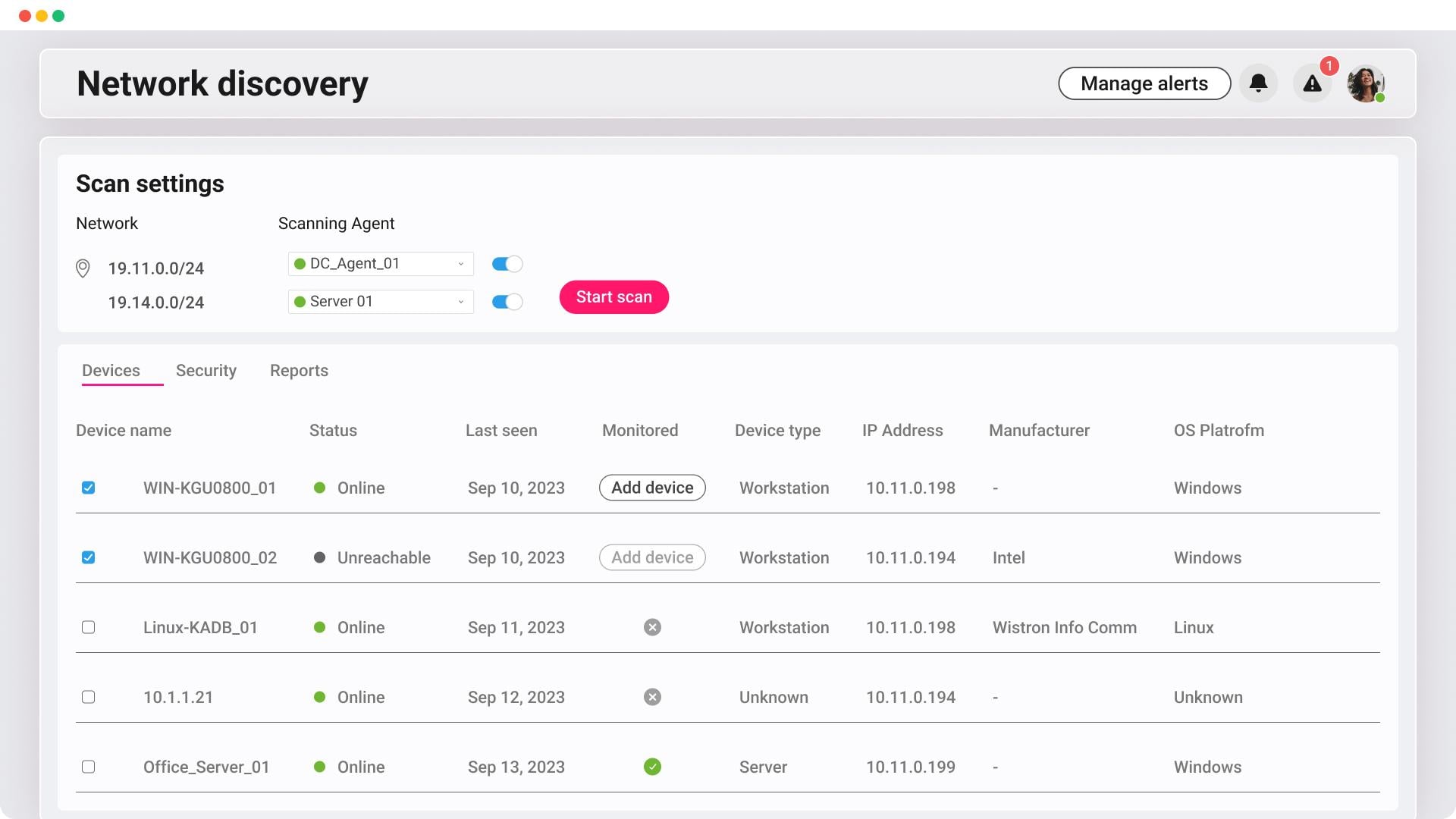
Atera’s Network Discovery tool is also highly beneficial for performance monitoring. It shows a list of all network devices—PCs, laptops, routers, servers, printers, etc—while also delivering status reports and attributes for each piece of equipment.
Agentic AI technology
Atera’s unique advantage over other PC performance monitoring tools is its two AI agents: Robin by Atera and AI Copilot.
Robin resolves up to 92% of Tier-1 and complex Tier-2 technical incidents by reaching directly into the device, server, or the cloud. For incidents within its scope, Robin diagnoses the issue, executes the fix, and closes the incident, with no technician in the loop.
It does this following a four-step resolution process:
- Diagnose: Robin traces the problem to root cause, on the device, across networks, and in the cloud.
- Remediate: Robin executes the fix autonomously, resolving Tier-1 and complex Tier-2 incidents with no technician in the loop. Examples include resetting a password, clearing a print queue, or reinstalling an app.
- Verify: Robin confirms the fix worked and the incident is fully resolved
- Close: Robin closes the incident autonomously and logs every action for governance and compliance.
Robin works within your rules. Approval workflows and hands-off actions route to a technician, with full context attached, when governance requires a human.
Robin responds in 0.1 seconds and resolves incidents in under 120 seconds on average. With Robin handling end-user support, your technicians can spend their time on higher-value tasks that actually need them.
Plus, there’s also Atera’s AI Copilot. It assists technicians with remote session summaries, instant ticket summaries, knowledge article generation, device troubleshooting, and an AI script generator.
The AI script generator generates scripts to fix issues such as slow device performance or recurring application crashes. Scripting is normally a manual process that takes a considerable amount of time.
User interface and usability
From the ground up, Atera was designed with ease of use in mind. Its interface keeps navigation simple, with admin dashboards that surface device health at a glance.
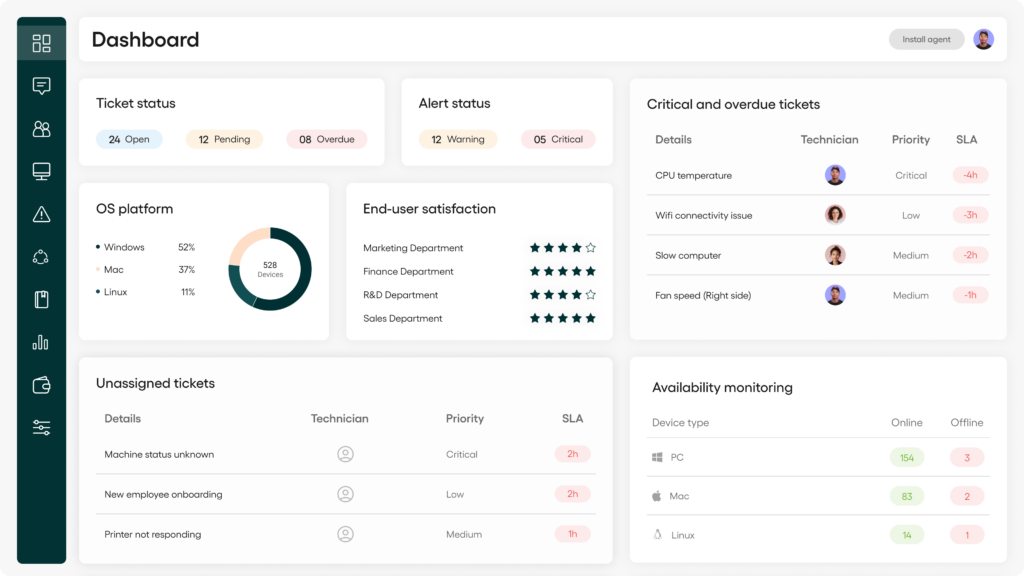
Atera’s admin dashboard
If you face any issues navigating Atera’s platform, you can contact customer support via live chat 24/7.
Atera also has an extensive library of self-help documents, including a knowledge base, hundreds of blog articles, webinars, and an active IT community.
Pricing and value for money
Atera’s pay-per-technician pricing diverges from the industry norm of pay-per-endpoint pricing. With pay-per-technician pricing, you can add and manage unlimited devices at no additional cost. With pay-per-endpoint plans, costs rise with every endpoint added, which makes it hard to scale predictably.
The pricing plans for IT departments range from $149 to $219 per month, and the MSP pricing plans range from $129 to $209 per month.
Enterprise customers can receive a custom quotation for a more tailored service. AI Copilot is included in every Atera plan at no additional cost. Network Discovery and Robin are available as an add-on.
Atera pricing:
Atera’s pricing plans for IT departments:
- Professional: $149 per month, per technician
- Expert: $189 per month, per technician
- Master: $219 per month, per technician
- Enterprise: Custom quotation. Contact sales for pricing.
Atera’s pricing plans for MSPs:
- Pro: $129 per month, per technician
- Growth: $159 per month, per technician
- Power: $209 per month, per technician
- Superpower (Enterprise): Custom quotation. Contact sales for pricing.
Get started today with Atera’s free 30-day trial, no credit card required.
Atera G2 rating: 4.6 out of 5.0 stars (1,200+ reviews)
What Atera users are saying on G2:
- “One unexpected benefit is the AI feature, especially Robin. It can reduce technicians’ workload by assisting with responses, ticket handling, and general troubleshooting,” Emil C. says.
- “The most helpful of using Atera is that you have both RMM and PSA in one platform and also the AI capabilities with Copilot and Robin,” Alan S. says.
Atera Capterra rating: 4.6 out of 5.0 stars (300+ reviews)
What Atera users are saying on Capterra:
- “Atera has been a reliable tool for handling day-to-day IT operations. It reduces repetitive work and gives good visibility into system health,” Dymasius S. says.
- “Atera’s dashboard is intuitive and provides insights into the systems we manage, making remote access and troubleshooting tasks easy for us,” Palash W. says.
2. Paessler PRTG
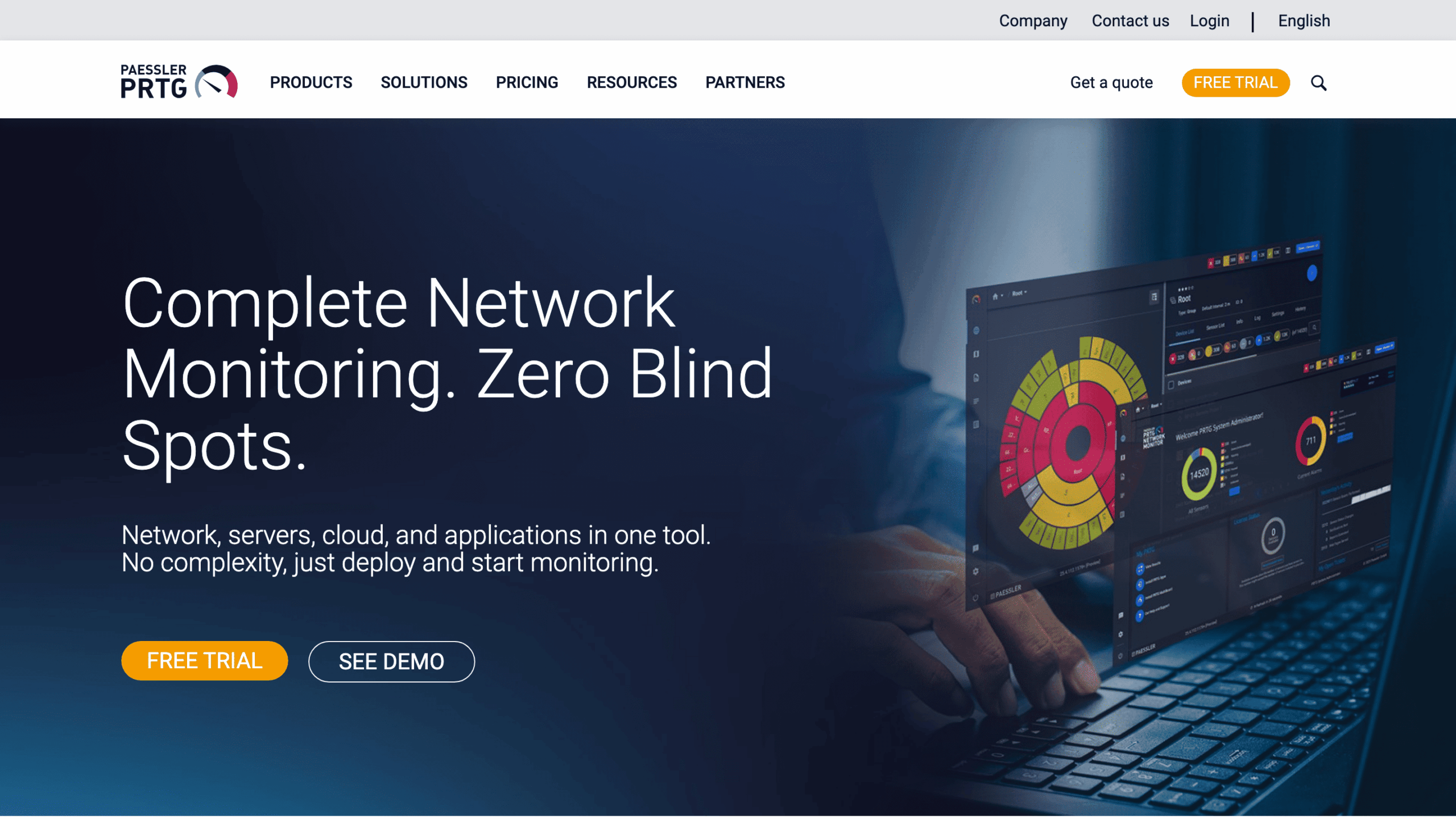
Paessler PRTG Network Monitor provides centralized monitoring for the entire IT infrastructure. It monitors various devices’ hardware, software, and network performance, including that of PCs. Paessler offers a built-in alarm system to detect and resolve issues proactively. For increased functionality, Paessler can integrate with select third parties.
Paessler offers three powerful network monitoring products, making it a great option for users solely focused on network monitoring capabilities. But it lacks other features many IT teams consider essential, including a strong RMM, PSA, and remote access. The PRTG version 26.2 added MAX, which is an AI chatbot that answers questions and helps with troubleshooting. However, it isn’t agentic, like Atera’s Robin.
G2 Rating: 4.6 out of 5.0 stars (100+ reviews)
Capterra Rating: 4.6 out of 5.0 stars (250+ reviews)
Paessler PRTG Pricing:
- PRTG 500: $137/month for about 50 devices
- RTG 1000: $242/month for about 100 devices
- PRTG 2500: $508/month for about 250 devices
- PRTG 5000: $908/month for about 500 devices
- PRTG 10000: $1,225/month for about 1,000 devices
3. SolarWinds NPM
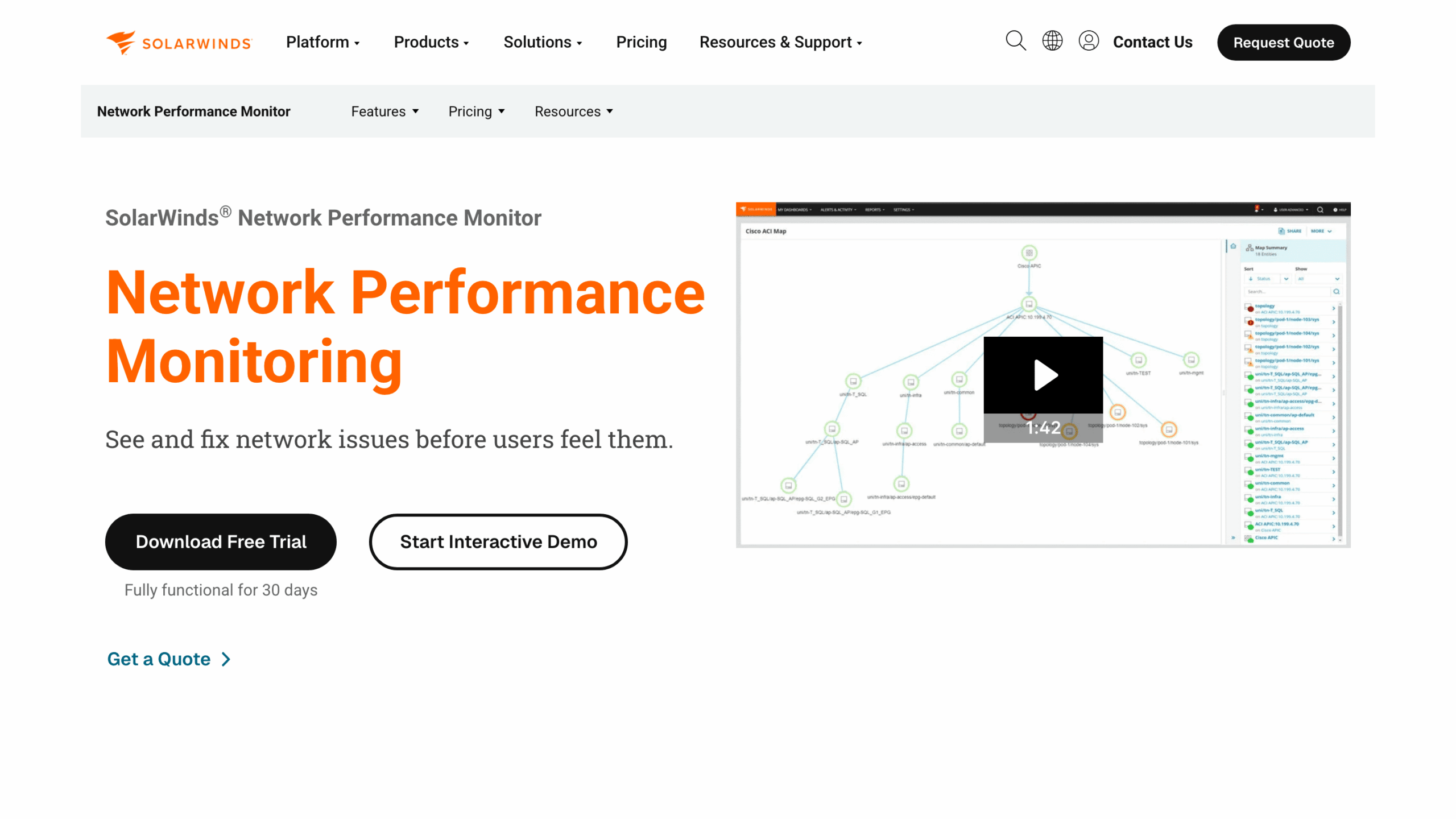
SolarWinds NPM is a network performance monitoring software that monitors the health of PCs and other network devices. Users can set threshold-based alerts to receive notifications on issues such as high CPU usage, request failures, low server health, and more. Automated network discovery is also available.
For increased functionality, SolarWinds NPM integrates with other SolarWinds products. In SolarWinds Observability Self-Hosted (which includes NPM’s features), users can also access SW1, an AI agent that answers questions about monitored infrastructure.
G2 rating: 4.5 out of 5.0 stars (200+ reviews)
Capterra rating: 4.5 out of 5.0 stars (70+ reviews)
SolarWinds NPM pricing:
- Custom quotation. Prices start at $1,856; to find out the exact cost, request a quote on their website.
4. Kaseya VSA
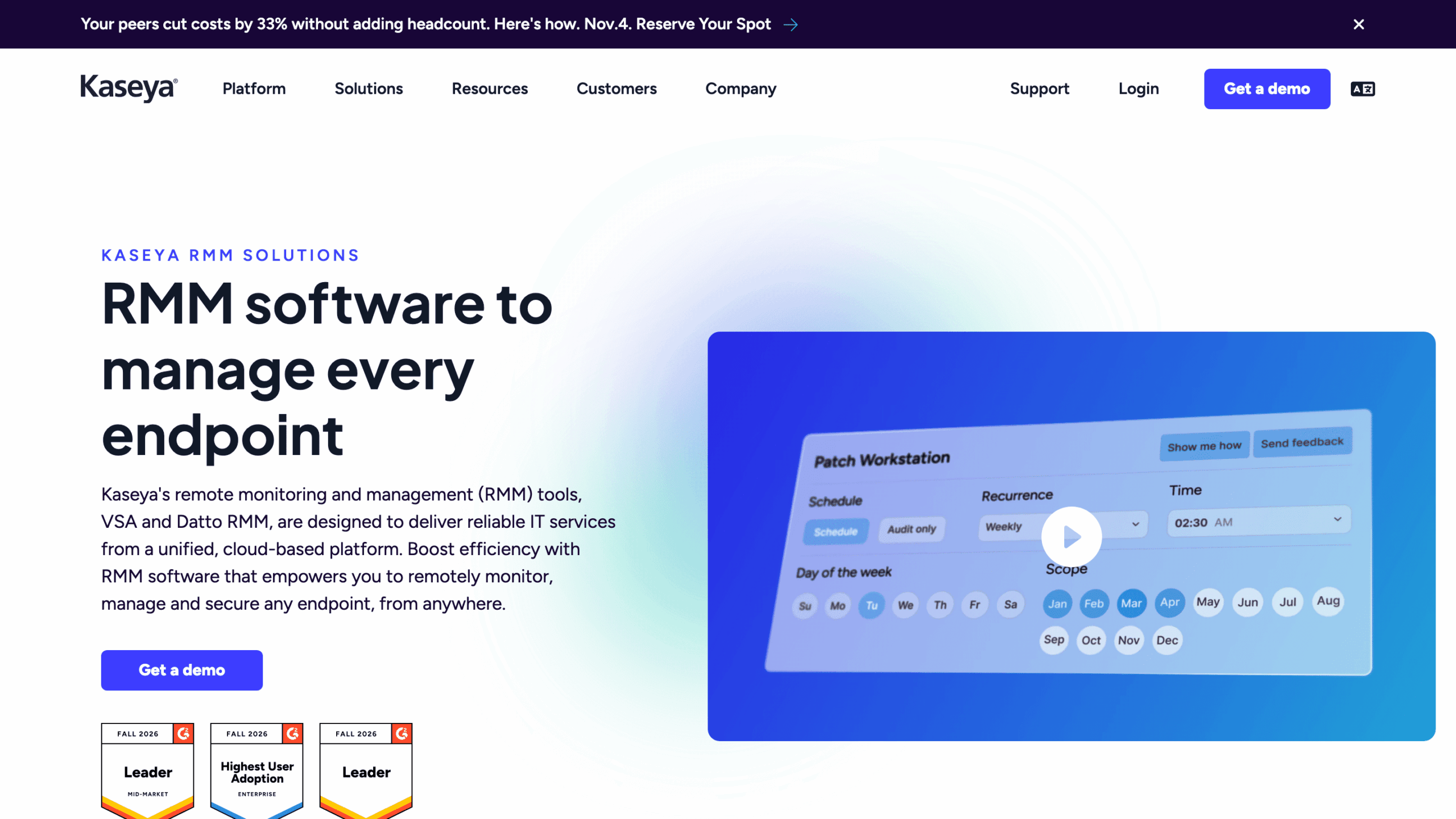
Kaseya VSA is RMM software that offers real-time monitoring and alerting, automated patch management, asset management, and network discovery tools. Its monitoring system tracks metrics like CPU load, disk utilization, bandwidth, and memory and triggers an alarm when thresholds are exceeded. Kaseya VSA offers basic IT automation tools for automating tasks such as patching, auto-remediation, and reporting.
Kaseya’s newest innovation is Kaseya Intelligence, which includes ‘Digital Specialists’ that take manual tasks, such as ticket triaging and categorization, off your technician’s plates.
G2 Rating: 4.4 out of 5.0 (4,800+ reviews)
Capterra Rating: 4.1 out of 5.0 (200+ reviews)
Kaseya Pricing:
- Custom-quote-based pricing for all Kaseya products. Visit Kaseya’s website to submit a form and request the price.
5. Pulseway
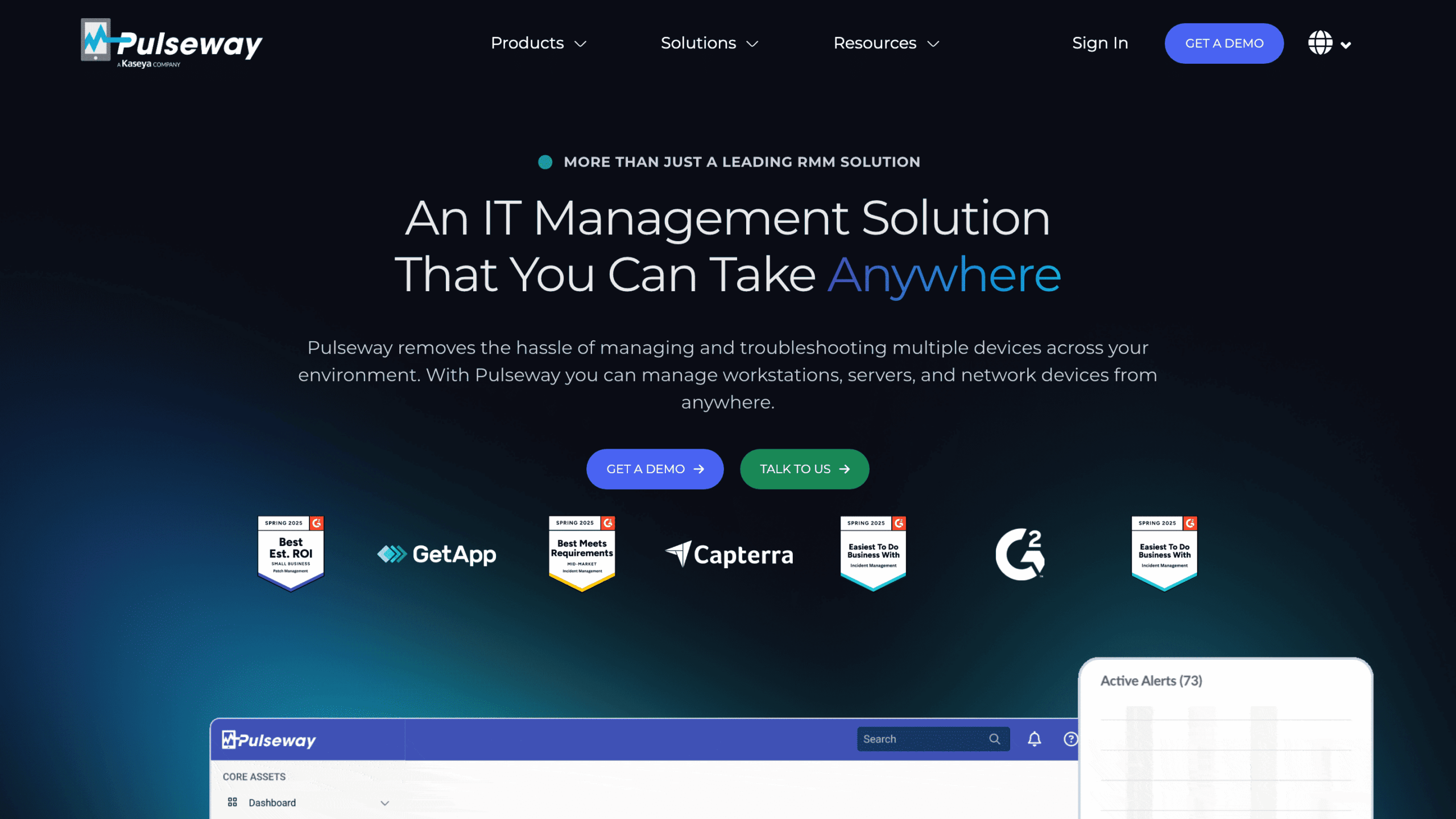
Pulseway is an RMM solution for MSPs and IT departments. It grants real-time insights into workstations, servers, and other network equipment performance. Pulseway hosts IT automation capabilities and auto-remediation capabilities that enable instantaneous handling of IT issues. Users can also choose from predefined script templates when resolving problems.
For PSA capabilities, Pulseway PSA is available. It also includes ‘Pulseway Assist’, which uses AI to generate ticket summaries and help draft responses.
G2 Rating: 4.5 out of 5.0 (120+ reviews)
Capterra Rating: 4.7 out of 5.0 (305+ reviews)
Pulseway Pricing:
- Pulseway’s pricing is entirely quote-based. To get pricing, request a demo from their website.
6. ManageEngine
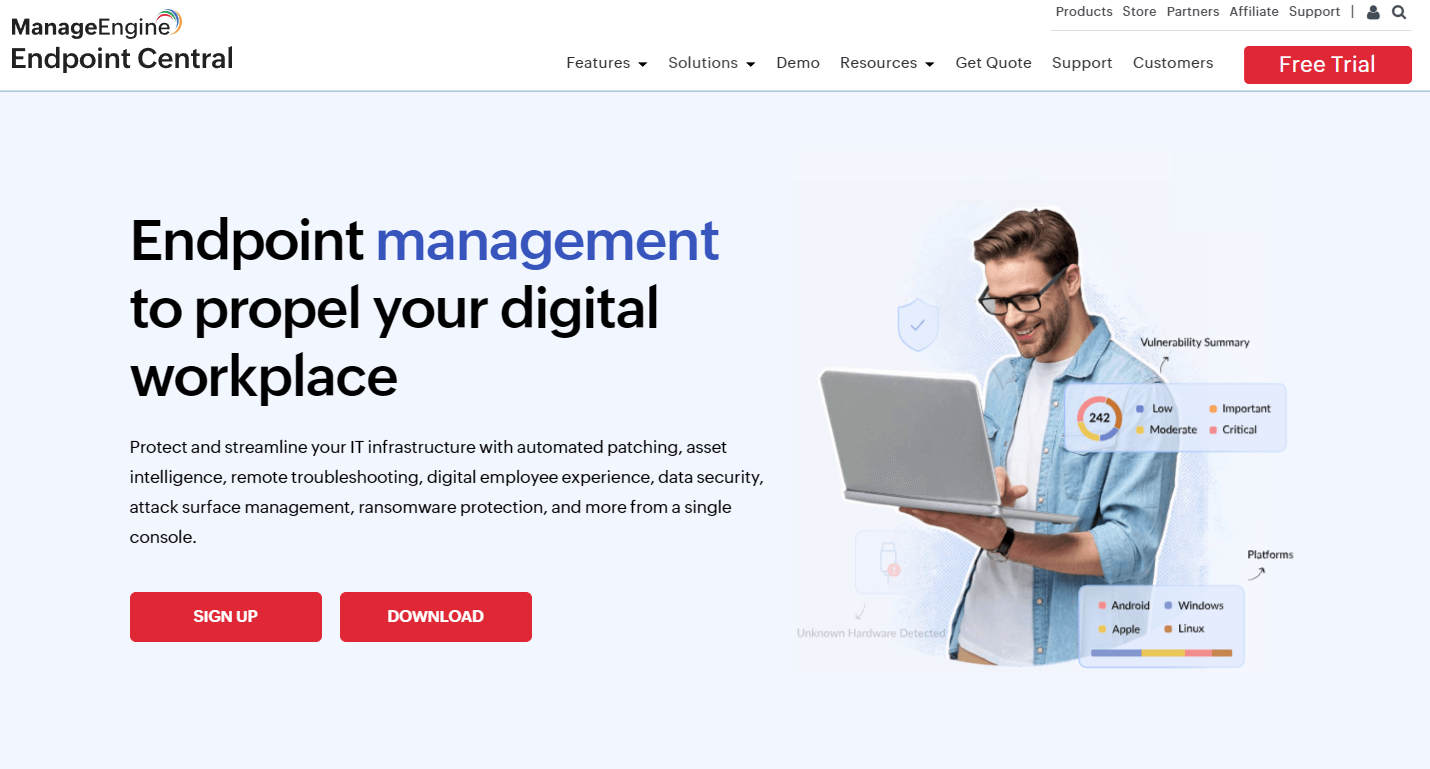
ManageEngine Endpoint Central is an endpoint management software that provides remote troubleshooting, automated patching, IT asset management, and ransomware protection capabilities. It allows the monitoring of laptops, desktops, mobile devices, servers, and more. Endpoint Central automatically detects and remediates vulnerabilities within a user’s IT environment.
ManageEngine also offers other IT management products, such as ManageEngine OpManager, a popular option for monitoring the health of IP-based devices. In the cloud version, ManageEngine’s new Zia Agents help to autonomously investigate device issues and triage alerts.
G2 Rating: 4.5 out of 5.0 (1,100+ reviews)
Capterra Rating: 4.6 out of 5.0 (1,800+ reviews)
ManageEngine Endpoint Central Pricing:
- Professional: Starts at $104 for 50 endpoints
- Enterprise: Starts at $124 for 50 endpoints
- UEM: Starts at $139 for 50 endpoints
- Security: Starts at $205 for 50 endpoints
All ManageEngine plans include one technician spot.
7. Domotz
Domotz is an IT infrastructure monitoring tool that helps monitor the performance of various IT components including computers, laptops, servers, and various SNMP-enabled devices. Users gain insight into bandwidth usage, latency, network traffic, and device connectivity.
For comprehensive IT management, Atera offers a native integration with Domotz. Together, they combine Domotz’s network monitoring with Atera’s RMM, PSA, remote access, and patching. In May 2026, Domotz launched an MCP server, which lets users ask questions about their Domotz data directly inside AI chatbots.
G2 Rating: 4.8 out of 5.0 (100+ reviews)
Capterra Rating: 4.9 out of 5.0 (120+ reviews)
Domotz Pricing:
- MSPs: $35 per home/month
- IT teams: $35 per home/month
- Commercial Integrators: $35 per home/month
- Residential Integrators: $20 per home/month
8. Datto RMM
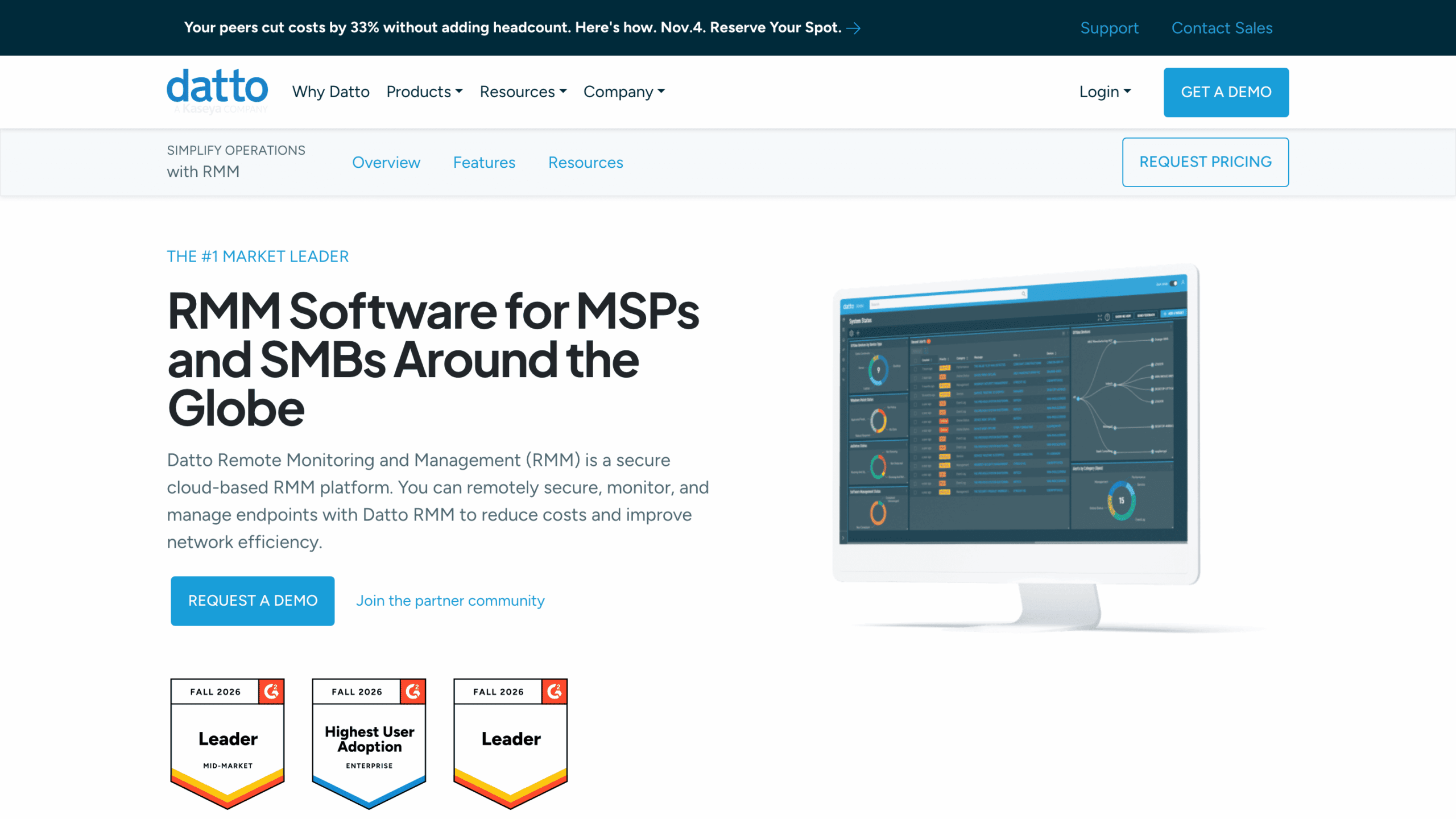
Datto RMM allows the monitoring of PCs, laptops, servers, and other network devices. It helps to simplify IT troubleshooting through auto-responses to alerts. Like Atera, Datto offers 24/7 customer support. Datto RMM includes network topology maps that visually display client networks.
Datto RMM integrates with Datto Autotask PSA to offer PSA capabilities. The hidden drawback to this approach is its cost. Using two software products to manage IT environments is pricier than relying on an all-in-one solution like Atera.
G2 Rating: 4.5 out of 5 stars (540+ reviews)
Capterra Rating: 4.1 out of 5 stars (25+ reviews)
Datto RMM Pricing:
- Datto RMM’s pricing is pay-per-device, and it’s not publicly listed. However, Reddit users estimate the pricing is $2.50 per endpoint and $100 per user for Autotask PSA.
PC performance monitoring combined with autonomous IT agents
Atera’s main advantage is Robin, which autonomously resolves up to 92% of Tier-1 and complex Tier-2 technical incidents, freeing up technicians for higher-value tasks.
Because Atera’s platform includes PC performance monitoring, IT teams don’t need to invest in multiple software solutions to meet their monitoring goals. That streamlines workflows and increases cost savings.
Ready to see Robin and AI Copilot in action? Get in touch with our sales team for a custom demo, or sign up for a 30-day free trial today; no credit card is required!
What is PC performance monitoring software?
PC performance monitoring software tracks and analyzes various aspects of a computer’s performance in real time. The key performance metrics monitored include CPU usage, memory consumption, hard disk usage, network traffic, temperature levels, and more.
PC performance monitoring capabilities are often included in a network monitoring solution. A few solutions, including Atera, offer PC performance monitoring as part of their broader IT management platform.
Types of PC performance monitoring software
The types of PC performance monitoring systems can be divided into system, network, cloud-based, unified IT management, and agentic AI solutions. Let’s look at each of these in more detail.
System monitoring tools
System monitoring tools monitor the performance of key system components, including CPU, memory, disk, network, and more.
These solutions typically provide a centralized dashboard with real-time monitoring, analytics, reporting, and alerting. All of these capabilities enable IT teams to maintain the optimal performance of multiple PCs.
Network monitoring tools
Network monitoring tools monitor various network activities, including bandwidth usage, network latency, traffic patterns, and more. IT teams can leverage this information to more efficiently manage network health and troubleshoot issues like network outages.
Network monitoring tools are offered as standalone products; however, more comprehensive RMM tools often include them. Atera’s RMM tool includes network monitoring.
Cloud-based monitoring tools
Cloud-based monitoring tools allow IT professionals to track and manage the performance of multiple PCs and servers from a centralized dashboard. Cloud-based solutions are ideal for IT teams with distributed IT infrastructures.
Cloud-based monitoring tools often work in tandem with more comprehensive network monitoring or IT management tools. For example, Atera offers a cloud-based IT management solution for PC performance monitoring.
Unified IT management solutions
Unified IT management software combines PC performance monitoring with a wide range of IT management capabilities.
Common features include RMM, PSA, remote access, network discovery, patching, and scripting. These tools are ideal for IT teams desiring a centralized solution for their entire IT operations.
Agentic AI solutions
PC performance monitoring tools with Agentic AI go beyond basic monitoring and alerting.
Instead of technicians having to manually resolve each device issue, these tools come with AI agents that diagnose root causes and execute fixes directly on the device, in the cloud, or on the network, without a technician in the loop.
These tools typically work on top of an RMM or unified IT management platform, which gives the agent the device data and access it needs to act. Atera is one example of such a solution. Its autonomous IT agent, Robin, resolves up to 92% of Tier-1 and complex Tier-2 technical incidents autonomously.
Why you need PC performance monitoring software
Now that we’ve defined what PC performance monitoring software is, we’ll review the main benefits of investing in a solution.
Bottleneck identification
PCs slow down over time for many reasons. Factors such as resource-intensive applications, system clutter, increased CPU usage, and more can all hamper a machine’s efficiency.
Performance monitoring tools help users identify and address these issues by tracking metrics like CPU, memory, and disk usage.
Optimized system performance
The top PC monitoring tools provide features like automated patching to ensure the timely and systematic application of OS and third-party application updates.
These regular updates optimize a system’s overall reliability and performance.
Enhanced security
PC performance monitoring software often includes real-time monitoring. This capability keeps watch on the network and analyzes security vulnerabilities.
By identifying potential weaknesses, such as unpatched software or suspicious activities, IT teams can respond to threats more swiftly.
Centralized monitoring
PC performance monitoring systems provide a centralized platform for monitoring and managing various PCs.
This results in many benefits, including streamlined workflows, higher productivity, better reporting, and enhanced industry compliance.
Increased productivity
PC performance monitoring tools can automate various tasks, including server monitoring, alerting, troubleshooting, and responding to end-user tickets. In addition to IT automation, a few PC performance monitoring tools, like Atera, expand to agentic AI, which can resolve issues on its own.
Robin, for example, finds the root cause of an issue, such as a slow device, executes the fix directly on the device, and closes the incident, all without a technician in the loop.
Related Articles

Best enterprise IT management software for efficient operations in 2026
Unlike traditional IT management tools, enterprise IT management software offers more advanced features, security, and scalability. This guide covers the best enterprise IT management tools that provide these perks.
Read now
Enterprise RMM: the 10 best tools compared for 2026
IT environments are larger than ever, now encompassing thousands of users and devices and requiring extensive monitoring capabilities that traditional tools can't manage to avoid tool fragmentation, overburdened IT staff, rising costs, and late detection of critical failures. Modern AI-powered RMM tools offer real-time alerts, patching and asset inventory management, and extensive integrations.
Read now
Which Linux command sends messages to network interface
Key Linux commands for sending messages to network interfaces. From ping to netcat, master tools for network management and troubleshooting.
Read now
The 8 best hardware monitoring software for 2026
Discover the top 8 hardware monitoring tools to help IT professionals maximize system performance, prevent failures, and extend hardware lifespan. Find the best solution for your organization.
Read nowEndless IT possibilities
Boost your productivity with Atera’s intuitive, centralized all-in-one platform