Recent Articles

How to run an AI readiness assessment for your IT organization
Most AI rollouts in IT don’t fail on the technology. They fail on stale asset data, overprivileged accounts, missing rollback plans, and technicians who’ve never been taught to question AI output. A readiness assessment exposes those gaps before production does.
Read now
How to prevent shadow AI in your organization
Shadow AI rarely needs an installer. A browser you’ve already approved and a public chatbot are enough to send source code, customer records, or meeting notes outside the business, with no endpoint control ever firing. Stopping it means knowing what’s on every device, covering the traffic endpoints can’t see, and making the sanctioned tool faster to reach than the one employees found.
Read now
How to write an AI acceptable use policy for your IT team
A list of approved AI tools stops nothing. Technicians paste configs into personal chatbots, and agents with write access can ignore the prompt telling them not to delete. A policy that works governs what data AI may receive and what agents are allowed to do, then backs both with identity, least privilege, and approval gates that hold even when the model gets it wrong.
Read now
How to spot AI washing in IT tools
AI washing has brought SEC fines and federal fraud charges, and now the pattern shows up in IT procurement. Here’s how to spot it before you sign a contract.
Read now
How to audit AI agent activity
The script ran, exit code 0, but nobody can say why the agent chose it. Standard logs prove an AI agent acted, but accountability needs the whole chain, including the request, the context it drew on, the approval, the action, and the verified outcome. Without that chain, an audit is guesswork after the damage is done.
Read now
How to apply least-privilege access to autonomous AI agents
An AI agent with a broad role and a long-lived token is one poisoned ticket away from acting against you. Scoping it down takes more than trimming permissions because every action needs its own tested boundary, a credential that expires with the task, and an authorization check the model can't talk its way past.
Read now
Top 5 Zoho Assist Alternatives for IT teams in 2026
Zoho Assist is a solid option for small-scale remote support, but often falls short for more demanding enterprise support. Find the five best Zoho Assist alternatives, with features, pricing, reviews, and AI compared.
Read now
Top 6 Automox alternatives IT pros are switching to in 2026
If you’re an IT manager selecting an Automox alternative, this article will come in handy. Below, we’ve compared the best six options and looked into each one’s top features, AI, and pricing plans.
Read now
Top 6 Motadata alternatives for organizations in 2026
Motadata splits its features into two products: ServiceOps and ObserveOps. See the best alternatives that fit your IT team’s needs. We’re listing each alternative’s pricing, reviews, and key features.
Read now
Atera vs. Automox: A full comparison for IT decision-makers in 2026
Compare Atera vs. Automox across all key categories: Agentic AI, features, pricing, user interface, customer support, and user feedback. Choose the best one for your organization.
Read now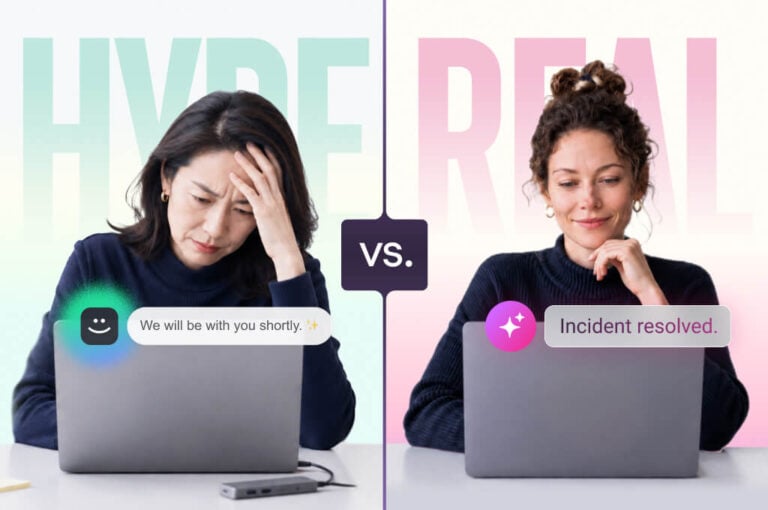
The action gap: How to tell real Autonomous IT from the hype
Most AI assists the work without finishing it, then hands the rest back to your people. Real Autonomous IT closes that action gap and proves the incident is resolved.
Read now
How organizations should approach IT cost management
IT budgets are growing, and so is the pressure on every dollar inside them. The bigger risk is spending decided by default: renewals that roll over unchecked, purchases nobody owns, and cuts that turn into technical debt.
Read now
How to decide if you need a dedicated DEX platform, or already have one
"IT feels slow" is the complaint that often sells DEX platforms. Sometimes it signals a real blind spot, but just as often already catches and fixes the problem, and a new scoring layer would only add another console. Telling the two apart takes evidence, and the real gap usually isn't visibility at all.
Read now
How device performance monitoring improves digital employee experience
Your fleet can be fully patched and green on every dashboard while employees lose minutes to slow logons, frozen apps, and throttled laptops. Without device performance monitoring, that friction reaches IT one ticket at a time. With it, degradation shows up as data first, so IT can fix it across the fleet before anyone has to ask.
Read now
How to build an IT governance framework that actually works
IT governance frameworks exist everywhere, but they don't often get followed. When approvals drag, scope creeps into routine work, and checkpoints live outside the tools teams use every day, people find the shortcut. Governance that holds keeps oversight on real risk, gives every decision an owner and a threshold, and enforces itself inside the workflows where the work already happens.
Read now
How much is shadow IT actually costing your business?
Nobody approved it, nobody tracks it, and the business still pays for it. Shadow IT hides in expense claims, personal cloud accounts, and AI tools full of pasted company data, and its cost runs well past duplicate subscriptions. The real figure is calculable, per tool and across the business.
Read now